Shakey the Robot: The First General-Purpose Mobile Robot
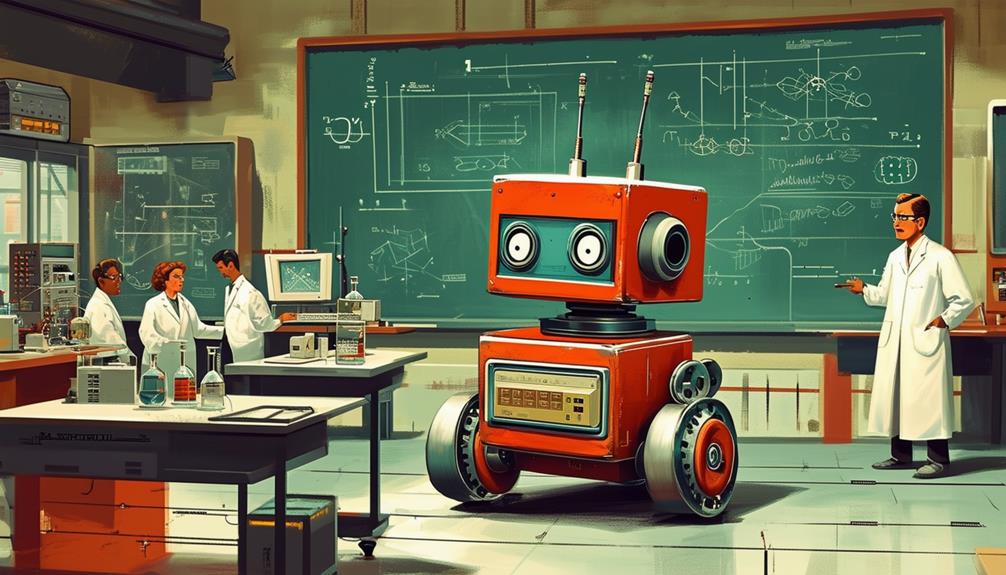
Imagine stepping back into the late 1960s, a time when computers occupied entire rooms and the concept of a mobile, autonomous robot seemed like pure science fiction. Developed by SRI International with funding from DARPA, Shakey the Robot shattered these boundaries. Equipped with advanced sensing and navigation systems, Shakey not only navigated its environment but also made decisions using early forms of artificial intelligence. This groundbreaking project didn't just push the envelope; it redefined it. Curious about how Shakey's pioneering features and software advancements continue to influence today's technology? Let's explore Shakey's legacy and its enduring impact on modern robotics.
Development Timeline
Shakey's development timeline commenced in 1966 under the leadership of Charles Rosen, Peter Hart, and Nils Nilsson at the Stanford Research Institute (SRI). These project managers guided the research that would revolutionize robotics. Funded by DARPA, following a 1964 proposal, Shakey became the world's first general-purpose mobile robot, marking a significant advancement in artificial intelligence and robotics.
Over six years, the team integrated various technologies into Shakey. Its hardware featured a TV camera for visual input, sonar range finders to measure distances, and a radio link antenna for communication. These components enabled Shakey to autonomously navigate and interact with its environment, a groundbreaking achievement at the time.
Shakey evolved from performing simple tasks to executing more complex operations, guided by the STRIPS (Stanford Research Institute Problem Solver) algorithm. This algorithm allowed Shakey to plan and execute actions, making it the first robot to use reasoning for problem-solving. Each phase of the project involved meticulous research and innovation, pushing the boundaries of robotics. By 1972, Shakey had laid the foundation for future advancements in robotics and AI, cementing its place in technological history.
Pioneering Features
Shakey's pioneering features included an advanced sensing and navigation system that enabled interaction with its environment. Its AI and reasoning capabilities allowed Shakey to autonomously create plans and perform tasks. Additionally, its modular design made it a versatile and adaptable platform for various robotics and AI experiments.
Sensing and Navigation System
The development of Shakey's sensing and navigation system was a milestone in mobile robotics. As the first mobile robot, Shakey employed a combination of a sonar range finder, a TV camera, and bump detectors to understand its environment. Data from these sensors were processed by Shakey's STRIPS planner, which facilitated logical reasoning and goal-oriented actions. By utilizing computer vision for image analysis and feature extraction, Shakey could autonomously navigate through rooms, interact with objects, and avoid obstacles.
Shakey's advanced capabilities set a new standard for autonomous mobile robots. Its sophisticated sensing system enabled it to detect and respond to its surroundings, marking a significant achievement in robotics. This robust navigation system demonstrated the potential for robots to move and operate independently in dynamic environments, paving the way for future advancements in robotic mobility and interaction.
Summary of Shakey's sensing and navigation components:
| Sensor Type | Function |
|---|---|
| Sonar Range Finder | Distance measurement |
| TV Camera | Image analysis and feature extraction |
| Bump Detectors | Obstacle detection |
| STRIPS Planner | Logical reasoning and planning |
Shakey's innovative features highlighted the feasibility of autonomous mobile robots by integrating advanced sensing systems with sophisticated navigation capabilities. This combination was crucial in proving that robots could operate independently and make informed decisions based on environmental data.
AI and Reasoning Capabilities
Building upon its sophisticated sensing and navigation system, Shakey also possessed groundbreaking AI and reasoning capabilities that allowed it to act independently. Developed at the Stanford Research Institute, Shakey could analyze commands, perceive its environment visually, and navigate effectively. What set Shakey apart was its ability to create and execute action plans using the STRIPS (Stanford Research Institute Problem Solver) planner.
The STRIPS planner was a pioneering automated planner that allowed Shakey to break down tasks into manageable actions. This critical component was essential for Shakey to perform complex sequences of physical actions. By integrating computer vision, logical reasoning, and graph traversal algorithms, Shakey could determine the best path to achieve its goals.
Moreover, Shakey's AI capabilities were bolstered by natural language processing, enabling it to understand and act upon commands given in plain English. According to the Computer History Museum, these features collectively pushed the boundaries of what was possible in robotics.
Shakey's AI and reasoning capabilities were revolutionary, setting the stage for future advancements in AI, robotics, and computer science. It demonstrated how diverse cognitive functions could be integrated into a single, autonomous robot, paving the way for modern intelligent systems.
Modular Design Elements
Shakey's modular design revolutionized robotics by integrating key components: a wheeled mobile platform for mobility, a TV camera for visual perception, and sonar range finders for precise distance measurement. These elements enabled Shakey to autonomously navigate and understand its surroundings. The TV camera captured visual information for environmental interpretation, while sonar range finders accurately measured distances, enhancing obstacle detection and avoidance.
Shakey's advanced hardware included bump detectors, often referred to as cat whiskers, which sensed immediate physical contact and provided crucial feedback for collision avoidance. On-board processors managed decision-making, allowing Shakey to execute complex tasks independently. The push bar was a simple yet effective tool for object manipulation, showcasing Shakey's ability to interact with its environment.
Communication was another key aspect of Shakey's design. The radio link antenna facilitated seamless data exchange with controlling computers, enabling real-time command transmission and status updates, which were essential for operational efficiency.
The integration of sensors and actuators was groundbreaking, allowing Shakey to perform various tasks autonomously. These innovative design elements laid the foundation for future advancements in mobile robotics and autonomous systems, setting a new standard in the field.
Software Innovations
Leveraging LISP and the STRIPS planner, Shakey demonstrated groundbreaking advancements in robotic software capabilities. At Stanford's Artificial Intelligence Center, researchers made history by developing software that enabled Shakey to perform complex tasks autonomously. The STRIPS planner was particularly revolutionary, allowing Shakey to devise and execute plans in real time. This automated planning marked a significant leap in AI, setting the stage for future robotics projects.
Shakey's programming was primarily done in LISP, a computer language known for its flexibility in AI applications. The robot navigated an environment filled with rooms, corridors, doors, light switches, and movable objects. Thanks to the STRIPS planner, Shakey could:
- Travel between different locations.
- Manipulate light switches and doors.
- Climb obstacles within its environment.
- Push and interact with objects.
- Plan and re-plan tasks dynamically.
These capabilities were practically demonstrated, showcasing that robots could understand and interact with their environment in meaningful ways. Shakey's software innovations laid the foundation for future developments in AI and robotics, proving that automated planning was both possible and effective. This pioneering work continues to influence current and future robotics projects.
Hardware Components
As impressive as Shakey's software was, its hardware components were equally crucial in actualizing the robot's capabilities. Standing approximately 2 meters tall, Shakey navigated using a wheeled mobile platform. Its ability to observe and interact with its environment was enabled by an array of sophisticated sensors and communication devices. Central to its vision system was a TV camera, which allowed Shakey to visually capture its surroundings.
Additionally, sonar range finders provided spatial awareness, helping the robot measure distances and avoid obstacles. On-board processors facilitated real-time data processing, essential for its autonomy. Bump detectors were integrated to sense physical contact, preventing collisions. For communication, a radio link antenna ensured Shakey could receive instructions and send back data.
A push bar was included for interacting with objects, demonstrating Shakey's ability to manipulate its environment. Each hardware component worked together to support Shakey's autonomous functions. Developed at SRI, the integration of these sensors and communication devices was pivotal, making Shakey a mobile, interactive robot. These elements collectively showcased the groundbreaking synergy of Shakey's design.
Impact on Robotics
The development of Shakey the Robot revolutionized the field of robotics, laying the foundation for future advancements in AI and autonomous systems. As the first robot to successfully integrate a logical, goal-based agent approach, Shakey demonstrated the potential for machines to plan and execute tasks independently. This groundbreaking project introduced several key AI techniques that continue to shape robotics today.
Shakey's innovative software and hardware design enabled it to reason about its actions and navigate its environment autonomously. One of Shakey's most notable contributions was the introduction of the A* search algorithm, a framework for efficient pathfinding that remains widely used in AI and robotics.
The impact of Shakey's legacy is evident in ongoing research and development within the field. From mobile robots capable of navigating complex terrains to advanced robot learning systems, Shakey's contributions laid the groundwork for modern innovations.
Key takeaways from Shakey's impact include:
- Shakey was the first robot to use a goal-based agent approach.
- The project introduced the A* search algorithm.
- Shakey's design showcased the potential for autonomous decision-making.
- Key AI techniques from Shakey continue to influence robotics.
- Ongoing research builds upon Shakey's pioneering work.
Shakey's influence endures, inspiring the evolution of intelligent robotics.
Legacy and Recognition
Shakey's groundbreaking innovations not only advanced robotics but also earned widespread recognition, leaving a lasting legacy in AI and computer science. As the pioneering general-purpose mobile robot, Shakey set the stage for future advancements, inspiring countless robotics projects and research endeavors. Its influence is still acknowledged today, underscoring its enduring impact on these fields.
One of Shakey's most notable contributions was the development of algorithms like A* search, which revolutionized pathfinding in robotics. These algorithms remain essential in various applications, showcasing Shakey's long-lasting effect on technology. Additionally, Shakey's approach to automated planning and logical, goal-based agents significantly shaped modern AI, laying the groundwork for future innovations.
In recognition of its technological significance, Shakey was honored with the prestigious IEEE Milestone in Computing and Electrical Engineering. This accolade underscores the project's pivotal role in advancing robotics and AI. Shakey's legacy is not only in its technical achievements but also in the inspiration it provided to generations of scientists and engineers, solidifying its place as a cornerstone in the history of mobile robots and general-purpose AI systems.
Conclusion
Exploring Shakey the Robot reveals its revolutionary impact on robotics and AI. Its pioneering features, innovative software, and robust hardware set new standards, paving the way for modern advancements. Shakey's legacy continues to inspire and drive progress in autonomous systems, highlighting the incredible evolution from its inception to today's sophisticated technologies. Shakey fundamentally changed the landscape of robotics.