The Role of Rodney Brooks in the Development of Behavior-Based Robotics
Rodney Brooks has been a pivotal figure in the advancement of behavior-based robotics. By challenging traditional artificial intelligence approaches, Brooks introduced the Subsumption Architecture, which emphasizes real-time responses and adaptable behaviors over complex computations. This paradigm shift not only made robots more practical but also enhanced human-robot interaction. His innovations have led to groundbreaking applications and the founding of companies like iRobot and Rethink Robotics. Brooks' contributions continue to shape the future of autonomous systems, cementing his legacy in the field.
Early Life and Education

Rodney Brooks, born in Adelaide, Australia, in 1954, demonstrated an early talent for technology by constructing a tic-tac-toe playing machine, foreshadowing his future contributions to robotics. With a strong foundation in mathematics, he pursued further studies in Australia before moving to the United States to advance his education in AI and Robotics at Stanford University, where he graduated in 1984.
Brooks' career took a pivotal turn when he joined MIT's robotic labs the same year he graduated. At MIT, he made significant advancements in behavior-based robotics, shifting away from traditional, rule-based systems. His doctoral research in Model-Based Computer Vision laid the groundwork for these innovations.
The Subsumption Architecture
The subsumption architecture employs a hierarchy of control layers, enabling robots to efficiently manage simple tasks. These layers facilitate emergent behavior, allowing robots to adapt to their environment dynamically. This method revolutionizes robotic operation by eliminating the need for complex computations.
Hierarchical Control Layers
The subsumption architecture, a pioneering concept in behavior-based robotics developed by Professor Rodney Brooks, organizes control layers hierarchically to enable robots to react swiftly and effectively to their environment. This architecture revolutionized robotic behavior and control by allowing higher layers to subsume or override the actions of lower layers when necessary.
Each layer in the subsumption architecture is responsible for a specific set of behaviors, operating with simple rules to facilitate fast and efficient decision-making. This design allows robots to make immediate decisions without relying on detailed maps or extensive computational processing. For example, Brooks implemented this architecture in robots like Allen, where fundamental behaviors such as obstacle avoidance were governed by basic rules, enabling the robot to navigate its environment effectively without complex planning.
The strength of the subsumption architecture lies in its ability to prioritize immediate reactions over extensive computation. By allowing higher layers to take control when needed, the system ensures that robots can rapidly adapt to changing environments and perform tasks more effectively.
Emergent Behavior Mechanisms
Emergent behavior mechanisms in the subsumption architecture enable robots to adapt and respond to their environment in real-time, creating complex actions from simple, layered rules. Pioneered by Rodney Brooks at the Artificial Intelligence Laboratory, this behavior-based design eschews a centralized control system in favor of multiple layers of behaviors, where higher-priority layers can override lower ones.
This architecture allows robots to exhibit complex behaviors without detailed pre-programming for every possible scenario. For example, Brooks' robots, such as Allen and Herbert, could effectively navigate and interact with their environments due to this layered system. Lower layers address basic tasks like obstacle avoidance, while higher layers handle more sophisticated behaviors such as goal-seeking.
Innovations in Robotics
Rodney Brooks' innovations in robotics are particularly compelling, notably his breakthroughs in autonomous navigation. His modular robot designs provided flexibility and adaptability in various environments. These advancements transformed how robots interact with their surroundings, enhancing their efficiency and capabilities.
Autonomous Navigation Breakthroughs
Rodney Brooks revolutionized autonomous navigation by introducing behavior-based robotics, shifting the focus from complex programming to adaptive, real-time responses. His subsumption architecture allowed robots to perform tasks by layering simple behaviors, enabling autonomous movement in complex environments.
Brooks' robots, such as Genghis and Cog, were early demonstrations of these capabilities. Genghis, for example, could navigate uneven terrains by reacting to its surroundings in real time, marking a paradigm shift from pre-programmed instructions to sensor-driven decision-making.
This innovation laid the groundwork for modern autonomous robots in industries ranging from warehouse automation to planetary exploration. Today's autonomous systems, including Amazon warehouse robots and Mars rovers, are a testament to Brooks' pioneering work in autonomous guidance.
Modular Robot Design
Rodney Brooks' modular robot design revolutionized robotics by introducing the subsumption architecture, which facilitates rapid adaptability and complex behaviors through easily modifiable layers. This architecture allows simple behaviors to be stacked and prioritized based on real-time requirements, enabling behavior-based robots to adapt quickly to changing environments without extensive reprogramming.
Key advancements in modular robot design include:
- Layered Behaviors: Subsumption architecture enables robots to perform complex tasks by integrating multiple layers of simple behaviors. Each layer operates independently, yet they work together seamlessly to navigate and interact with the environment.
- Rapid Reconfiguration: Modularity allows for swift modification or expansion of robot behaviors. To tackle a new task, you only need to add or adjust a behavior layer without overhauling the entire system.
- Scalability and Flexibility: The modular design supports scalable systems. As technology evolves, new behavior layers can be incorporated, ensuring the robot remains effective and up-to-date.
Brooks' emphasis on modularity has laid a strong foundation for behavior-based robots, driving significant advancements in autonomous navigation and decision-making capabilities. This approach has transformed the landscape of robotics.
Founding Irobot
Co-founding iRobot in 1991 with Helen Greiner and Colin Angle, Brooks set the stage for revolutionary advancements in both military and consumer robotics. By integrating his AI-driven approach, Brooks aimed to build robots that not only performed tasks efficiently but also adapted to their environments. The initial project, PackBot, designed for the U.S. military, excelled in bomb disposal and hazardous material handling.
In 2002, iRobot revolutionized consumer robotics with the release of the Roomba. This autonomous vacuum cleaner redefined home cleaning with its suite of sensors, including optical sensors, bump detectors, encoders, and piezoelectric sensors. The success of Roomba is evident in the sale of over 25 million units, making it a household name and demonstrating the commercial viability of Brooks' vision.
Here's a quick comparison of iRobot's key products:
| Product | Year Launched | Primary Use | Key Features |
|---|---|---|---|
| PackBot | Early 2000s | Military, Bomb Disposal | Robust, remote-controlled, versatile |
| Roomba | 2002 | Home Cleaning | Autonomous, sensors, adaptable navigation |
| Braava | 2013 | Floor Mopping | Quiet operation, efficient mapping |
| Mirra | 2014 | Pool Cleaning | Intelligent, easy maintenance |
| Terra | 2019 | Lawn Mowing | Precision cutting, weather-resistant |
Rethink Robotics
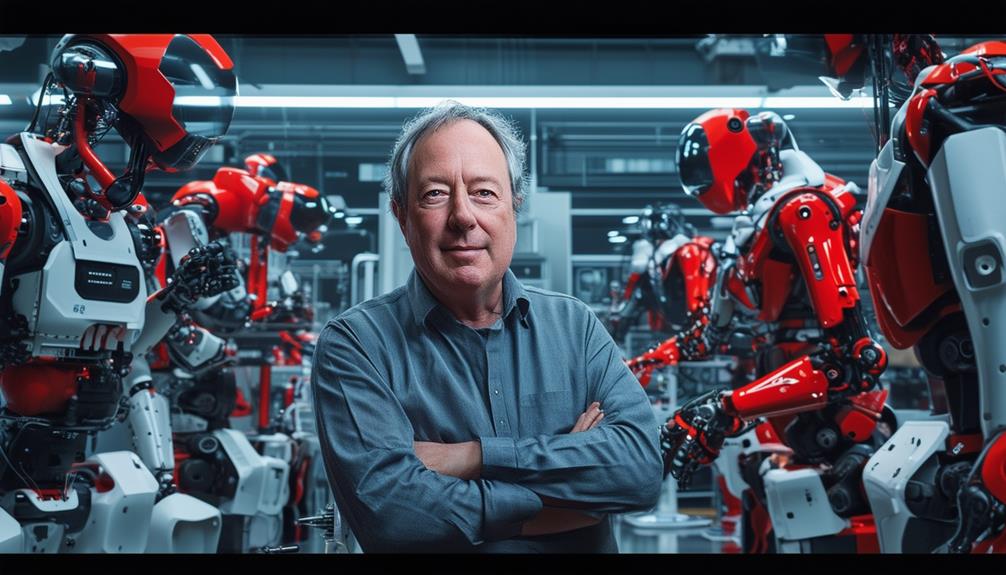
Rethink Robotics, founded by Rodney Brooks, aimed to transform the manufacturing sector with innovative robots like Baxter. Frustrated with traditional symbolic approaches, Brooks pioneered behavior-based robotics, leading to the creation of Rethink Robotics. The subsumption robotic architecture, a key innovation by Brooks, was integral to the company's designs.
Baxter, the flagship robot, was notable for its affordability and safety features, designed to work alongside humans without extensive safety cages. The company focused on key aspects:
- Affordability: Priced lower than traditional industrial robots, Baxter was accessible to smaller businesses.
- Safety: Built-in sensors and adaptive behavior allowed Baxter to operate safely alongside human workers.
- Ease of Use: An intuitive interface enabled easy programming and reprogramming of tasks without specialized training.
Despite its innovative approach, Rethink Robotics closed in October, marking a significant moment in the robotics industry. Nevertheless, the principles of behavior-based robotics and Rodney Brooks' vision continue to influence ongoing and future developments in the field.
Legacy and Impact
Brooks' pioneering work in behavior-based robotics has significantly influenced the field, steering AI research towards practical and real-world applications. By prioritizing action and behavior over mere representation, Brooks and his students have expanded the possibilities in robotics. His renowned creations, such as the Roomba and PackBot, are not only technological marvels but also demonstrate that robots can effectively solve real-world problems and interact with their environments.
Unlike the traditional top-down approach, which focuses on intricate representations of the world, Brooks' method emphasized simple yet effective behaviors. This paradigm shift has placed Brooks and his students at the forefront of robotics, showing that practical, behavior-based solutions can often outperform more complex systems.
Although Rethink Robotics, the company co-founded by Brooks, closed in 2018, his influence endures. His focus on human-robot interaction and practical applications continues to inspire new generations of researchers and engineers. Brooks' legacy is clear: he reshaped AI research by demonstrating that emphasizing real-world utility and human interaction can create robots that are not only functional but also indispensable in daily life.
Conclusion
Rodney Brooks revolutionized behavior-based robotics with his Subsumption Architecture, which emphasized simple, adaptive behaviors. His innovations extended beyond theory; by founding iRobot and Rethink Robotics, he demonstrated a commitment to practical applications. Brooks' legacy continues to inspire advancements in human-robot interaction and autonomous systems. As you delve deeper into the field of robotics, his profound influence serves as a reminder that simplicity can drive groundbreaking progress.
Related posts