The History of the Roomba: The First Commercially Successful Robot Vacuum
When you think about modern conveniences, the Roomba likely comes to mind as a game-changer in home cleaning. Its journey from an MIT engineer's concept in 1989 to becoming a household staple by 2002 is filled with significant milestones. Early interest from companies like Bissell and crucial funding from S.C. Johnson were instrumental in its development. However, what truly set the Roomba apart was its advanced technology and strategic decisions, which led to the sale of over a million units within just two years. Curious about how this innovative robot redefined vacuuming? Let's delve into its captivating history.
Early Beginnings
The inception of the Roomba traces back to 1989, when engineer Joe Jones, working at MIT, conceived the idea of an autonomous vacuuming robot. His vision was to create a robot that could independently manage the mundane yet essential task of vacuuming. Throughout the 1990s, early prototypes were shown to companies like Denning Mobile Robot and Bissell, but it wasn't until 1999 that the project gained significant traction.
That year, S.C. Johnson provided crucial funding, allowing the development to officially commence in December. This marked the beginning of the first commercially successful robotic vacuum. iRobot, the company behind Roomba, aimed to create a device that was both functional and accessible for home use.
The early Roomba models were designed to be fully autonomous, navigating homes, avoiding obstacles, and cleaning efficiently without human intervention. This innovation represented a major shift in household chores, paving the way for smarter homes and automated living. The Roomba was more than just a vacuum; it was a pioneering step towards an automated future.
Launch of the Roomba
In September 2002, iRobot launched the Roomba, revolutionizing the vacuuming industry. As the first commercially successful robot vacuum, the Roomba marked a significant milestone in home cleaning technology. Its autonomous operation and compact design quickly made it popular, allowing it to navigate and clean floors with minimal human intervention.
Within two years, iRobot sold over a million units, demonstrating the Roomba's widespread appeal. Its ability to operate independently resonated with busy households, offering a glimpse into a future where mundane chores could be automated. The Roomba's success led to numerous media references to Rosie the Robot from The Jetsons, as it brought a touch of science fiction into everyday life.
The Roomba's launch wasn't just about introducing a new gadget; it was about transforming home maintenance. By combining practical functionality with pioneering technology, iRobot set a new standard in the industry. The Roomba's debut not only showcased the potential of robotic aids but also paved the way for more advanced home automation solutions.
Technological Innovations
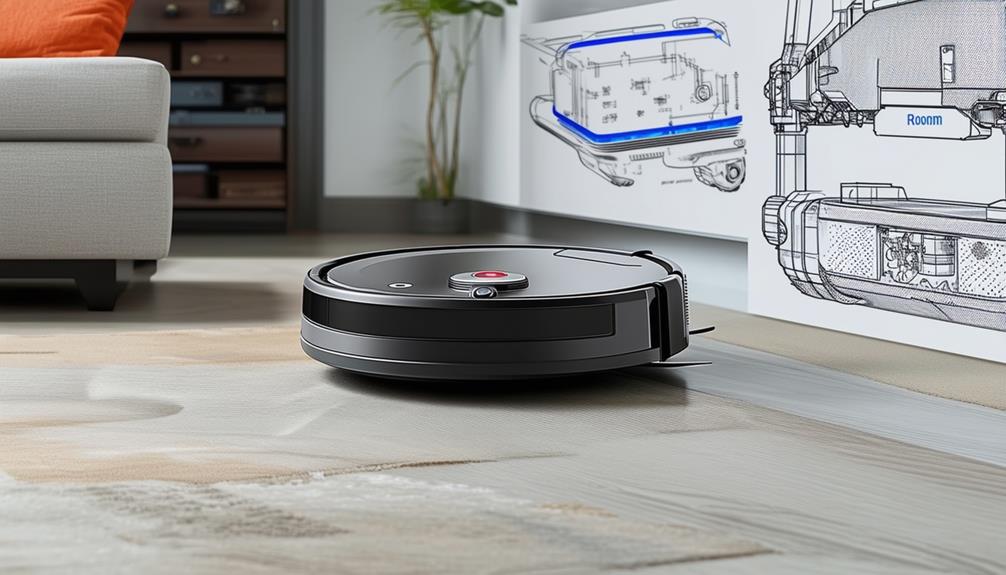
Building on its groundbreaking launch, Roomba's technological innovations have continually evolved to enhance both cleaning efficiency and user convenience. As an autonomous robotic vacuum cleaner, Roomba employs advanced onboard mapping and navigation systems. These systems integrate contact-sensing mechanical bumpers and infrared sensors for obstacle detection and precise movement, ensuring seamless navigation throughout your home.
Roomba models are equipped with rotating brushes or rollers that effectively capture dirt and debris. Customizable cleaning options are available through various modes such as Spot, Max, and Dock, allowing you to tailor the cleaning process to your needs. The Virtual Walls accessory lets you block off certain areas, ensuring that Roomba only cleans designated spaces.
The iRobot HOME app offers remote control capabilities, enabling you to set cleaning schedules, monitor progress, and make real-time adjustments for unparalleled convenience. The two independently operating side wheels ensure precise movement and thorough floor coverage. With these technological advancements, Roomba continues to set the standard in the autonomous robotic vacuum cleaner market, simplifying household chores.
Evolution of Models
Roomba's evolution from its fourth to tenth generation models exemplifies iRobot's commitment to innovation and user-centric design. Each new iteration builds upon its predecessors, integrating advanced features to enhance cleaning efficiency and user experience.
A key example of this continuous improvement is the Roomba S9 and S9+, which introduced a semicircular design. This innovation significantly improved edge cleaning and overall performance compared to earlier, circular models.
Another notable advancement is the introduction and refinement of Virtual Walls technology. This feature allows users to restrict Roombas from entering specific areas, ensuring targeted cleaning. Over successive generations, this technology has become increasingly effective.
To navigate homes efficiently, Roombas are equipped with contact-sensing mechanical bumpers and infrared sensors. These features enable the robot to detect and avoid obstacles, ensuring smooth navigation. Additionally, the design includes two independently operating side wheels, enhancing the Roomba's maneuverability.
Market Impact and Legacy
The Roomba revolutionized the robot vacuum market, igniting widespread consumer interest and fierce competition among brands. Its market impact was immediate and profound, capturing consumer imagination and setting a new standard for robotic cleaning technology. The Roomba's success wasn't fleeting; it established a lasting legacy that continues to shape the industry.
Roomba's legacy can be illustrated through several key aspects:
- Innovation: Continuous advancements in cleaning efficiency and smart features.
- Competition: Numerous brands entering the market, pushing each other to improve.
- Brand Recognition: Roomba becoming synonymous with robot vacuums.
- Market Leadership: iRobot maintaining a dominant position through ongoing development.
As a market leader, iRobot's relentless innovation has led to significant advancements in robotic cleaning technology. These innovations have not only enhanced the Roomba's cleaning efficiency but also inspired other companies to improve their products. The result is a dynamic market where competition drives rapid advancements. Roomba's influence is unmistakable; it has made robotic vacuums a common household item and continues to push the boundaries of home cleaning technology.
Conclusion
From its inception as a simple idea to its groundbreaking launch in 2002, the Roomba has evolved into a household name. This robotic vacuum revolutionized home cleaning and set the stage for future advancements in the industry. The Roomba's impact is significant and lasting, forever changing the way we think about vacuuming.
Related posts