The History of Shakey the Robot: The First Mobile Robot
Exploring the history of Shakey the Robot takes you back to the mid-1960s, a period marked by groundbreaking technological advancements. Developed by the Stanford Research Institute, Shakey was not just any robot; it was the first to demonstrate autonomous reasoning and task planning. Under the leadership of Charles Rosen and with significant contributions from experts such as Nils Nilsson and Peter Hart, this project integrated advanced AI techniques and innovative hardware.
What truly distinguished Shakey was its ability to perceive its environment, make decisions based on that data, and execute complex tasks autonomously. This early robot laid the foundation for modern AI and robotics, influencing the development of systems capable of autonomous navigation and decision-making. Join us as we explore the pivotal developments and lasting impact of this trailblazing machine.
Early Development
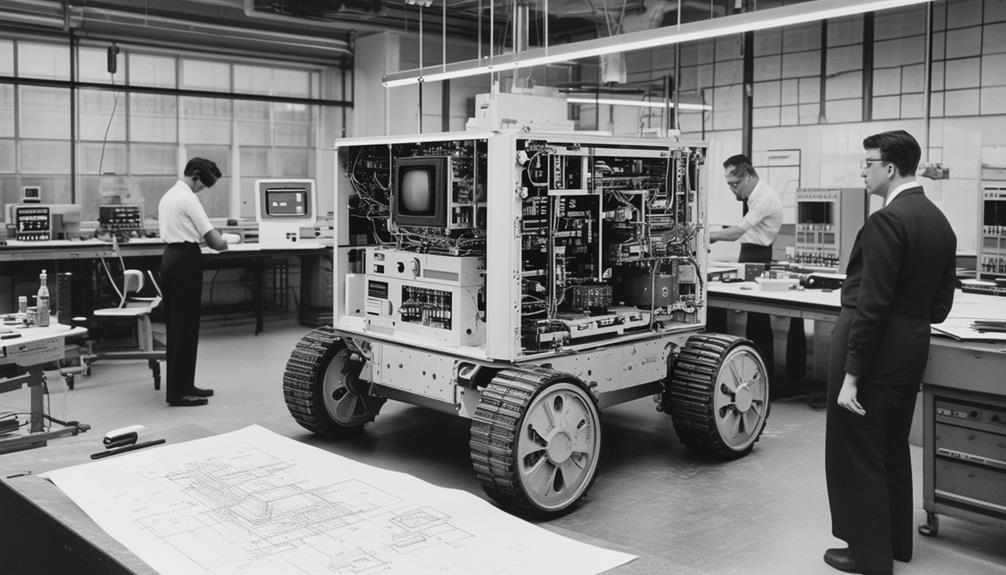
In the mid-1960s, a team at Stanford Research Institute embarked on the groundbreaking development of Shakey the Robot, a seminal project in the field of robotics and artificial intelligence. Shakey was designed to be the first mobile robot capable of reasoning about its actions. Equipped with a TV camera, range finder, radio link, and drive wheels, Shakey could navigate environments, manipulate objects, and plan tasks autonomously.
Shakey's development marked a significant milestone in robotics. The team aimed to create a robot that could move independently and make decisions based on real-time environmental data. Through rigorous research and innovation, they succeeded in developing a system where Shakey could analyze its surroundings, plan actions, and execute tasks without human intervention.
The introduction of Shakey paved the way for future advancements in autonomous systems. This project was not just about building a robot; it was about exploring the potential of artificial intelligence and expanding the capabilities of machines. Shakey's early development demonstrated the possibilities of AI and remains a landmark project in robotics.
Key Contributors
Shakey the Robot's development was a collaborative effort led by Charles Rosen, with key contributions from Nils Nilsson and Peter Hart. Their work resulted in pioneering AI innovations and significant technical breakthroughs. Funded by DARPA, the project brought together researchers who pushed the boundaries of robotics and artificial intelligence.
Research Team Formation
The Shakey project brought together a distinguished team of experts, including Charles Rosen, Nils Nilsson, and Peter Hart, who led this groundbreaking initiative. Funded by DARPA and based on a proposal from SRI International, the project was spearheaded by Charles Rosen, a visionary in artificial intelligence. Nils Nilsson and Peter Hart, both pioneers in AI and robotics, played pivotal roles in its development.
The team featured an impressive array of talent, including Alfred Brain, Sven Wahlstrom, Bertram Raphael, Richard Duda, and Richard Fikes. These key contributors brought extensive knowledge in robotics, AI, and computer science, propelling the project forward. Their collaboration was a melting pot of ideas and innovations that were ahead of their time.
Strategic team formation was essential for addressing the complex challenges involved in developing Shakey, the pioneering mobile robot. Each member's unique skills complemented the others, creating a dynamic and effective research environment. This collective effort not only advanced the field of robotics but also laid the groundwork for future AI developments. The Shakey project exemplifies the power of collaborative innovation.
Pioneering AI Innovations
Pioneering AI innovations emerged from the brilliant minds of Charles Rosen, Nils Nilsson, and Peter Hart, who led the Shakey project with groundbreaking vision and expertise. These project managers, along with other key contributors like Alfred Brain, Sven Wahlstrom, Bertram Raphael, Richard Duda, and Richard Fikes, pushed the boundaries of artificial intelligence and robotics.
Shakey was one of the earliest robots to use advanced AI techniques, programming in LISP, and the STRIPS planner, which revolutionized how machines could interpret and interact with their environment. It wasn't just about moving; Shakey operated as a logical, goal-based agent, capable of planning and executing tasks autonomously. This level of sophistication required a deep understanding of AI and robotics, which the team exemplified.
Here's a quick look at these pioneering contributors:
| Name | Role | Contribution |
|---|---|---|
| Charles Rosen | Project Manager | Visionary leadership and project oversight |
| Nils Nilsson | Project Manager | AI techniques and logical agent research |
| Peter Hart | Project Manager | Goal-based planning and STRIPS development |
| Alfred Brain | Key Contributor | Robotics expertise |
| Sven Wahlstrom | Key Contributor | System integration and software development |
| Bertram Raphael | Key Contributor | Natural language processing and problem-solving |
| Richard Duda | Key Contributor | Pattern recognition and machine learning |
| Richard Fikes | Key Contributor | Knowledge representation and reasoning |
Their collective efforts laid the foundation for future advancements in AI and robotics, making Shakey an epochal landmark in technological history.
Technical Breakthroughs Achieved
Shakey's technical breakthroughs were driven by the pioneering contributions of its key developers, who introduced groundbreaking algorithms and technologies to the field of robotics. Charles Rosen, Nils Nilsson, Peter Hart, Alfred Brain, Sven Wahlstrom, Bertram Raphael, Richard Duda, and Richard Fikes played pivotal roles in advancing robotics. They developed the A* search algorithm, revolutionizing pathfinding by efficiently navigating Shakey through its environment. The Hough transform for image analysis enabled Shakey to recognize and interpret visual information, a fundamental step for autonomous navigation.
The STRIPS planner allowed Shakey to perform logical, goal-based actions. This planner, combined with LISP programming, empowered Shakey to make decisions and execute tasks autonomously. Collision detection sensors ensured Shakey could avoid obstacles, facilitating safe movement. These sensors, along with sonar range finders and a television camera, represented cutting-edge technology and significantly enhanced Shakey's operational capabilities.
These technical breakthroughs not only demonstrated the ingenuity of Shakey's development team but also established foundational standards for future robotics advancements. Shakey's legacy is celebrated through its induction into the Robot Hall of Fame and recognition by the IEEE Milestone in Electrical Engineering and Computing award.
Technological Innovations
In the 1960s, Shakey the Robot marked a significant milestone in robotics by integrating a TV camera, range finder, and radio communications. This pioneering robot utilized LISP programming and the STRIPS planner to autonomously execute tasks, a remarkable achievement for its time. Shakey's hardware featured sonar range finders and collision detection sensors, which enabled effective environmental navigation.
Among the key technological innovations were the development of the A* search algorithm and the visibility graph method. These advancements allowed Shakey to plan its movements and find the shortest paths around obstacles, making it a trailblazer in robotic navigation.
Here's a summary of Shakey's technological marvels:
| Technology | Function | Impact |
|---|---|---|
| LISP Programming | AI task execution | Laid the groundwork for advanced AI development |
| Sonar Range Finders | Environment navigation | Enhanced autonomous movement capabilities |
| A* Search Algorithm | Pathfinding | Increased efficiency in navigating obstacles |
These innovations were not only groundbreaking at the time but also set the foundation for future advancements in robotics and AI. Shakey's legacy continues to influence the field, illustrating the progress made and inspiring ongoing innovations.
Software Architecture
Shakey's software architecture was groundbreaking for its time. The integration of the STRIPS Planning System and a hierarchical control structure enabled Shakey to navigate and interact with its environment efficiently. SRI's algorithmic innovations in these areas laid the groundwork for modern advancements in AI and robotics.
STRIPS Planning System
The STRIPS planning system, developed at Stanford Research Institute, empowered Shakey the Robot to autonomously plan and execute complex tasks in its environment. This pioneering system, formally known as the Stanford Research Institute Problem Solver, was revolutionary for its use of symbolic representation and logical reasoning. These methods enabled Shakey to break down tasks into manageable steps and generate action sequences to achieve its goals.
Here's a breakdown of how the STRIPS planning system operated for Shakey:
- Symbolic Representation: STRIPS used symbols to represent objects, locations, actions, and states in Shakey's environment. This abstraction facilitated Shakey's understanding and manipulation of its surroundings.
- Logical Reasoning: By applying logical operations, Shakey could reason about its actions and predict outcomes of different action sequences.
- Automated Planning: STRIPS automated the creation of action plans. Shakey could analyze its current state and desired end state, then generate a sequence of actions to achieve its goals.
- Execution and Adaptation: Once a plan was formulated, Shakey would execute the steps, adapting as needed based on real-time feedback from its sensors.
With the STRIPS planning system, Shakey was not just following pre-programmed instructions; it was autonomously thinking, planning, and acting.
Hierarchical Control Structure
Shakey's control software utilized an innovative hierarchical structure to manage and coordinate its various tasks and decision-making processes effectively. This structure was transformative, breaking down complex activities into manageable layers. At the top level, strategic planning and decision-making occurred, involving choices about goals and tasks. Mid-levels handled tactical planning, translating these goals into actionable steps. The lowest level managed direct control of motors and sensors, ensuring precise execution of actions.
This software architecture enabled seamless integration between Shakey's computer vision, planning, and navigation components. By structuring information processing hierarchically, Shakey could process inputs and make decisions in an organized manner, minimizing errors and maximizing efficiency. This approach was groundbreaking and laid the foundation for future robotic control systems.
The structured information processing allowed Shakey to reason about its actions and interact effectively with its environment. Shakey could adapt to changes and obstacles in real-time, making it not just a trailblazer but also a functional and adaptable robotic system.
SRI's Algorithm Innovations
Building on a hierarchical control structure, SRI's algorithm innovations in Shakey's software architecture revolutionized automated planning and execution. Central to Shakey's design was the Stanford Research Institute Problem Solver (STRIPS) planner, which enabled the robot to create and follow complex plans.
Programming Shakey in LISP allowed for efficient manipulation of symbols and lists, crucial for decision-making processes. Shakey's environment, comprising interconnected rooms, doors, light switches, and movable objects, provided a dynamic setting where the robot could demonstrate its advanced capabilities.
Here are four key aspects of SRI's algorithm innovations:
- STRIPS Planner: This automated planner empowered Shakey to decompose tasks into manageable actions, streamlining the execution of complex sequences.
- LISP Integration: Utilizing LISP in Shakey's programming enabled sophisticated data handling and problem-solving techniques.
- Dynamic Environment Interaction: Shakey navigated rooms, operated switches, and manipulated objects, illustrating real-world applications of automated planning.
- Foundation for Future AI: Innovations in Shakey's design laid the groundwork for modern advancements in robotics and artificial intelligence.
These developments not only enhanced Shakey's functionality but also paved the way for future innovations in the field.
Hardware Components
Shakey the Robot was equipped with groundbreaking hardware components for its time, enabling it to explore and interact with its environment efficiently. Its primary visual sensor, a TV camera, captured images of its surroundings, which were essential for maneuvering and object identification.
Range finders measured distances to obstacles, working alongside collision detection sensors to prevent crashes. These sensors were crucial for Shakey's safe navigation, ensuring it could move without damaging itself or its environment. The drive wheels provided necessary mobility, allowing Shakey to traverse various terrains within its operational space.
A significant feature was its radio link antenna, which facilitated communication between Shakey and the controlling computers at the Stanford Research Institute. This radio link enabled Shakey to receive commands and transmit data back to researchers, allowing real-time adjustments and monitoring. Despite its tall and somewhat unstable structure, which earned it the nickname "Shakey," its sophisticated hardware components made it a pioneer in mobile robotics.
Research Achievements
The development of Shakey the Robot at the Stanford Research Institute marked significant milestones in the fields of robotics and artificial intelligence. The project pioneered several groundbreaking technologies that have since become foundational elements in these domains.
One of the most notable contributions was the A* search algorithm, now integral to pathfinding and graph traversal applications. This algorithm efficiently identifies the shortest path between points, a critical function in robotics and computer science.
Shakey also introduced the Hough transform for image analysis, profoundly impacting computer vision research. This technique detects shapes such as lines and circles in images, enabling robots to better interpret their surroundings.
Another key achievement was the implementation of a logical, goal-based agent approach. This method allowed Shakey to plan and execute tasks by decomposing them into smaller, manageable steps, laying the groundwork for future advancements in autonomous systems.
The project also developed the visibility graph method for finding shortest paths in environments with obstacles, essential for navigation and planning in complex spaces.
Key research achievements include:
- A* search algorithm
- Hough transform
- Logical, goal-based agent approach
- Visibility graph method
Public Demonstrations
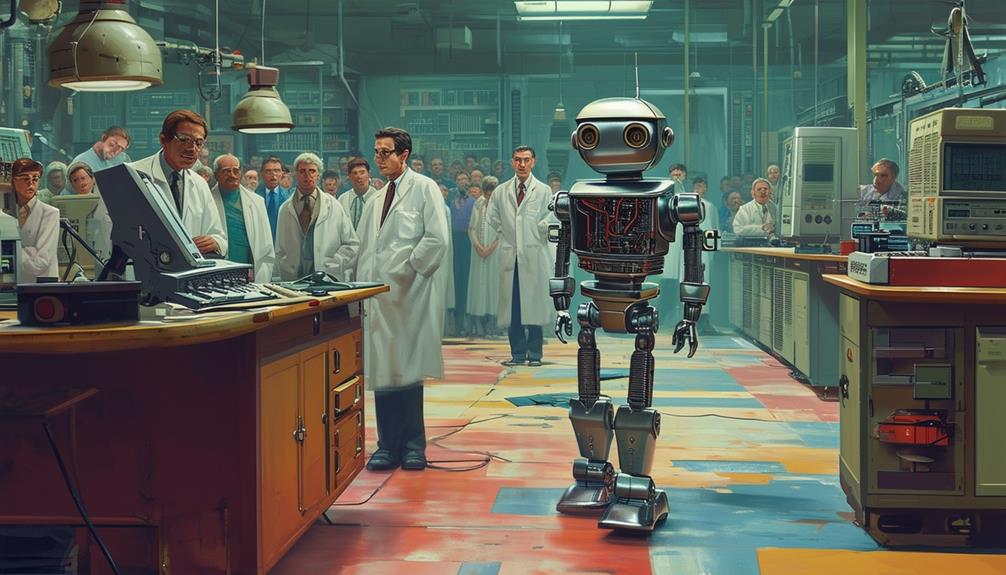
Shakey the Robot captivated audiences with public demonstrations that showcased its groundbreaking capabilities in autonomous navigation and problem-solving. These demonstrations were pivotal in illustrating the advancements in robotics and artificial intelligence. Watching Shakey navigate its environment, manipulate objects, and solve complex tasks was extraordinary for the time.
Shakey displayed remarkable mobile prowess, deftly moving around obstacles and executing commands autonomously—an unprecedented achievement in 1969. These public demonstrations offered a glimpse into the future of robotics, where machines could think and act independently. The events not only impressed the audience but also ignited widespread interest in the potential applications of AI and mobile robots.
The 1969 demonstrations were crucial in solidifying Shakey's legacy as a pioneering force in the field. Its ability to perform tasks requiring both physical movement and cognitive processes laid the foundation for future advancements in robotics and artificial intelligence. Shakey's public demonstrations showcased what was possible, inspiring a new generation of scientists and engineers to push the boundaries even further.
Media Coverage
Shakey's remarkable capabilities quickly caught the media's attention following the release of SRI's 1969 video. This groundbreaking footage showcased Shakey navigating its environment, making decisions, and performing tasks autonomously—a revolutionary feat for its time. The ensuing media coverage elevated Shakey from a research project to a symbol of technological progress.
Several prominent publications spotlighted Shakey, introducing its story to a wider audience:
- Life magazine featured an article that enthralled readers with images and descriptions of Shakey's functions, making complex technology both accessible and exciting.
- National Geographic included Shakey in its coverage, emphasizing the robot's potential to transform our understanding of machine intelligence.
- The New York Times provided in-depth articles analyzing the implications of Shakey's capabilities for future technological advancements.
- Shakey's achievements were later honored with the prestigious IEEE Milestone in Electrical Engineering and Computing, solidifying its place in technological history.
These media features not only informed but also inspired a generation of engineers and scientists. The widespread attention Shakey received underscored significant public interest in artificial intelligence and robotics during that period, setting the stage for future innovations.
Legacy and Impact
You've seen how Shakey captivated the media; now let's delve into its lasting impact on robotics and AI. Shakey's pioneering work at the Artificial Intelligence Center directly influenced the development of Mars rovers. The mobility lessons learned were crucial for designing rovers capable of navigating the Martian landscape, highlighting its enduring legacy in space exploration.
At the Computer History Museum, Shakey is not just celebrated as a mobile automaton but as a groundbreaking project that expanded the horizons of robotic capabilities. The advanced algorithms and architecture developed for Shakey have been extensively cited in robotics research, underscoring their importance in advancing the field.
Shakey's influence is evident in ongoing recognition within AI and robotics communities. The foundational concepts it introduced—from autonomous movement to decision-making processes—continue to shape modern robotics. By integrating Shakey's technological advancements into subsequent projects, researchers have paved the way for new explorations and applications, affirming Shakey's role as a cornerstone in robotics and AI history. Its legacy continues to inspire and drive technological progress today.
Conclusion
Shakey the Robot revolutionized robotics through the integration of advanced AI techniques and state-of-the-art hardware developed by visionary engineers. Public demonstrations and media coverage highlighted Shakey's groundbreaking abilities, proving the feasibility of autonomous reasoning in machines. Its legacy continues to inspire progress in AI and robotics, exemplifying the remarkable achievements possible through collaboration and innovation.