The History of AI in Art and Creativity

The intersection of artificial intelligence and art dates back to the 1950s, with pioneers like Ben F. Laposky and Harold Cohen exploring machine-generated creativity. Today, advancements in deep learning algorithms and generative adversarial networks have significantly transformed the artistic landscape. These technologies prompt questions about authorship and originality, impacting the future of art and society. Let's explore these developments and their implications.
Early Experiments in AI Art
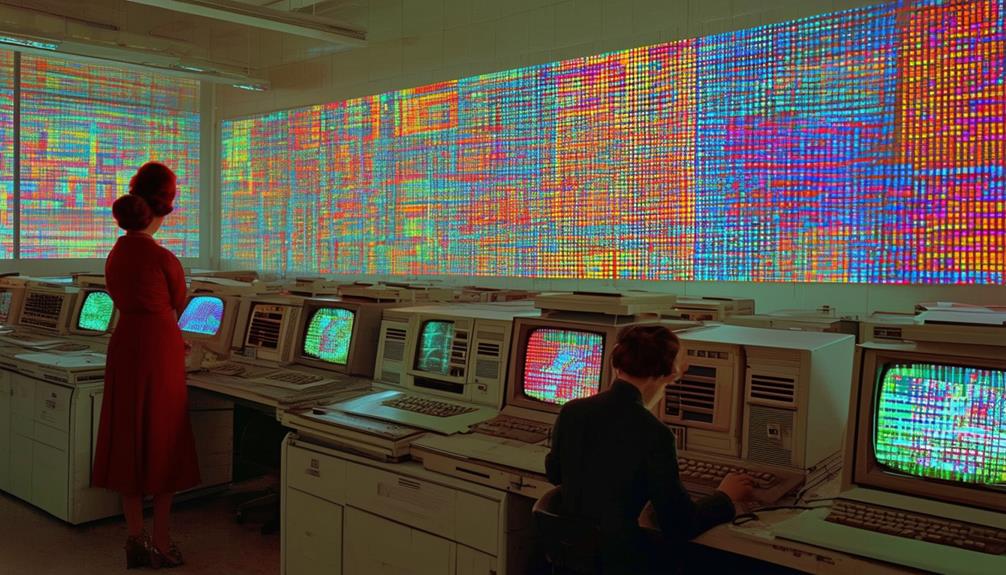
Early Experiments in AI Art
In the early stages of AI art, pioneers like Ben F. Laposky and Harold Cohen laid the groundwork with innovative experiments that fused technology and creativity. Laposky's 1953 artwork, Oscillon 40, is often recognized as one of the earliest examples of digital art. His work in automated art opened new avenues where technology could enhance creativity.
Harold Cohen took AI art further in the 1970s with his AARON program, a groundbreaking system that generated complex artworks autonomously. Cohen's work showcased the potential of AI in creative processes, marking a significant leap forward by demonstrating how AI could produce creative outputs comparable to those of human artists.
As neural networks emerged in the late 20th century, AI art saw new advancements. Karl Sims' contributions highlighted AI's capacity to create both visual and auditory content, pushing the boundaries further. The development of aesthetic style transfer techniques in the 2010s marked another milestone, with Alexander Mordvintsev's DeepDream project creating mesmerizing, dream-like artworks by blending different artistic styles.
These early experiments in AI art laid the foundation for future innovations, demonstrating the incredible potential of combining technology with creativity to produce unique and captivating works of art.
1950s to 2000s Innovations
Building on the foundational experiments of previous decades, the 1990s and early 2000s witnessed a surge in AI-driven artistic innovations, driven by advancements in computing power and neural network research. Visionary figures like Karl Sims demonstrated AI's capacity to simulate natural evolution, creating visually stunning images that pushed the boundaries of artistic expression. Neural networks gained prominence during this period, enabling the creation of sophisticated visual and auditory content.
Significant developments in AI art tools began to surface during this era. Deep learning algorithms opened up new creative possibilities for artists and technologists, leading to AI-generated images that challenged traditional art forms. The introduction of generative adversarial networks (GANs) in the late 2000s further revolutionized the field, allowing AI systems to generate highly realistic images and adding a new dimension to artistic creation.
As AI art flourished, ethical questions about AI-generated art emerged. Debates on issues such as authorship, originality, and the role of human creativity in this new age of AI became prevalent. This period laid the groundwork for the explosive growth and innovation in AI art that followed in the subsequent decade.
Deep Learning in the 2010s
In the 2010s, deep learning revolutionized AI-generated art, notably through artistic style transfer and Generative Adversarial Networks (GANs). These advancements enabled AI to blend different artistic styles to produce unique, high-quality images. GANs, in particular, facilitated the creation of highly realistic and complex artworks, significantly expanding the possibilities of digital creativity.
Artistic Style Transfer
The 2010s witnessed a transformative shift in AI-generated art, driven by advances in deep learning and convolutional neural networks through the technique of artistic style transfer. These neural networks empowered AI to understand and mimic various artistic styles, integrating them seamlessly with existing images. This capability enabled artists to blend aesthetics from different eras and creators, resulting in captivating artworks that stretched the boundaries of traditional art.
Deep learning models facilitated AI's ability to grasp and replicate the distinctive characteristics of an artistic style, applying these features to new images. This process involved convolutional neural networks that analyzed the content and style of images separately before merging these elements to produce visually striking artworks. Consequently, AI art in the 2010s exhibited a broad spectrum of influences, ranging from classical paintings to modern designs.
Artists leveraged these AI advancements to explore new realms of creativity. By employing style transfer techniques, they could experiment and refine their creations, achieving outcomes previously deemed unattainable. This era marked a pivotal advancement in the interplay between technology and art, fundamentally altering the conceptualization and production of artistic images.
Generative Adversarial Networks
Generative Adversarial Networks (GANs), pioneered by Ian Goodfellow in 2014, have significantly impacted the field of AI art by enabling machines to generate realistic and imaginative artworks through the collaboration of two neural networks: the generator and the discriminator. The generator creates new images, while the discriminator evaluates their authenticity, thereby compelling the generator to enhance its output iteratively. This interaction has propelled AI creativity to new heights, producing a variety of images that challenge conventional art paradigms.
GANs have empowered AI to create captivating art that often blurs the distinction between human and machine creativity. Notably, Google's DeepDream program, developed by engineer Alexander Mordvintsev, exemplifies the remarkable potential of GANs. This innovation marks a transformative phase in art creation, where machines play a significant role in the artistic process.
Key aspects of GANs include:
- GANs: Comprising a generator and a discriminator, these networks compete to produce realistic images.
- Ian Goodfellow: Credited with the introduction of GANs in 2014, revolutionizing AI's approach to art creation.
- AI creativity: GANs have greatly enhanced AI's capacity to generate diverse and imaginative artworks.
- Art paradigms: The application of GANs challenges and broadens traditional concepts of art creation.
Transformer Models in the 2020s
In the 2020s, transformer models like DALL·E have revolutionized content generation by producing high-quality visual art from text prompts. These advancements allow users to easily convert their creative ideas into intricate and detailed artworks. This progress has significantly enhanced artistic expression, pushing the boundaries of what AI can achieve in the realm of art.
Revolutionizing Content Generation
With the emergence of transformer models like GPT-3 and DALL·E, the 2020s have witnessed a significant shift in how AI contributes to art and creativity. Developed by OpenAI, these models leverage attention mechanisms to generate high-quality and diverse artistic content. GPT-3 and DALL·E can comprehend and create complex patterns, making AI-generated art both realistic and imaginative. This evolution has opened new dimensions in contemporary art, allowing artists to explore uncharted creative territories.
One of the most revolutionary features of these transformer models is their ability to perform text-to-image generation. Here's why this capability is game-changing:
- Creativity Enhancement: Artists can describe a scene in words, and the AI generates a visual representation, pushing the boundaries of traditional art.
- Efficiency: Rapid art generation reduces the time-consuming aspects of creation, allowing artists more time for ideation and refinement.
- Versatility: The models can produce a wide range of styles and concepts, enriching the spectrum of artistic possibilities.
- Accessibility: Even individuals without formal artistic training can create compelling art, democratizing creativity.
These advancements ensure that AI-generated art is semantically accurate, complete, consistent, concise, relevant, interoperable, and trustworthy, fundamentally transforming the landscape of creative expression.
Enhancing Artistic Expression
Leveraging the transformative capabilities of GPT-3 and DALL·E, transformer models in the 2020s have elevated artistic expression to unprecedented heights. These models don't merely generate images; they comprehend and interpret textual descriptions, empowering artists to articulate their visions using natural language. This has expanded the horizons of creativity, making AI an indispensable tool in contemporary artistic endeavors.
By enhancing patterns and facilitating intricate artistic expressions, transformer models have revolutionized the synergy between AI and human artists. Artists now have the power to create diverse and groundbreaking artworks that were previously inconceivable. The ability to generate high-quality images from simple text prompts allows artists to effortlessly broaden and enrich their creative perspectives.
This collaboration signifies a major shift in the artistic landscape. AI as a tool has enabled artists to produce pioneering works that seamlessly blend technology with human creativity. Researchers and artists are continuously exploring innovative ways to utilize these models, resulting in a rich tapestry of artistic possibilities. The 2020s have demonstrated that the fusion of transformer models and human ingenuity can usher in a vibrant and dynamic era of artistic expression.
AI Tools and Techniques
As you delve into the world of AI art, you'll discover that neural networks and machine learning techniques laid the groundwork for modern creative tools and methodologies. Pioneers like Harold Cohen and Vera Molnar used these technologies in the 1980s and 1990s, marking the beginning of early AI art. Today, the landscape has evolved dramatically with the introduction of deep learning algorithms, which have advanced the field by generating realistic and intricate artworks.
Generative Adversarial Networks (GANs), introduced in 2014, revolutionized AI art creation techniques by enabling the production of both realistic and imaginative pieces. More recently, diffusion models, adopted in 2022, have provided stability and diversity in AI-generated outputs, pushing the boundaries of what AI can achieve in art.
In 2021, CLIP by OpenAI combined language processing and computer vision, greatly enhancing AI art generation capabilities. These advancements have led to a variety of creative AI tools and techniques:
- Neural Networks - Foundation for early AI art and modern methodologies.
- Deep Learning Algorithms - Enable generation of complex and realistic artworks.
- GANs - Revolutionized the field with imaginative and lifelike art.
- Diffusion Models - Offer stable and diverse outputs, enhancing AI creativity.
These tools continue to shape the future of AI art, enabling new forms of creative expression.
Impact on Art and Society
AI art frequently transforms how we perceive and engage with creative works, reshaping both the art world and society at large. It broadens niche genres and enriches artistic output, making art-making more accessible to everyone. However, this transformation brings about legal and ethical complexities. Debates rage over copyright ownership and income stability for traditional artists, as AI-generated works blur the lines of creative authorship.
The impact on creativity is another significant concern. While AI can create stunning artworks, some argue it may stifle human creativity by automating the creative process. Additionally, the environmental impact of AI art cannot be ignored, as training AI models often requires substantial computational power, contributing to carbon emissions.
Bias in AI models is another pressing issue. The data used to train these models can lead to unintended biases in the generated art, affecting representation and perpetuating stereotypes. Moreover, AI art's influence on society includes the spread of deceptive content and its potential impact on reputations and hate speech. These multifaceted impacts underscore the need for ongoing dialogue around the ethical use and legal frameworks governing AI art.
Future Prospects in AI Art
With technology advancing rapidly, the future of AI art and its integration into the creative world looks promising yet complex. AI is poised to revolutionize the art world through neural networks and deep learning, enabling the creation of lifelike and intricate images. This innovation is set to expand the range of artistic styles and media, making the creative landscape more versatile and accessible.
However, the evolution of AI art presents both challenges and opportunities. Consider the following aspects:
- Ethical Implications: As AI-generated art becomes more prevalent, questions about authorship and copyright will become critical. Who owns the rights to a piece created by an algorithm?
- Human Creativity: There's an ongoing debate about whether AI can truly replicate the human touch and emotional depth that traditional art embodies.
- Art World Acceptance: The art world is grappling with the integration of AI art, balancing innovation with the preservation of traditional methods.
- Devaluation Concerns: Some worry that the flood of AI-generated art might devalue traditional forms, impacting the livelihoods of human artists.
In essence, the future of AI art holds immense potential but requires careful navigation of these complex issues.
Conclusion
AI has significantly transformed art, evolving from early experiments to modern-day innovations. Its role in creativity has expanded, pushing boundaries and redefining artistic norms. Looking ahead, the possibilities AI offers for future art and creativity seem boundless. Embrace the fusion of human ingenuity and machine intelligence to envision new horizons. The evolution of AI in art is far from over—it's just beginning.
Related posts