The Evolution of Reinforcement Learning in AI

Reinforcement learning (RL) has significantly transformed artificial intelligence (AI). The journey began with addressing fundamental challenges such as the credit assignment problem and sample efficiency. Pioneers like Richard Bellman and Arthur Samuel laid the groundwork, leading to the development of today's sophisticated actor-critic architectures. With advancements in computing power, RL has found applications across varied domains, from robotics to finance. Algorithms like Q-learning have even achieved mastery in video games. What does the future hold for this dynamic field? Let's explore the next steps together.
Early Challenges
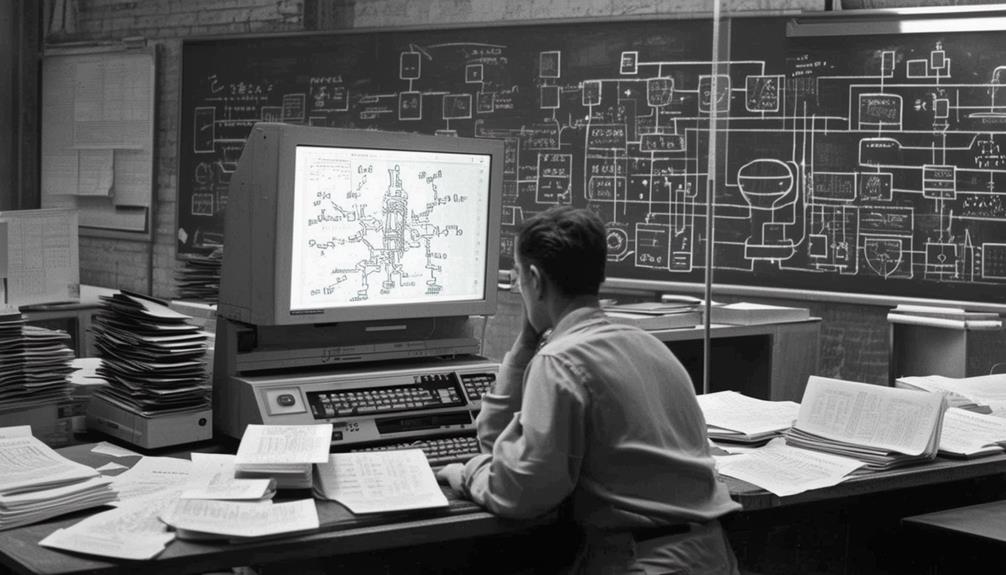
In the early days of reinforcement learning, researchers faced significant challenges like the credit assignment problem, which hindered the ability to identify which actions led to rewards. This foundational issue complicated the learning process by making it difficult for agents to understand the consequences of their actions. Furthermore, sample efficiency was a major concern, as training often required extensive interactions with the environment, making it both time-consuming and resource-intensive.
Another early challenge was managing the exploration-exploitation tradeoff. Researchers had to decide whether to try new actions to discover potentially better rewards or to exploit known successful actions. Striking this balance was crucial for effective learning but tricky to achieve.
Function approximation also posed difficulties. Generalizing learned behaviors to new states or situations was challenging, limiting the application of learned knowledge in different contexts and hampering overall learning effectiveness.
Lastly, non-stationarity adaptation was a persistent issue. Environments and task dynamics often changed over time, necessitating continual adjustments in learning strategies. Adapting to these changes was a significant challenge in early reinforcement learning efforts, making consistent performance hard to achieve.
Key Milestones
Richard Bellman's development of dynamic programming in the early 1950s marked a pivotal milestone in reinforcement learning. His introduction of value functions and the Bellman equation provided a systematic way to break down complex decision-making processes, forming the foundational framework that still underpins the field today.
Arthur Samuel advanced the field by implementing temporal-difference learning methods, which allowed machines to improve their learning efficiency and effectiveness by learning from experience. Samuel's contributions were crucial in bridging theoretical models and practical applications.
In 1981, the introduction of the actor-critic architecture represented another significant advancement. This architecture combined trial-and-error learning with backpropagation in neural networks, addressing the credit assignment problem—an issue Marvin Minsky had emphasized—by using separate components to evaluate actions and refine policies.
Computing Power Influence

The rapid progress in reinforcement learning (RL) is closely linked to advancements in processor speeds and GPU capabilities. These technological improvements enable faster and more efficient training of RL models, facilitating their scalable deployment across various industries.
Increasing Processor Speeds
Advances in computing power, such as GPU acceleration and specialized hardware like TPUs, have significantly enhanced the capabilities of reinforcement learning. Leveraging these powerful tools allows you to tackle previously unimaginable problems, accelerating innovation and enabling real-world applications across various industries.
Effectively harnessing reinforcement learning requires substantial computational power. Recent developments have played a pivotal role:
- Cloud Computing: Access vast computational resources on-demand, providing scalable and flexible model training.
- Distributed Computing: Spread computational tasks across multiple machines, speeding up training and efficiently handling larger datasets.
- Specialized Hardware: Utilize devices like TPUs and ASICs specifically designed for machine learning tasks to enhance performance and reduce training times.
- Real-World Applications: High computational power facilitates the deployment of reinforcement learning in sectors such as healthcare, finance, and autonomous systems, driving rapid progress and enabling unprecedented innovation.
With increasing processor speeds, we are entering a new era in artificial intelligence where computational limitations are diminishing. This progress fosters innovation and brings us closer to solving some of the world's most challenging problems.
Enhanced GPU Capabilities
Enhanced GPU capabilities have revolutionized the training of deep reinforcement learning (RL) models by enabling faster and more efficient computations. Leveraging GPU acceleration and parallel computing, deep RL algorithms can now be trained significantly quicker than with traditional CPU resources. This leap in computational power greatly enhances training efficiency, allowing for the tackling of more complex tasks.
Additionally, the development of specialized hardware optimized for deep RL has further improved performance. GPUs specifically designed for parallel computing can manage the intensive workloads required by reinforcement learning. This advancement makes deploying RL models in real-world applications not only feasible but also highly effective.
To illustrate the benefits, here's a comparison of different aspects:
| Aspect | Traditional CPU | GPU Acceleration | Specialized Hardware |
|---|---|---|---|
| Training Speed | Slower | Much Faster | Optimized |
| Efficiency | Lower | Higher | Highest |
| Real-World Applications | Limited Feasibility | Feasible | Highly Effective |
Moreover, cloud and distributed computing resources further scale up RL model training. With enhanced GPU capabilities, you are equipped to push the boundaries of what reinforcement learning models can achieve, paving the way for innovative solutions and applications.
Domain Applications
Reinforcement learning (RL) is revolutionizing various fields by optimizing tasks and improving decision-making processes. Its applications span across multiple domains, including:
- Robotics: RL enhances control and manipulation tasks, boosting efficiency and autonomy.
- Autonomous Vehicles: RL is crucial for navigation and path planning, significantly improving decision-making capabilities.
- Healthcare: RL helps develop personalized treatment plans, leading to better patient outcomes and more efficient resource utilization.
- Finance: RL drives algorithmic trading, refining predictive models and risk management strategies.
- Gaming: RL enables the creation of adaptive AI opponents, making games more engaging and dynamic.
In robotics, RL optimizes control mechanisms and improves the autonomy of machines, while in autonomous vehicles, it enhances navigation systems and decision-making. In healthcare, RL's ability to generate personalized treatment plans results in improved patient care and resource management. In finance, RL's impact on algorithmic trading enhances predictive accuracy and risk mitigation. Finally, in the gaming industry, RL contributes to the development of intelligent, adaptive AI that enhances player experience. These applications highlight RL's transformative power across various sectors, driving innovation, efficiency, and advanced decision-making processes.
Popular Algorithms

To fully leverage reinforcement learning across various domains, it's essential to grasp the popular algorithms that underpin these advancements. Q-learning is a foundational RL algorithm that is model-free, meaning it doesn't require a model of the environment. Instead, it uses a Q-value function to guide decision-making, making Q-learning both versatile and broadly applicable.
Another crucial algorithm is Actor-Critic, which merges value-based and policy-based approaches. This hybrid method enhances learning stability and efficiency through two components: the 'actor,' which updates the policy, and the 'critic,' which evaluates the actions taken by the actor.
For complex environments, the Deep Q Network (DQN) excels by utilizing deep neural networks to approximate Q-values. This capability enables DQN to manage high-dimensional input spaces like images, making it particularly effective for tasks such as playing video games.
Advantage Actor-Critic (A3C) improves training efficiency by using asynchronous updates from multiple agents. This not only accelerates learning but also boosts policy performance.
Lastly, SARSA (State-Action-Reward-State-Action) is an on-policy algorithm that learns action values directly from experience, offering a practical solution for real-time decision-making. Mastering these RL algorithms will equip you to address a broad spectrum of AI challenges.
Future Directions
As reinforcement learning continues to evolve, future advancements will likely focus on improving algorithmic efficiency and explainability to foster broader trust and application. Significant progress is expected in making AI decisions more transparent and understandable. By enhancing explainability and interpretability, researchers aim to build systems that users can trust and interact with reliably.
Future directions also involve developing more data-efficient algorithms to improve training efficiency and scalability, making reinforcement learning models more practical and widely applicable. Integrating reinforcement learning with other AI techniques like deep learning and transfer learning will lead to more versatile and robust systems capable of handling a variety of tasks and environments.
Moreover, exploring meta-learning and self-supervised learning approaches will allow agents to adapt to new tasks and environments more quickly and efficiently. This adaptability is essential for creating AI systems that can operate effectively in dynamic real-world scenarios.
Key areas of focus include:
- Explainability and interpretability: Enhancing understanding of AI decisions.
- Data-efficient algorithms: Improving training efficiency and scalability.
- Integration with deep learning and transfer learning: Creating versatile AI systems.
- Meta-learning and self-supervised learning: Enabling rapid adaptation to new tasks.
Conclusion
Reinforcement learning (RL) has made significant strides, overcoming early challenges and achieving notable milestones. Leveraging powerful computing resources, RL's applications have expanded into diverse fields such as robotics, finance, and healthcare. Algorithms like Q-learning and Deep Q Networks have demonstrated RL's potential, particularly in gaming. Looking forward, the focus will be on enhancing explainability, scalability, and integrating RL with deep learning to create more versatile AI systems. The journey is far from over!
Related posts