
The Evolution of AI in Financial Markets and Trading

AI has been transforming financial markets and trading for decades, evolving from basic statistical methods in the 1950s to today's sophisticated neural networks. High-frequency trading (HFT) emerged in the 2000s as a notable shift, but recent advancements go far beyond that. The latest developments in AI are redefining strategies and execution, posing new ethical dilemmas and raising important questions. There's much more to explore regarding AI's evolving role and its impact on financial markets.
Historical Milestones
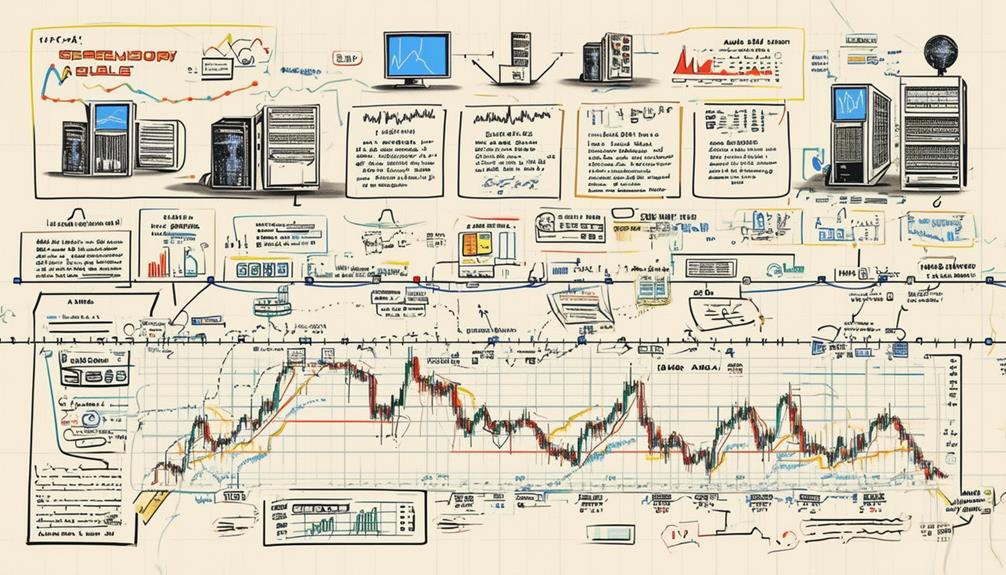
The evolution of AI in financial markets began in the 1950s with the introduction of mathematical and statistical methods to trading strategies. These early innovations laid the groundwork for modern financial technology. By analyzing historical data, traders developed algorithms to predict market movements and optimize trading decisions.
In the 1980s, the emergence of neural networks and machine learning marked a significant milestone. These technologies enabled sophisticated analysis and pattern recognition within financial markets. Algorithms became more advanced, allowing traders to process larger datasets and make better-informed decisions.
The 2000s saw the rise of high-frequency trading (HFT), which emphasized speed and precision in executing trades. HFT firms employed advanced algorithms and AI to make split-second trading decisions, capitalizing on minimal price fluctuations. This development significantly increased trading volume and transformed market dynamics.
Algorithmic Trading
In algorithmic trading, high-frequency trading, predictive analytics, and risk management algorithms are essential. These elements enable rapid and precise trade execution and advanced market forecasting. Leveraging AI and machine learning enhances the effectiveness of your trading strategies.
High-Frequency Trading
In high-frequency trading (HFT), algorithms execute trades at extraordinary speeds to exploit minor market fluctuations. These algorithms, enhanced by artificial intelligence and machine learning, analyze massive datasets to predict market movements with remarkable accuracy. This allows for optimized trade execution and the generation of alpha, which is the excess return on an investment relative to a benchmark index.
HFT is a significant component of the U.S. stock market, accounting for an estimated 70% of the trading volume. This prevalence underscores the efficiency and profitability of sophisticated algorithms. In 2021, the global algorithmic trading market, including HFT, was valued at USD 15.55 billion, highlighting its substantial impact on financial markets.
Machine learning is crucial in improving trade execution efficiency. By continuously learning from historical data and adjusting strategies in real-time, these systems maintain a competitive edge. The speed and precision of HFT enable traders to capitalize on even the smallest market inefficiencies, making it an essential tool for modern financial institutions.
Predictive Analytics Models
Predictive analytics models in algorithmic trading utilize historical data and advanced algorithms to forecast market trends and optimize trading strategies. By leveraging machine learning, these models analyze vast amounts of financial data, enabling more informed trading decisions. With approximately 70% of U.S. stock market trading volume driven by algorithmic trading, predictive analytics is integral to modern finance.
Predictive analytics models employ various types of financial data and market conditions to generate trading signals. Here's a quick comparison of different data and techniques used:
| Type of Data | Techniques |
|---|---|
| Historical Prices | Time Series Analysis |
| Technical Indicators | Pattern Recognition |
| News Sentiment | Natural Language Processing |
| Fundamental Data | Statistical Models |
| Market Conditions | Machine Learning Algorithms |
These methods provide a robust framework for developing sophisticated trading strategies. The global algorithmic trading market, valued at USD 15.55 billion in 2021, is projected to grow significantly, driven by continuous advancements in AI in financial markets. As algorithms evolve and incorporate machine learning, they become more adept at identifying profitable opportunities, ensuring efficient trade execution and alpha generation.
Risk Management Algorithms
Effective risk management algorithms are crucial for safeguarding investments and optimizing returns in algorithmic trading. In the context of automated trading, market volatility can be both an opportunity and a risk. AI algorithms assist in navigating these fluctuations by leveraging machine learning to analyze vast amounts of historical data, enabling financial institutions to predict potential risks and make informed decisions in real-time.
In high-frequency trading (HFT), where transactions occur at lightning speeds, even minor errors can result in significant losses. Risk management algorithms are vital in this environment, as they continuously monitor and adjust trading strategies to mitigate potential downsides. These algorithms are designed to adapt to market fluctuations, ensuring that investments remain protected even under unpredictable conditions.
Furthermore, AI-powered risk management algorithms not only react to market changes but also proactively identify emerging threats and opportunities. This proactive approach allows traders to stay ahead of the curve, optimizing returns while minimizing risks. Given that algorithmic trading accounts for approximately 70% of the U.S. stock market trading volume, the importance of robust risk management algorithms cannot be overstated.
Machine Learning Advancements

Machine learning advancements are revolutionizing financial markets by harnessing complex patterns to predict price movements with unprecedented accuracy. Utilizing these technologies allows for the analysis of vast datasets, known as big data, which were previously too intricate for traditional methods. Deep learning, a subset of machine learning, has become crucial in extracting valuable insights from unstructured financial information, aiding in the development of sophisticated AI trading systems. These systems are transforming the financial industry by creating more effective and responsive investment strategies.
Artificial Intelligence in financial markets extends beyond pattern recognition. Predictive analytics, powered by machine learning, enables the anticipation of price movements based on historical data, facilitating more informed trading decisions. Natural language processing, another facet of AI, allows for the interpretation and analysis of human language for market insights, adding an additional layer of intelligence to trading strategies.
The global algorithmic trading market is booming, with an expected CAGR of 12.2% from 2022 to 2030. This growth underscores the significant role of machine learning and AI technologies in shaping the future of financial trading, providing tools to stay competitive in the market.
High-Frequency Trading
High-frequency trading (HFT) leverages advanced algorithms to execute trades at speeds measured in microseconds, taking advantage of brief market opportunities. This form of trading has rapidly become a dominant force in the financial sector, accounting for approximately 50-60% of US equity market transactions. These sophisticated algorithms are engineered to identify and exploit minor price discrepancies, targeting market inefficiencies that exist for only a fraction of a second.
With ongoing advancements in technology, HFT has integrated artificial intelligence (AI) and machine learning, bringing unprecedented sophistication to trade execution. These technologies enable the creation of complex strategies that can adapt in real-time. AI and machine learning algorithms can analyze vast datasets faster and more accurately than before, providing HFT firms with a substantial edge.
The global high-frequency trading market is projected to continue its growth trajectory. As algorithms become more advanced and technology progresses, HFT is expected to play an increasingly pivotal role in financial markets. By harnessing AI and machine learning, HFT firms are continually fine-tuning their strategies to maintain a competitive advantage in an ever-evolving landscape.
AI-Powered ETFs

AI-powered ETFs are revolutionizing investment strategies by using advanced algorithms to optimize portfolio performance. For example, the AIEQ ETF, managed by IBM's Watson, has demonstrated competitive returns, often outperforming the S&P 500. These ETFs utilize data-driven decision-making processes, analyzing vast amounts of information more rapidly and accurately than human managers.
AI stock pickers are increasingly replacing their human counterparts in actively managed equity funds. This transition enhances efficiency and returns by eliminating emotional biases and relying solely on data and statistical models. By integrating AI into ETFs, investment firms can swiftly adapt to market changes and make more informed decisions.
The democratization of information has made AI and quantitative strategies essential for active portfolio management. Individual investors and smaller firms now have access to advanced data analytics previously reserved for large institutions, leveling the playing field and enabling broader access to sophisticated investment strategies.
Ethical Considerations
When considering ethical implications, it is crucial to address data privacy concerns and algorithmic bias risks. Ensuring transparency in AI models promotes fairness and accountability. Additionally, it is essential to mitigate biases in algorithms to prevent unfair practices.
Data Privacy Concerns
Managing sensitive financial data in AI trading systems demands rigorous attention to data privacy and ethical considerations. As AI technologies evolve, they increasingly handle vast amounts of financial information, raising significant data privacy issues. The sensitive financial information processed by these systems requires robust safeguards to guarantee protection and prevent misuse and unauthorized access. Data privacy is not just a technical challenge but also an ethical dilemma that financial institutions must navigate.
Major banks, such as JP Morgan Chase, have already banned certain AI technologies due to data privacy risks. Regulatory frameworks must adapt swiftly to the integration of AI in financial systems to address these concerns effectively. Ethical considerations extend beyond data privacy to include the potential for AI-generated misinformation, which could manipulate markets and undermine trust.
To better manage these challenges, consider the following:
- Encrypt sensitive financial data to safeguard it from unauthorized access.
- Implement strict access controls to ensure that only authorized personnel can access sensitive information.
- Regularly update regulatory frameworks to keep pace with advancements in AI technologies.
- Conduct thorough ethical reviews of AI systems to identify and mitigate potential risks.
Algorithmic Bias Risks
Algorithmic bias in AI trading models can unjustly influence financial decisions, raising significant ethical concerns and perpetuating systemic inequalities. When biases infiltrate AI algorithms, they can lead to discrimination or unfair treatment based on race, gender, or socioeconomic status. These risks are especially concerning in financial markets, where decisions directly affect individuals' financial well-being.
Unaddressed biases in AI trading models can exacerbate inequalities, as these systems often learn from historical data that may already contain inherent biases. When AI systems inadvertently incorporate these biases, they impact trading outcomes and can distort market dynamics. This is not merely an important issue—it is an ethical imperative that demands attention.
To tackle these biases, it is crucial to promote fairness, transparency, and accountability in AI-driven financial decision-making. Proactive measures such as regular data audits and the use of diverse datasets are effective strategies to mitigate algorithmic bias risks. By rigorously examining the data and refining the algorithms, it is possible to ensure that AI trading models do not perpetuate discrimination or unfair treatment. Implementing these steps will contribute to making financial markets more equitable and just for all participants.
Future Trends

As AI technologies continue to evolve, expect a significant transformation in financial markets and service delivery. Machine learning and Data Science are set to revolutionize stock trading by offering more accurate predictive analytics and informed investment decisions. AI in financial services will enhance operational efficiency and reduce costs, fundamentally reshaping the industry. High-frequency trading (HFT) will particularly benefit from these advancements, enabling faster and more precise trades.
Looking ahead, key trends to watch include:
- AI-Powered Robo-Advisors: These will become increasingly prevalent, providing personalized and data-driven investment advice.
- Enhanced Predictive Analytics: AI technologies will continue to refine predictive models, leading to improved investment strategies and superior risk management.
- Automation in Financial Processes: Expect increased automation in areas such as compliance, fraud detection, and customer verification, significantly reducing operational costs.
- AI-Driven Customer Service: AI-powered chatbots will deliver personalized and efficient customer service, enhancing the overall client experience.
Conclusion
AI has revolutionized financial markets and trading, evolving from basic mathematical models to sophisticated high-frequency trading systems and AI-powered ETFs. As machine learning continues to advance, the future promises even more groundbreaking developments. However, it's essential to consider the ethical implications as AI progresses. Embrace the future of AI in finance, but remain vigilant in balancing innovation with ethical responsibility.