How Artificial Intelligence Is Changing the Mechanics of Modern Robots
You're witnessing AI transforming modern robots by enhancing sensory perception and decision-making. Sensor fusion now lets robots understand their environment by combining multiple data sources, while adaptive learning allows them to evolve based on past experiences. AI empowers robots to function autonomously, maneuvering and avoiding obstacles seamlessly with the use of advanced navigation systems. In collaborations, AI-driven robots combine machine precision with human intuition, responding to environments through emotional intelligence. Future trends like soft robotics and swarm intelligence promise further change. This exciting progression suggests a world where robotics greatly impacts daily life and industry. Uncover more shortly.
Enhanced Sensory Perception
In recent years, improved sensory perception has become a cornerstone of modern robotics, allowing machines to interact with their environments in increasingly sophisticated ways. You'll find that sensor fusion plays a vital role in this evolution. By combining data from diverse sensors, robots achieve a higher level of environmental awareness. This multi modal sensing enables them to accurately interpret their surroundings, regardless of whether it's through visual recognition or auditory perception.
You're probably familiar with how tactile feedback has transformed the way robots handle objects. With improved sensors, robots can now "feel" the texture, weight, and even the temperature of objects they interact with. This sensory input is fundamental for tasks requiring delicate handling, such as assembling intricate components or performing precise surgical procedures.
Visual recognition also benefits greatly from these advancements. Robots now identify objects, people, and even facial expressions with remarkable accuracy. This capability augments their ability to navigate complex environments and interact with humans in a more intuitive manner.
Auditory perception adds another layer to their environmental awareness. By processing sounds, robots can detect changes in their surroundings, respond to verbal commands, or even identify sources of noise. Through these improvements, modern robots are becoming more capable and adaptable than ever before.
Real-Time Decision Making
Imagine a world where robots make split-second decisions seamlessly. In such a world, robots wouldn't just react; they'd proactively adapt to their environments in real-time. At the heart of this capability lies the magic of sensor fusion. By integrating data from multiple sensors, robots gain an all-encompassing view of their surroundings. Think of it as combining the sharp eyes of a hawk with the acute hearing of a bat, all processed instantly.
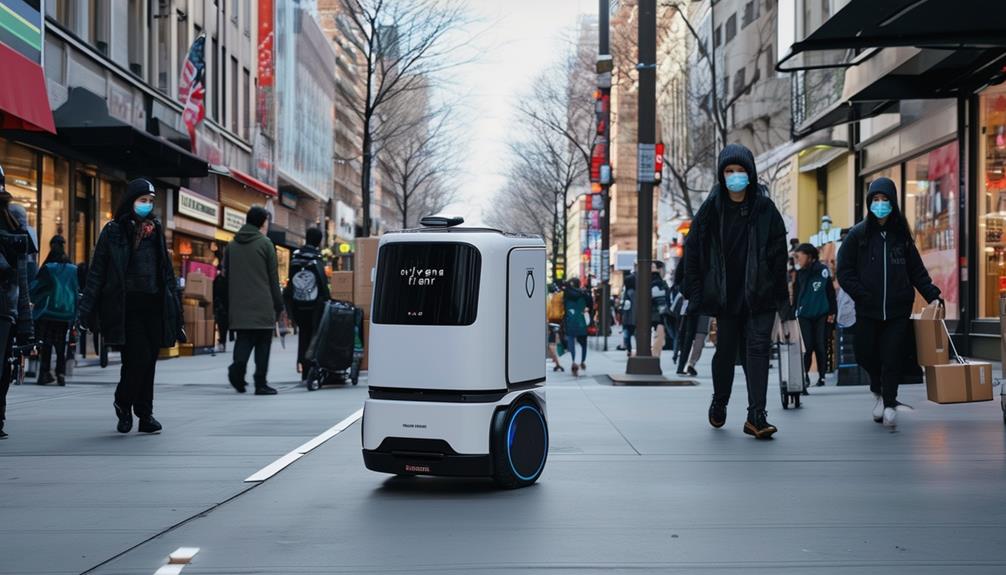
When you incorporate data processing into the mix, robots analyze this wealth of information in milliseconds. They don't just collect data; they interpret it to make informed decisions. For instance, a robot maneuvering a crowded street can instantly distinguish between a pedestrian and a stationary object, adjusting its path accordingly. This rapid decision-making process hinges on advanced algorithms that prioritize tasks and allocate resources efficiently.
In real-time decision making, every millisecond counts. The ability to process data quickly and accurately guarantees that robots can operate safely and efficiently, even in dynamic environments. By mastering sensor fusion and advanced data processing, robots are becoming more adept at traversing the complexities of the real world, bringing us closer to a future where they seamlessly integrate into our daily lives.
Adaptive Learning Algorithms

Adaptive learning algorithms are transforming how robots interact with their environments. They're not just about following pre-set instructions, but about evolving based on experiences. Imagine a robot in a warehouse. Instead of repeating the same tasks robotically, it learns from its surroundings and adjusts its actions. This is where personalized training comes into play. By tailoring the learning process to a robot's specific tasks and environments, you guarantee that it becomes more efficient over time.
Machine adaptability is at the heart of these algorithms. It allows robots to respond dynamically to unexpected changes. For example, if an obstacle suddenly appears in its path, a robot with adaptive learning can find an alternative route without waiting for human intervention. This adaptability reduces downtime and increases operational efficiency.
You've probably seen drones that can navigate complex landscapes without crashing. They use adaptive learning to modify their flight paths, accounting for new obstacles and changing weather conditions. As you incorporate adaptive learning algorithms into robotic systems, you utilize the power of real-time learning and adaptation. This not only improves performance but also opens up new possibilities for robots to function autonomously in diverse settings.
Human-Robot Collaboration
Fostering human-robot collaboration transforms how we work and live by combining human intuition with robotic precision. By embracing task sharing, you allow robots to handle repetitive or dangerous jobs, freeing you up for more creative and strategic tasks. Communication protocols are fundamental for guaranteeing that humans and robots understand each other, making interactions seamless and efficient. These protocols help you coordinate more effectively, guaranteeing that each task is completed with precision and speed.
Safety standards are critical when working alongside robots. You need to verify that these standards are consistently updated and followed, protecting both human and robotic workers. Implementing emotional intelligence in robots improves their ability to read and respond to human emotions. This not only boosts task sharing but also aids in workforce integration by making robots more approachable and relatable.
Building trust is significant for successful human-robot collaboration. You can achieve this by showcasing the reliability and consistency of robots in performing their tasks. Trust-building exercises, combined with clear communication, allow teams to work harmoniously. As robots become an integral part of the workforce, integrating them effectively guarantees that they complement human abilities, creating a more productive and creative environment.
Autonomous Navigation Systems

While human-robot collaboration enhances our daily interactions, the development of autonomous navigation systems takes robotic independence to the next level. These systems empower robots to navigate complex environments without human intervention. You'll find that autonomous navigation hinges on advanced sensor fusion and mapping techniques to create accurate, real-time representations of the robot's surroundings.
By integrating data from multiple sensors, such as cameras, lidar, and ultrasonic sensors, robots can make informed decisions. Sensor fusion allows them to process diverse data sources, reducing uncertainty and improving accuracy. As you investigate further, you'll notice how essential mapping techniques are. They enable robots to build maps of their environment, which are critical for path planning and obstacle avoidance.
Consider the following benefits of autonomous navigation systems:
- Increased Efficiency: Robots can perform tasks without constant human supervision.
- Enhanced Safety: With real-time data processing, robots can avoid obstacles, minimizing accidents.
- Adaptability: Robots can operate in dynamic environments, adjusting to changes effortlessly.
- Cost-Effectiveness: Reducing the need for human intervention lowers operational costs.
Future Trends in Robotics
Looking ahead, several emerging trends are set to shape the future of robotics, transforming industries and daily life alike. Soft robotics, which focuses on creating flexible and adaptable machines, will revolutionize sectors like healthcare and manufacturing by allowing robots to interact more safely and efficiently with humans. Swarm intelligence, inspired by the collective behavior of social insects, will enable robots to collaborate together seamlessly, leading to advancements in fields like agriculture and disaster response.
Bio-inspired designs will push the boundaries of what's possible by mimicking nature's most efficient systems, resulting in robots that can move and adapt in complex environments. You'll see these innovations in places ranging from exploration missions to urban environments. Meanwhile, modular robotics will allow you to customize and reconfigure robots to meet diverse needs, providing flexibility and cost-effectiveness.
Telepresence technology will continue to evolve, giving you the ability to interact with distant environments as if you were physically present, impacting fields like remote work and medicine. However, ethical considerations must guide these advancements, ensuring that robots improve human life without compromising privacy or security. As these trends unfold, they promise a future where robots are integral partners in our everyday lives.
Related posts