From Pilot to 500 Seats: Scaling Image, Video and LiDAR Annotation for Robotics Through Computer Vision Outsourcing to the Philippines
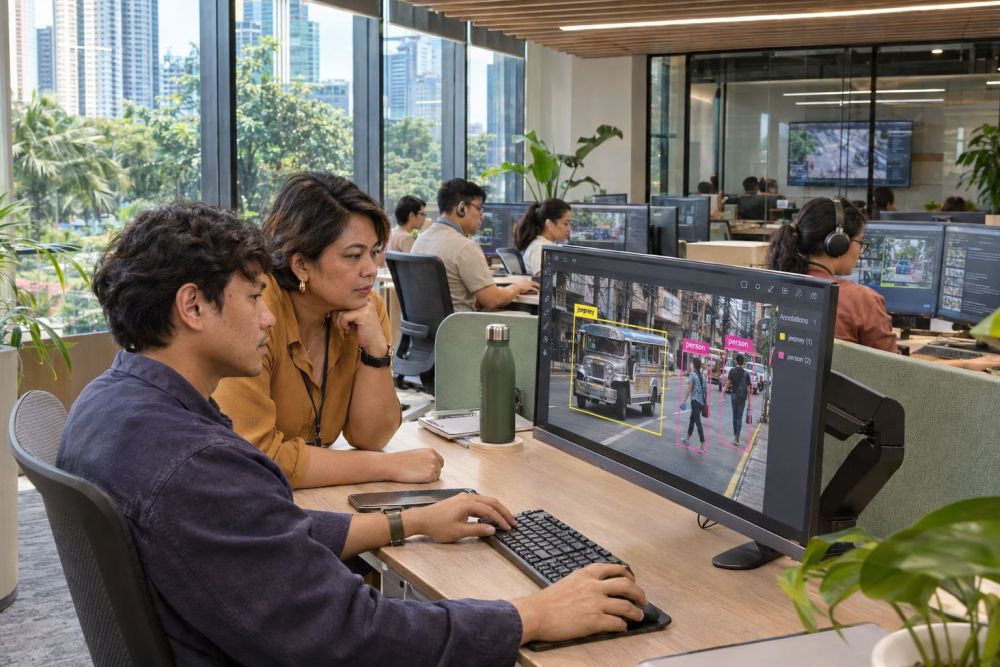
Auto-labeling was supposed to retire the human annotator. Instead, the hardest frames in robotics and autonomous driving, night rain, an occluded cyclist, a LiDAR return with a child behind a parked van, are flowing to managed annotation floors in Metro Manila and Cebu. The economics explain why. So does the safety case.
At 3 a.m. in BGC (Metro Manila), the queues are full of frames a model gave up on. A reviewer spins a LiDAR point cloud through 180 degrees, snaps a cuboid around a cluster of returns the network had scored as vegetation, and relabels it: pedestrian, partially occluded, 11 meters. In Mountain View, where the frame was flagged, it is 11 a.m. the previous day; the engineer who flagged it will see the fix after lunch.
"The location is no accident. Over the past three years computer vision outsourcing to the Philippines has turned from a cost line into a design decision for robotics and autonomous vehicle programs, the place where image annotation, video annotation, and LiDAR annotation get done at the scale and price that let perception teams keep up with their fleets. This is how that happened, what it costs, and where the catch is," says John Maczynski, chief executive of PITON-Global, a BPO advisory firm that vets Philippine providers and shortlists them for robotics and autonomous vehicle buyers at no cost.
The frames the models can't finish
The pitch for auto-labeling was simple: let the model draw the boxes, let humans check a sample, cut the labor bill by an order of magnitude. Part of it came true. When Volvo-backed Zenseact fed pre-labels from its own models into its annotation pipeline, per-object cost fell by up to 46 percent on dynamic objects and 38 percent on static ones, and dropping classes the model already handled well cut the objects passing through human review by 80 percent.
Then came the complication. The 80 percent that left were the easy objects: cars at noon, lane lines on dry asphalt. What stayed is the 20 percent the model is unsure about, and it takes longer per frame than the old queue ever did. The same study notes that "fixing poor auto-labels frequently takes longer than annotating from scratch." The human role climbed the difficulty curve, from drawing to verifying, correcting, and adjudicating (Figure 1).
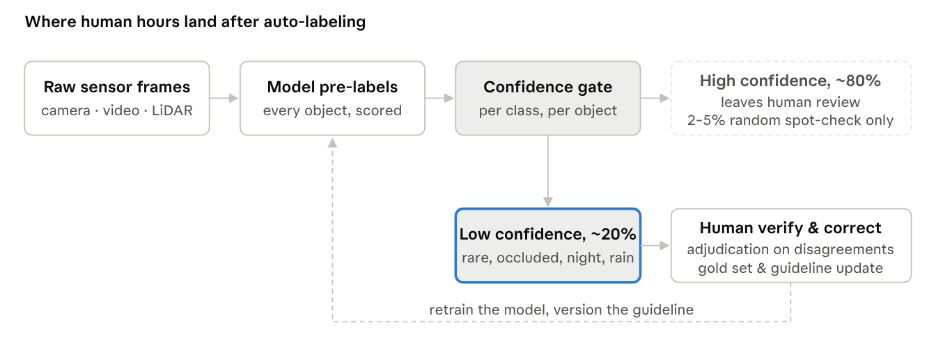
Figure 1. Where human hours land after auto-labeling. The confidence gate strips out the objects a model already handles; what reaches people is the long tail, and what people decide flows back into the next model.
The volumes make the point. The Waymo Open Dataset's perception split alone carries 12.6 million 3D boxes and 11.8 million 2D boxes across roughly 390,000 frames, about 32 labeled objects in every frame, and a production fleet logs orders of magnitude more than a research release. A second customer is arriving: Goldman Sachs analysts estimate that embodied robotics will need some 10 million hours of multimodal interaction data to reach general-purpose production capability. Somebody has to look at those frames.
Why the LiDAR annotation queue ends up in Manila and Cebu
The Philippine IT-BPM industry closed 2025 on track for about $40 billion in export revenue and 1.9 million jobs, growing 5 percent against a 3 percent global pace. What matters more than the size is what the industry has already built: recruiters who can fill 50 seats a fortnight, trainers who run calibration drills for a living, delivery centers with redundant power and fiber, and a workforce that ranks second for English in Asia, the language labeling guidelines are written in.
Geography does the rest. Manila sits 16 hours ahead of Pacific Standard Time, so a Philippine day shift runs through the West Coast's afternoon and evening, and the night shift returns finished batches before the first stand-up in Palo Alto.
Then there is the price, the part every buyer asks about first. Managed Philippine providers typically deliver image annotation, video annotation, and LiDAR annotation for robotics at 60 to 70 percent below the fully loaded cost of an equivalent in-house team in the United States, a gap wide enough to survive the wage inflation each renewal brings. Within that envelope, specialist tiers for 3D and sensor-fusion work and senior consensus-QA reviewers price above general annotators, and the useful way to read the bill is in minutes per frame and skill tier rather than in a headline hourly rate (Table 1).
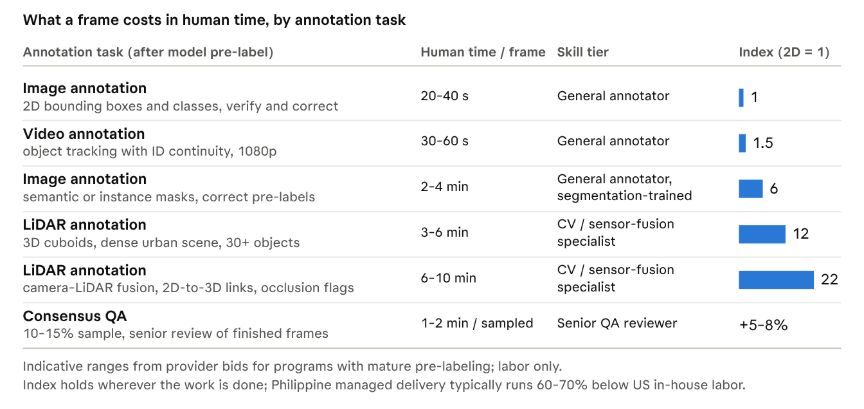
Table 1. What a frame costs in human time: effort, skill tier, and relative cost by annotation task once a model has pre-labeled the frame
"Robotics teams arrive with a modality mix and a frame count, not a vendor list. Of the hundred-plus providers we track in the Philippines, about a dozen can run LiDAR annotation at scale, and the gap between the best of those and the median is wider than the gap between the Philippines and the United States. Sourcing is where the saving is won or lost," states Ralf Ellspermann, CSO of PITON-Global.
Five hundred seats is an engineering problem, not a hiring one
Programs that cross a few hundred seats stop talking about vendors and start talking about capacity. The arithmetic: 500 seats at roughly 6.5 productive hours a day over 21 working days yields about 68,000 labeled hours a month, on a LiDAR-heavy mix on the order of two million reviewed frames, enough to feed the retraining cycle of a mid-sized autonomous trucking or sidewalk-delivery fleet.
The managed-provider operations that make that number reliable share a shape (Figure 2). They split across two cities, usually Metro Manila and Cebu, so a typhoon or a grid fault in one does not stall a model release in the other. They hire in cohorts of 25 to 50 and organize them into pods of 21 annotators, three senior QA reviewers, and one lead, with the pod, not the individual, owning throughput and accuracy. They work inside the customer's tooling through single sign-on, so frames never leave the buyer's cloud. And they layer quality: every frame touched by an annotator, 10 to 15 percent re-reviewed by consensus QA, a 2 percent gold set the customer seeds and scores, and a monthly audit the customer runs itself.
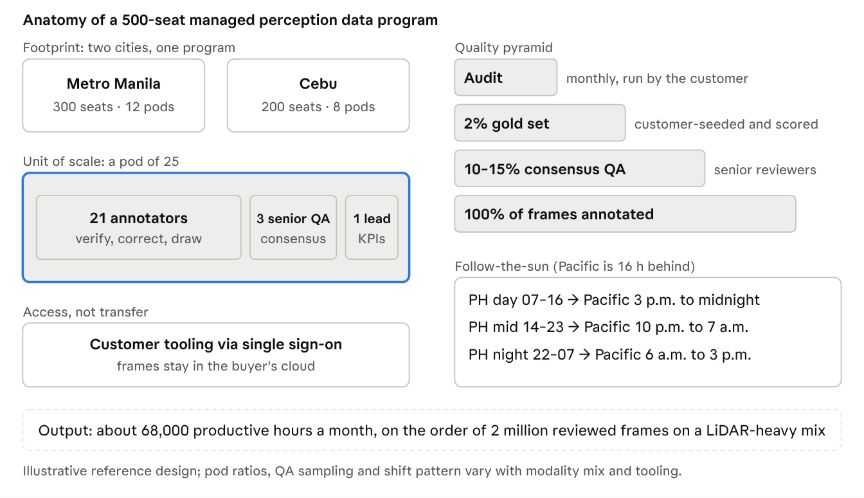
Figure 2. Anatomy of a 500-seat managed perception data program: two cities, pods of 25, access to the buyer's tooling rather than copies of its data, a four-layer quality pyramid and three shifts that cover every Pacific working hour.
Ramp is the number buyers underestimate. A LiDAR annotation cohort reaches guideline-level accuracy on 3D cuboids in four to six weeks; image annotation and video annotation cohorts get there in two to three. Mature programs hire a cohort ahead of demand, never behind it.
The safety case wants receipts
Perception data for a vehicle or a warehouse robot is evidence as much as training fuel, and three documents now shape what that evidence must look like. ISO 21448, the standard for Safety of the Intended Functionality, asks developers to hunt for unknown unsafe scenarios, in practice data that covers the long tail of weather, lighting and occlusion. ANSI/UL 4600 takes a claim-based safety-case approach and lists validation of machine-learning functionality and data integrity among the topics a case must address. And ISO/PAS 8800, published in December 2024, is the first ISO document to set out safety properties for AI elements in road vehicles, including the output insufficiencies and systematic errors that bad labels create.
Regulators have added a date. The EU's digital omnibus, approved by the European Parliament on June 16, 2026, fixes August 2, 2028 as the day high-risk obligations, data governance, and record-keeping among them, apply to AI embedded in regulated products.
What all of this asks of an offshore annotation floor is traceability: who labeled a frame, under which guideline version, who reviewed it, and which scenario tags it carries (Table 2). Programs that collect those records from the first frame find the safety case largely writes itself; the rest end up labeling twice.
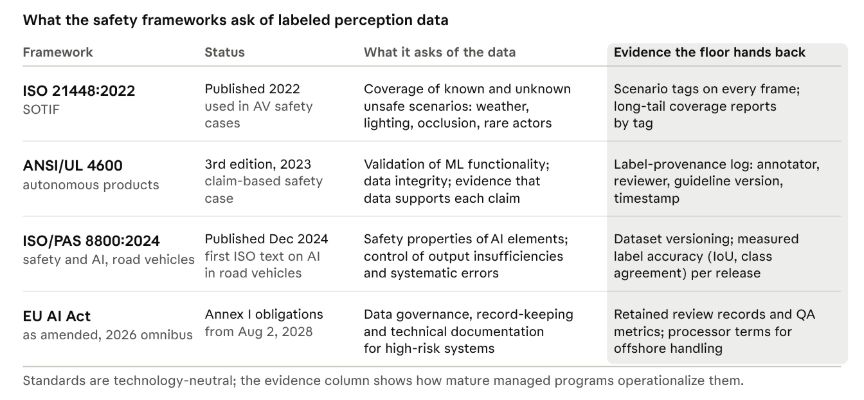
Table 2. What the safety frameworks ask of labeled perception data, and what an offshore floor must hand back
What could still go wrong
None of this is frictionless. Rates drift upward at each renewal as the specialist pool tightens. Year-one attrition on night shifts climbs when a floor treats annotators as interchangeable. The June-to-November typhoon season is a live operational variable. And buyers who concentrate 500 seats in one building with one provider are taking a risk they would never take with their compute.
"Every robotics program we have helped scale past 250 seats runs on the same three rules," explains Maczynski. "No provider holds more than 50 percent of the seats, no provider runs from a single city, and the rate card is fixed for the first 24 months with escalation tied to a published index. Buyers who skip those rules discover them in year two, at the renewal table or in typhoon season."
The deeper question is whether the work itself persists. Simulation and synthetic data are improving fast, yet Deloitte's 2026 technology outlook still describes a persistent gap between simulated and real-world performance, and every real mile a fleet drives produces frames nobody has labeled yet. The job is changing shape, toward curation, verification, and edge-case adjudication, faster than it is shrinking.
The quiet advantage
Deloitte expects physical AI to move from niche to mainstream within 18 to 24 months; UBS, cited in the same report, projects two million humanoid robots in workplaces by 2035. Each of those machines will need to see, and each will see badly until a person has told it what it was looking at. That makes image annotation, video annotation, and LiDAR annotation for robotics a growth market with a long runway, whatever the next generation of auto-labeling takes off the top.
The bet the Philippines has quietly won is not that labeling is cheap there, though it is. It is that the country already has the recruiters, trainers, English, time zone, and secured delivery centers to run perception data at fleet scale through managed providers, and that buyers who treat computer vision outsourcing to the Philippines as engineering rather than procurement end up with a floor that keeps pace with their models.
"Nobody fails a safety audit because annotation was expensive," Maczynski concludes. "They fail because nobody can show who labeled the frame, under which guideline, and who checked it. The Philippine floors that win the big programs are the ones built to answer that question from the first frame."
Related posts