W. Grey Walter: Early Robotics and the Tortoise Robots
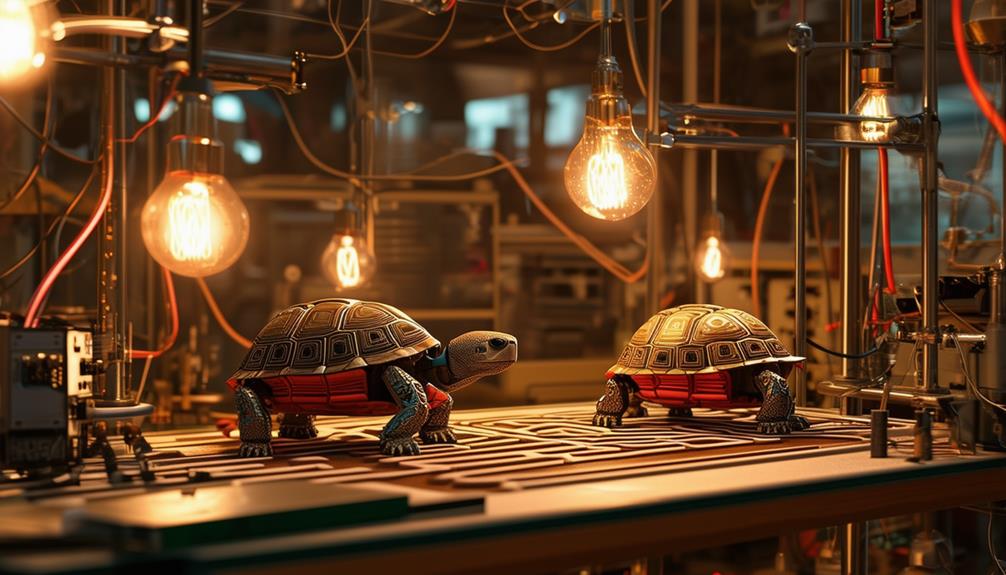
Exploring the groundbreaking contributions of W. Grey Walter in early robotics reveals the fascinating world of the tortoise robots, Elmer and Elsie. These small, autonomous machines were not mere novelties; they exemplified the advanced cybernetic principles of their era. By employing feedback mechanisms, Walter enabled these robots to display behaviors that appeared almost lifelike. Imagine a machine capable of navigating its environment and responding to stimuli in real-time—Walter accomplished this many decades ago. Interested in how these early innovations have shaped modern robotics and artificial intelligence? Delving deeper into his pioneering work offers substantial insights.
Early Life and Education

William Grey Walter was born in 1910 in Kansas City, Missouri. He received his early education at Westminster School and later attended Kings College, Cambridge. His fascination with the human brain began in his formative years and deepened during his time at Cambridge, where he studied neurophysiology extensively.
After completing his education, Walter embarked on neurophysiological research in London and Bristol, including at the prestigious Neurological Institute. His work led to significant discoveries in brain wave types, such as alpha and delta waves. Walter's dedication to understanding the brain was evident early on, and his contributions were pioneering.
Walter studied under the renowned Ivan Pavlov, which profoundly influenced his approach to brain research. He also developed electroencephalogram (EEG) machines, which became essential tools for non-invasive monitoring of brain activity, marking a significant advancement in the field. Walter's early life and education provided a strong foundation for his later innovations in neurophysiology and robotics. His work continues to influence advancements in artificial intelligence and robotics today.
Introduction to Cybernetics
Let's delve into the foundations of cybernetic theory and its pioneers. Norbert Wiener coined the term "cybernetics" in 1948, marking a significant milestone in the study of systems, control, and communication in animals and machines. Early innovations, such as W. Grey Walter's robotic tortoises, exemplified the practical application of these principles. Understanding these concepts reveals the profound impact cybernetics has had on the development of robotics and artificial intelligence.
Foundations of Cybernetic Theory
Norbert Wiener's seminal work in cybernetics laid the groundwork for the study of systems, communication, and control in both living and artificial entities. Grey Walter's contributions to cybernetic theory were instrumental in demonstrating the application of feedback mechanisms to biological and artificial systems alike. By investigating these self-regulating systems, Walter bridged the gap between biology and technology, setting the stage for modern robotics and artificial intelligence.
Walter's cybernetic tortoises were an early, practical demonstration of these principles. These robots illustrated how simple feedback loops could produce complex behaviors, proving that machines could emulate certain aspects of living organisms. The tortoises were not just an engineering achievement but also a philosophical statement on the potential of cybernetics.
The following comparison highlights key aspects of Walter's contributions and cybernetic theory:
| Aspect | Grey Walter's Contributions | Cybernetic Theory |
|---|---|---|
| Focus | Biological and Artificial | Systems, Communication, Control |
| Key Innovation | Cybernetic Tortoises | Feedback Mechanisms |
| Impact | Early Robotics, AI | Interdisciplinary Research |
Understanding these foundations enhances your appreciation of Walter's work, which continues to influence contemporary robotics and AI research. His pioneering efforts blurred the lines between living systems and machines, opening new avenues for technological advancement.
Pioneers and Early Innovations
Building on the foundational work in cybernetics, early pioneers like W. Grey Walter propelled the field forward by creating pioneering machines that demonstrated autonomous behaviors. Walter's electro-mechanical creations, named Elmer and Elsie, were among the first robots to showcase basic autonomous behaviors such as seeking light and avoiding obstacles. These tortoise robots were groundbreaking, illustrating how feedback mechanisms could mimic simple forms of animal behavior.
Walter's work explored the relationship between machines and living organisms, investigating how both could be governed by similar principles. By implementing feedback loops, Elmer and Elsie could react to their environment in real-time, a concept that was revolutionary at the time. These early robots didn't just perform pre-programmed tasks; they interacted dynamically with their surroundings, laying the groundwork for future innovations in robotics and artificial intelligence.
The impact of Walter's innovations extends far beyond his lifetime. His investigation of self-regulating systems and interdisciplinary research in cybernetics continues to influence modern robotics and AI. Today, researchers still reference Walter's pioneering work, acknowledging his contributions to the evolution of autonomous machines and the broader field of cybernetics.
Concept of Machina Speculatrix
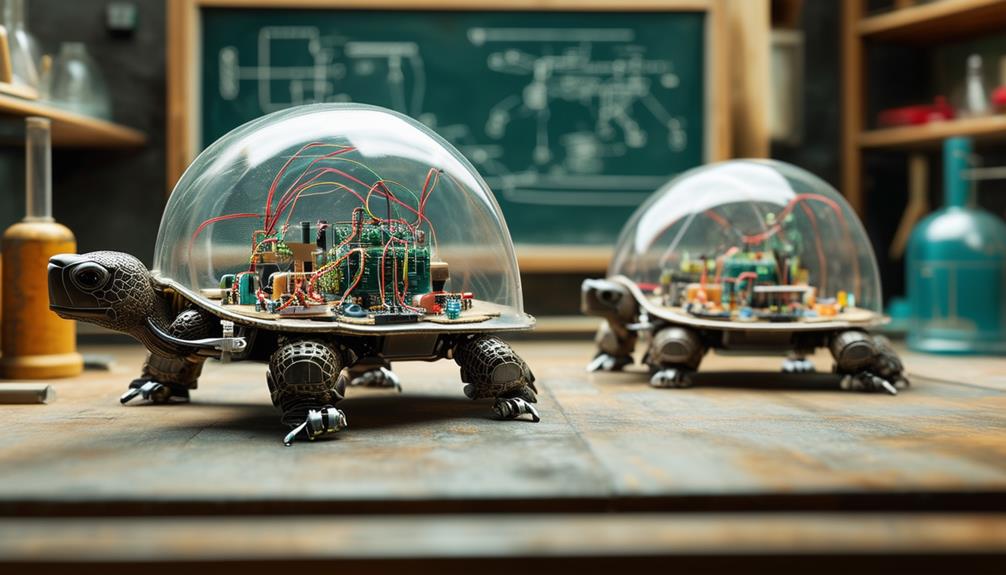
Exploring the concept of Machina Speculatrix reveals its pioneering role in autonomous behavior and sensory-motor coordination. These early robots, equipped with photocells and contact switches, navigated their environment by exhibiting phototropism and photophobia. By responding to light and avoiding obstacles, they demonstrated the core principles of autonomous exploration, laying the groundwork for future advancements in robotics.
Autonomous Behavior Exploration
Grey Walter's pioneering design of Machina Speculatrix robots in the 1940s paved the way for the study of autonomous behavior in robotics. These early robots, known as 'tortoises' due to their shape and movement, were groundbreaking in their ability to exhibit behaviors such as phototropism (moving towards light) and photophobia (avoiding light).
Utilizing vacuum tubes and sensors, Walter's robots could navigate their environment, actively survey a room, detect light sources, and avoid obstacles. This was achieved through simple circuitry that enabled the robots to react to stimuli, allowing them to move in a purposeful and seemingly intelligent manner.
The significance of Walter's work lies not just in the robots themselves, but in the principles they demonstrated. These early robots showcased the potential for machines to operate independently, responding dynamically to their surroundings. This concept of autonomous behavior was revolutionary at the time and laid the foundation for future advancements in behavior-based robotics and artificial intelligence.
Sensory-Motor Coordination
The sensory-motor coordination in Machina Speculatrix robots enabled them to autonomously explore their environment by reacting to stimuli. These early robots were equipped with sensors such as photocells and contact switches, which allowed them to detect light and avoid obstacles. This sensory capability facilitated behaviors like phototropism, where robots moved towards light sources, and photophobia, where they steered clear of obstacles.
The integration of sensory inputs and motor responses was crucial for effective navigation. The robots managed this through:
- Photocells: These sensors detected light intensity, guiding the robots to move towards or away from light sources.
- Contact Switches: These switches detected obstacles, helping the robots avoid collisions.
- Vacuum Tubes: Functioning like interconnected neurons, these components processed sensory information and coordinated motor actions.
This sensory-motor coordination was noteworthy for its era, demonstrating basic animal-like behaviors through simple electronic circuits. It paved the way for future advancements in robotics. By combining sensors and motors effectively, the Machina Speculatrix robots laid the foundation for modern autonomous systems, illustrating that even basic sensory-motor integration can produce complex and adaptive behaviors.
Development of Tortoise Robots
Have you ever wondered how the early development of tortoise robots by William Grey Walter in the late 1940s paved the way for modern autonomous robotics? Grey's pioneering work with his tortoise robots, Elmer and Elsie, was groundbreaking. These early autonomous robots were equipped with light sensors and simple 'brains' made of vacuum tubes, allowing them to exhibit behaviors like seeking light and avoiding obstacles.
Elmer and Elsie weren't just simple machines; they demonstrated emergent behaviors such as phototropism (moving towards light) and photophobia (moving away from light). These behaviors showcased a level of robotic autonomy that was revolutionary for its time. Walter's tortoise robots were a significant part of his cybernetics research, which aimed to investigate the relationship between machines and living organisms.
Behavioral Experiments
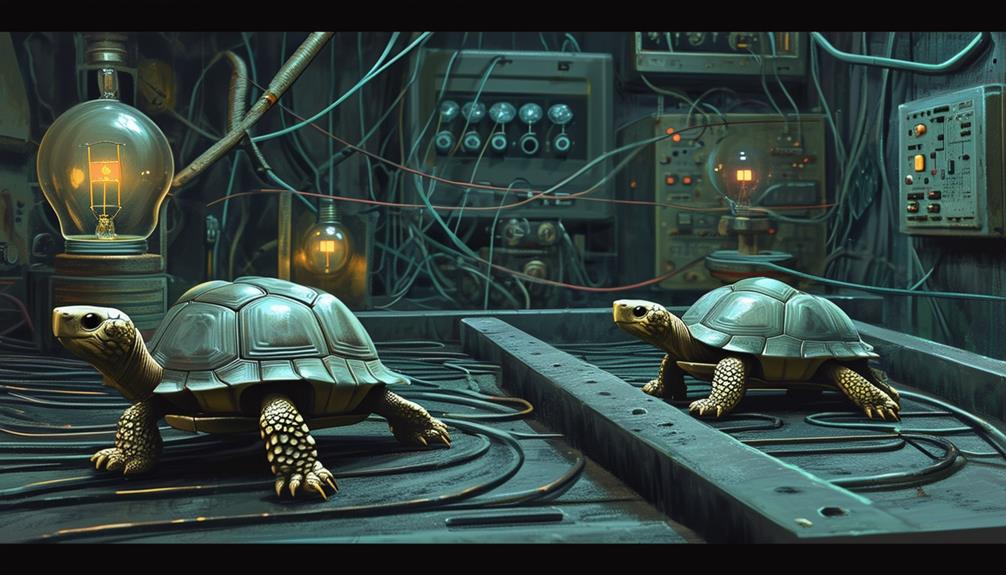
In his behavioral experiments, Grey Walter demonstrated how simple circuits could simulate basic animal behaviors in his tortoise robots. These robots could seek out light sources, avoid obstacles, and exhibit emergent behaviors, all through straightforward circuit designs. These experiments were groundbreaking, illustrating that even without memory, machines could react and adapt to their environment in real time.
Key behaviors displayed by Walter's tortoise robots included:
- Light-seeking: The robots moved towards light sources, resembling the behavior of certain animals attracted to light.
- Obstacle avoidance: Upon encountering an obstacle, the robots changed direction, demonstrating a basic form of problem-solving.
- Emergent behaviors: Through simple interactions between their sensors and motors, the robots exhibited complex behaviors that appeared purposeful and intelligent.
Walter's work laid the foundation for modern robotics by proving that complex, adaptive behaviors could emerge from simple, neural-like circuitry. His tortoise robots didn't just react to their environment; they interacted with it in lifelike ways. This pioneering approach continues to influence the design and function of autonomous robots today.
Impact on Robotics
Following Grey Walter's pioneering work, modern robotics has embraced behavior-based design principles to develop more adaptive and intelligent autonomous systems. Walter's tortoise robots, created at the Neurological Institute in Bristol, demonstrated how simple designs and behavioral principles could result in complex, lifelike actions. These early robots exhibited emergent behaviors by responding to environmental stimuli, a concept that has significantly influenced contemporary robotics.
Walter's experiments with his tortoises laid the foundation for behavior-based robotics, where robots operate based on real-time interactions rather than pre-programmed instructions. This paradigm shift has led to the creation of versatile and intelligent machines capable of adapting to unpredictable environments. The 'Living Brain' concept, which Walter explored through his work, highlighted the importance of simple neural circuits in generating complex behaviors. This idea remains central to modern autonomous systems.
Current robotics research continues to build on Walter's insights, aiming to create machines that can adjust and learn from their surroundings. His legacy lives on in the fields of robotics and artificial intelligence, inspiring innovations designed to emulate the adaptive and responsive nature of biological organisms. Walter's contributions have fundamentally transformed how we approach and design autonomous systems today.
Public Demonstrations
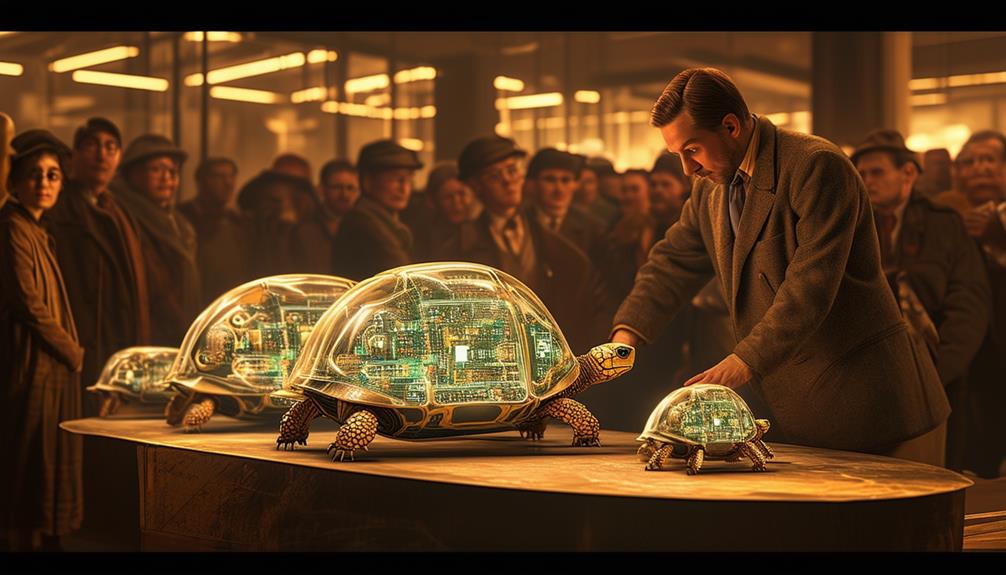
Walter's tortoise robots, Elmer and Elsie, made a significant public impact when they were showcased at the 1951 Festival of Britain. This event allowed the general public to witness firsthand the groundbreaking work of W. Grey Walter. The tortoises captivated audiences with their ability to exhibit behaviors such as phototropism (moving toward light sources) and photophobia (avoiding bright light). These demonstrations were more than just pioneering achievements; they provided early glimpses into the potential of autonomous machines.
During the Festival of Britain, the tortoises sparked excitement and curiosity among visitors. Their seemingly animal-like behaviors fascinated onlookers and made complex concepts in cybernetics more accessible. Here's what made their public demonstrations truly remarkable:
- Autonomous Movement: The tortoises moved independently without human intervention, showcasing early examples of machine autonomy.
- Environmental Interaction: They responded to light sources in their environment, demonstrating a rudimentary form of environmental awareness.
- Engaging Behaviors: Their phototropic and photophobic actions provided an entertaining yet educational display of robotic capabilities.
Walter's pioneering approach highlighted the potential for robots to interact with their surroundings in ways that mimicked life, making a lasting impression on everyone who saw Elmer and Elsie in action.
Legacy and Influence
How did W. Grey Walter's tortoise robots, Elmer and Elsie, leave a lasting mark on the fields of robotics and artificial intelligence? Walter and his tortoises demonstrated that simple mechanical systems could exhibit complex, adaptive behaviors. By employing principles akin to a conditioned reflex, these early robots responded to stimuli in ways that mimicked basic animal reactions. This groundbreaking work laid the foundation for behavior-based robotics, emphasizing the importance of adaptive and autonomous systems in the field.
Walter's contributions extend beyond theoretical advancements; his tortoise robots have become iconic symbols of early autonomous machines. Displayed in museums like the Science Museum in London, Elmer and Elsie continue to educate and inspire new generations of roboticists. The ability of these robots to showcase emergent behaviors has had a profound impact, pushing the boundaries of what is possible in robotics and artificial intelligence.
Moreover, Walter's work in cybernetics and artificial intelligence has left an indelible mark on both fields. His pioneering efforts have profoundly shaped contemporary understandings of robotics and neuroscience, ensuring that his influence endures. Walter and his tortoises have indeed set the stage for future innovations, creating a lasting legacy.
Modern Reflections
Have you ever considered how the pioneering work of W. Grey Walter's tortoise robots continues to shape today's advancements in robotics and artificial intelligence? Walter's creations, Elmer and Elsie, are not merely historical artifacts but foundational pillars in the fields of cybernetics and robotics. These early autonomous machines displayed behaviors similar to living creatures, igniting a wave of innovation that endures today.
Modern researchers still draw inspiration from Walter's work when developing adaptive and autonomous systems. The principles behind Elmer's design are mirrored in contemporary AI and robotics, emphasizing behavior-based models over rigid programming. This approach has driven significant advancements in creating robots capable of learning and adapting to their environments.
To appreciate Walter's lasting impact, consider these three modern reflections:
- Behavior-Based Robotics: Walter's tortoises laid the groundwork for robots that operate based on simple behavioral rules, influencing modern autonomous systems.
- Adaptive Systems: His work demonstrated that machines could adapt to their surroundings, a core principle in current AI research.
- Educational Legacy: Institutions like the Science Museum showcase these pioneering robots, inspiring new generations of engineers and scientists.
Walter's legacy is a testament to the enduring relevance of his groundbreaking work.
Conclusion
Grey Walter's pioneering work with the tortoise robots laid the foundation for modern robotics. By harnessing cybernetic principles and creating adaptive, autonomous machines, he blurred the lines between artificial and living systems. His influence is still felt today, shaping the future of robotics and artificial intelligence. Reflecting on Walter's legacy, one can appreciate the profound impact his innovations continue to have on technology and our understanding of intelligent behavior.