The Role of Robotics in Space Exploration: Mars Missions and Beyond
Robotics has been transformative in space exploration, particularly in Mars missions and beyond. From the Viking landers to the advanced Perseverance rover, robots have significantly enhanced our understanding of Mars and paved the way for future missions. Autonomous systems could one day build habitats on distant moons or mine asteroids for essential resources. Interested in the key breakthroughs and challenges in this field? Let's explore further.
History of Robotics in Space
History of Robotics in Space
Starting with the Viking landers in the 1970s, robotic technology has significantly enhanced our ability to explore space. The Viking landers were the first robots to successfully land on Mars, providing critical data on the Martian atmosphere and surface. These early missions laid the groundwork for future explorations and advanced technology.
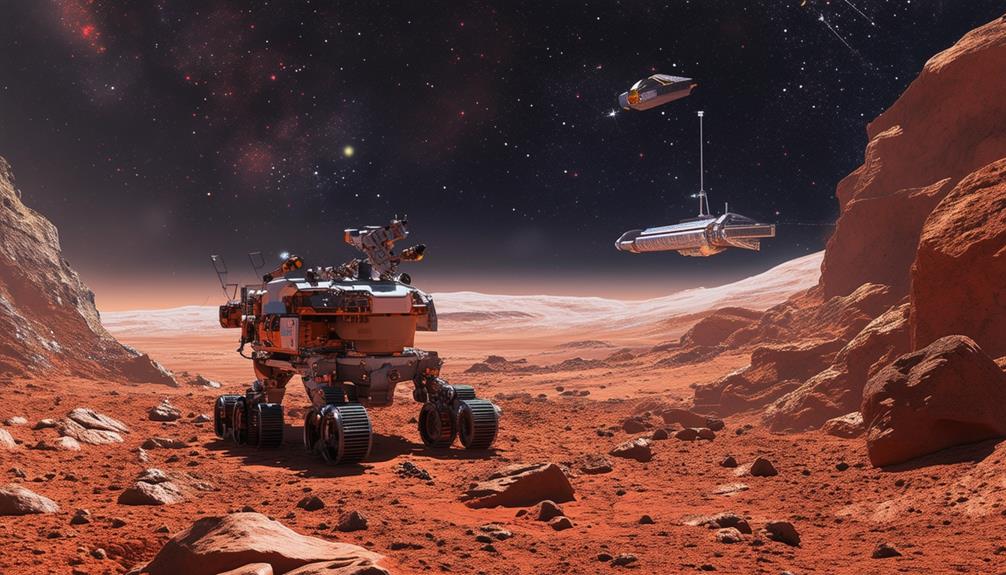
Fast forward to the 1990s, and the Sojourner rover emerged as a pioneering mobile explorer on Mars. Sojourner's success marked a monumental advancement, setting the stage for more sophisticated rovers like Curiosity and Perseverance. These advanced rovers have revolutionized our understanding of the Red Planet, examining its geology and searching for signs of past life.
Robotic orbiters, such as the Mars Reconnaissance Orbiter, have also been instrumental. They have provided invaluable data, enabling scientists to study Mars from above and plan future missions with greater precision. Continuous advancements in robotic technology have significantly broadened our knowledge of Mars and other celestial bodies. These robots are the unsung heroes, making it possible to investigate the cosmos without human presence on site.
Mars Rovers: Achievements
Investigating the accomplishments of Mars rovers reveals remarkable milestones such as uncovering evidence of water, analyzing Martian soil, and capturing stunning surface images. These robotic explorers have revolutionized our understanding of Mars by unveiling its ancient secrets. They continue to provide invaluable data, pushing the boundaries of space exploration and enhancing our knowledge of the Red Planet.
Discovering Water Evidence
By analyzing geological samples, Mars rovers like Curiosity and Perseverance have uncovered compelling evidence of ancient water on the Red Planet. These missions have revolutionized our understanding of Mars through robotic investigation. The role of these robots has been pivotal, providing scientific data that reveals a history of water presence.
For instance, the Perseverance rover has detected hydrated minerals and sedimentary layers, suggesting Mars once had dynamic water systems, including riverbeds and lake deposits. The evidence gathered by these rovers helps scientists piece together the planet's watery past. The rocks and soil samples collected show signs of mineral formations that could only occur in the presence of water.
The search for water is a critical objective for these missions. By understanding Mars' geological evolution through these robotic explorers, we gain insights not only into Mars' history but also into its potential for sustaining life. These findings are crucial milestones in space exploration.
Analyzing Martian Soil
Mars rovers like Curiosity and Perseverance have meticulously examined Martian soil, revealing its intricate composition and offering clues about the planet's past. Utilizing advanced instruments such as X-ray diffraction and spectrometers, these rovers have provided invaluable insights into the mineralogy and chemistry of Martian soil. This detailed analysis has uncovered clay minerals and sulfates, strong indicators of ancient water presence on Mars.
These findings hold profound implications for understanding Mars' history and its potential to support past life. The detection of organic molecules in Martian soil suggests the possibility of past habitable environments, prompting us to wonder about the ancient conditions that might have allowed microbial life to thrive on Mars.
Here's why these discoveries are significant:
- Water Evidence: The presence of water on Mars opens up the thrilling possibility of ancient life.
- Organic Molecules: Discovering organic molecules raises excitement about Mars' potential to have supported life.
- Geological History: Understanding Mars' geological history connects us to the planet, sparking our curiosity and imagination.
The work of these Mars rovers in scrutinizing Martian soil is a monumental step towards unraveling the mysteries of our neighboring planet.
Capturing Surface Images
Equipped with advanced imaging systems, Curiosity and Perseverance have captured over 500,000 images, revealing Mars' diverse landscapes in unprecedented detail. These Mars rovers act as your eyes on the Martian surface, providing stunning images essential for scientific discoveries.
Perseverance's Mastcam-Z system, with its high-resolution 3D capabilities, allows for detailed examination of geological formations. These images have uncovered ancient riverbeds, sedimentary rocks, and mineral deposits, offering critical insights into Mars' past environments. Each snapshot is not just a view of the Martian surface; it's a window into Martian geology, history, and climate.
Through robotic exploration, these rovers transmit breathtaking panoramas and close-up shots, enabling detailed geological analysis from Earth. You can study sediment layers in ancient riverbeds to understand water's historical role on Mars or analyze mineral deposits to assess the planet's potential for past life.
Robotic Landers and Orbiters
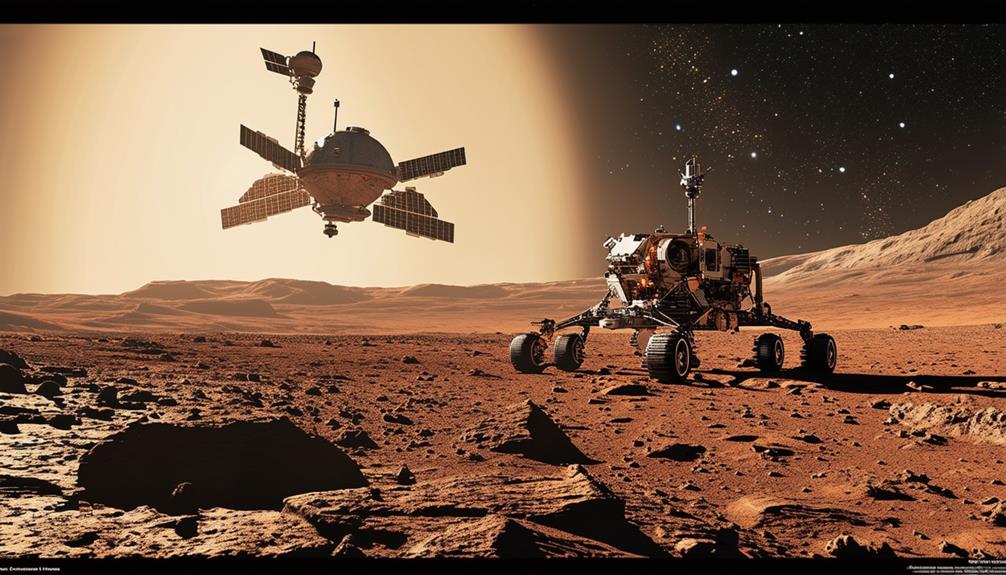
Robotic landers and orbiters revolutionize space exploration through advanced landing technologies and sophisticated orbital data collection. These innovations enable precise landings and comprehensive analysis of planetary atmospheres and surfaces. Equipped with autonomous navigation systems, these robotic explorers operate independently, significantly expanding our ability to uncover new information about the cosmos.
Advanced Landing Technologies
Robotic landers and orbiters employ advanced landing technologies to enhance our exploration of Mars. These technologies allow for precise targeting of landing sites, enabling missions like NASA's InSight to gather valuable scientific data effectively. By identifying safe landing locations, we have revolutionized Mars exploration, uncovering critical information about the planet's composition and evolution. This advancement is vital not only for current missions but also for scouting future manned mission sites.
Consider the following advancements:
- Advanced landing technologies facilitate safe landings on Mars' complex terrain, unlocking new exploration opportunities.
- Robotic landers provide groundbreaking insights into Mars' geological and seismic activity, enriching our understanding of the planet's history.
- Each successful landing advances our goal of sending humans to Mars, making interplanetary travel a tangible reality.
These innovations are not only expanding our knowledge but also preparing us for future milestones in space exploration. By perfecting these technologies, we are setting the stage for humanity's next giant leap on the Red Planet.
Orbital Data Collection
Robotic landers and orbiters collect extensive data from celestial bodies, significantly enhancing our understanding of planetary systems. A prime example is the Mars Reconnaissance Orbiter (MRO), which captures high-resolution images and analyzes the Martian atmosphere. This kind of orbital data collection helps us understand Mars' geological features and climate, shedding light on planetary evolution and cosmic processes.
Robotic landers, like NASA's InSight probe, explore Mars' interior, providing vital insights into its composition. These landers analyze soil and rock formations, transforming our knowledge of nearby planets and comets. Similarly, the Lunar Reconnaissance Orbiter (LRO) collects invaluable data about the Moon's surface, aiding in our understanding of its history and formation.
Here are some key missions and their contributions:
| Mission | Key Contributions |
|---|---|
| Mars Reconnaissance Orbiter | High-resolution imaging, atmospheric analysis |
| InSight | Probing Mars' interior, soil and rock analysis |
| Lunar Reconnaissance Orbiter | Detailed mapping of the Moon's surface, lunar evolution |
The data from these missions enhances our understanding of celestial bodies, providing critical insights into planetary systems. By leveraging the capabilities of robotic orbiters and landers, we gain a comprehensive view of planetary evolution and cosmic processes, pushing the boundaries of space exploration.
Autonomous Navigation Systems
Autonomous navigation systems are transforming space exploration by enabling robotic landers and orbiters to independently survey and analyze extraterrestrial environments. These systems empower spacecraft like NASA's Mars Reconnaissance Orbiter to capture high-resolution images of celestial bodies, offering detailed views of geological formations. They also facilitate missions such as NASA's InSight lander, which uses advanced instruments to study Mars' geological activity.
The impact of autonomous navigation systems is profound:
- Detailed Planetary Maps: High-resolution images from robotic orbiters provide intricate details of celestial bodies.
- Groundbreaking Insights: These systems offer new understandings of planetary evolution and cosmic processes.
- Independent Exploration: Robots conduct surveys and analyses without direct human intervention, expanding the frontiers of space exploration.
Robotic orbiters like the Lunar Reconnaissance Orbiter significantly enhance our understanding of the Moon by analyzing its atmospheric composition and geological formations. These autonomous systems contribute to our knowledge of planetary evolution and cosmic processes. Space exploration has entered a new era where robots, equipped with autonomous navigation systems, uncover the mysteries of our solar system and beyond, reshaping our comprehension of the universe.
Robotics on the ISS
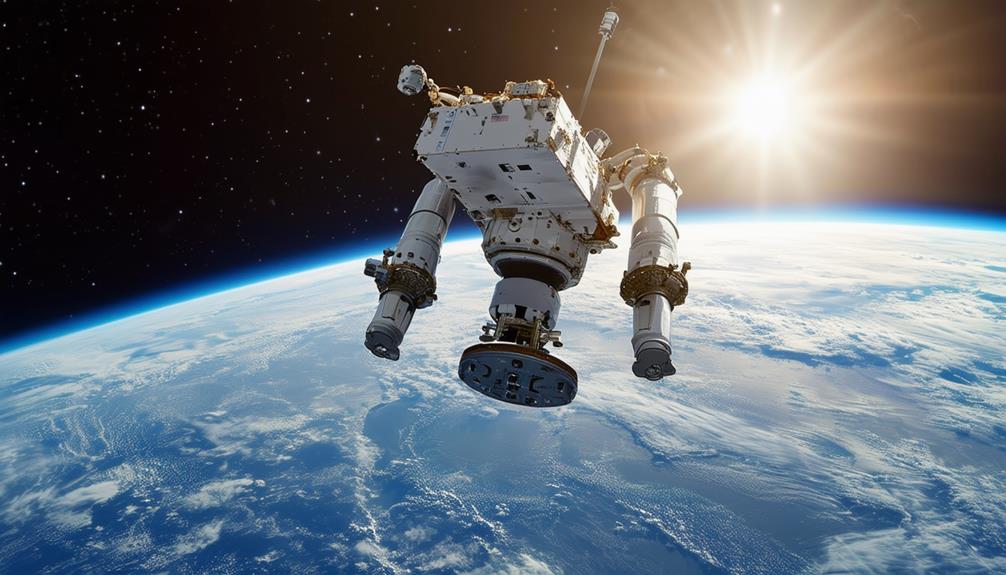
On the International Space Station (ISS), advanced robotic systems such as Canadarm2 and Dextre are crucial for maintaining and repairing the station. These robotic arms are essential for capturing visiting spacecraft, moving payloads, and conducting scientific experiments in space. In the unique microgravity environment of the ISS, these robotics systems are indispensable for performing tasks that would be challenging or impossible for astronauts alone.
Canadarm2, a sophisticated robotic arm, can handle large payloads and assist in the station's maintenance and repair. Dextre, a more precise robotic tool, excels in smaller, intricate tasks, enhancing the efficiency of operations on the ISS. Together, they ensure the station remains operational and safe for its crew.
Additionally, the ISS employs Astrobees—small, free-flying robots designed to support technology demonstrations and assist astronauts with various tasks. These robots can monitor equipment, perform experiments, and help with daily operations, thereby making life on the station more manageable.
Future Robotic Missions
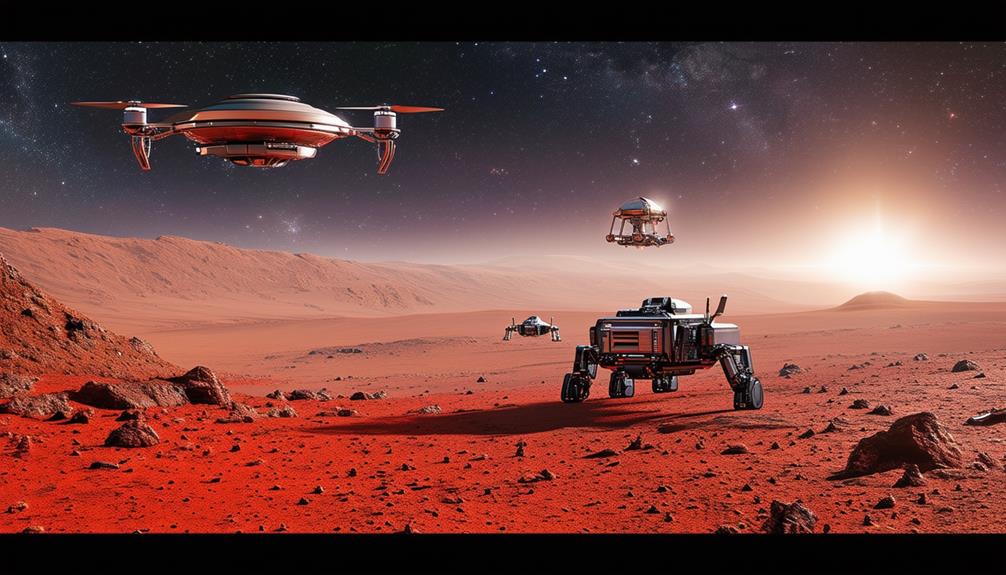
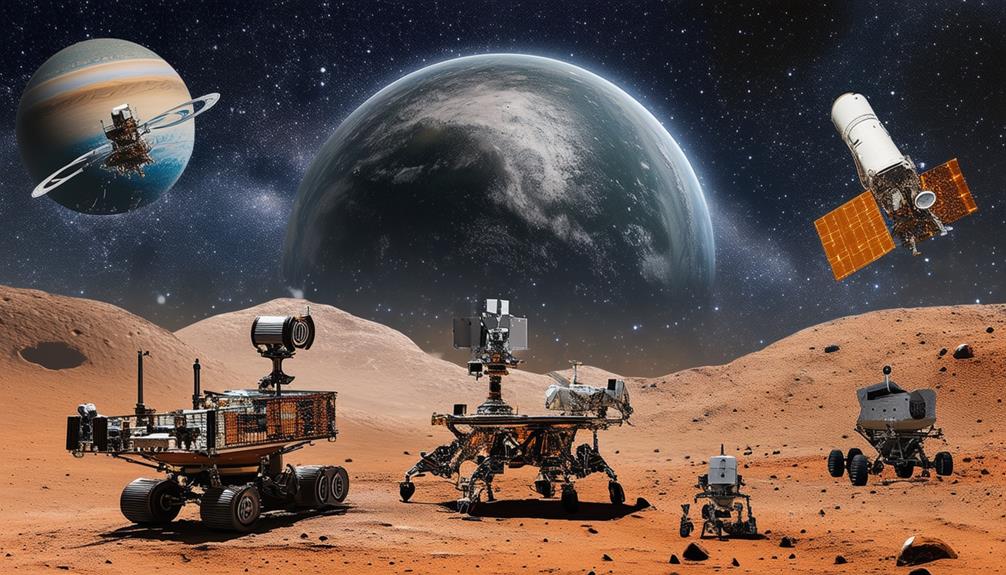
Future robotic missions will push the boundaries of space exploration by targeting distant moons, asteroids, and planets beyond Mars. These missions will rely heavily on advanced space robots with high levels of autonomy and adaptability, essential for tackling the unpredictable conditions on different celestial bodies.
You will witness robots constructing habitats, extracting resources, and gathering critical data to facilitate potential human settlements. Robots will autonomously build initial shelters on distant moons and mine asteroids for valuable materials. This is not science fiction—it's the future of space exploration.
Consider the emotional impact of these advancements:
- Constructing Habitats: Visualize robots creating the primary livable shelters on alien worlds, offering humanity a new home.
- Extracting Resources: Picture robots mining asteroids to provide necessary materials for sustaining human life and missions.
- Data Gathering: Envision the wealth of knowledge robots will collect, helping us understand and eventually inhabit other celestial bodies.
These future missions and their space robots will be the trailblazers of interplanetary exploration, bringing the cosmos closer to us than ever before. Embrace this incredible adventure into the unknown!
Challenges and Innovations
Designing robots for space exploration entails overcoming significant challenges and fostering groundbreaking innovations. Robotic explorers must endure the harsh Martian conditions, requiring advanced solutions like thermal insulation and dust mitigation systems to protect sensitive equipment. Communication delays, which can be up to 24 minutes one way, necessitate optimizing data transmission rates and developing robust autonomy for independent decision-making.
Power limitations present another critical hurdle. Ensuring that robotic explorers can function effectively over long periods demands the use of solar panels, efficient energy storage systems, and power-saving operational strategies. Advanced AI algorithms are indispensable, enhancing robots' adaptability and autonomy in navigating the challenging Martian terrain.
Additionally, extreme radiation levels on Mars require the development of resilient robotic systems capable of withstanding such harsh conditions. Focusing on these challenges enables the creation of robotic explorers that can not only survive but also thrive in Mars' unforgiving environment. Addressing these issues advances reliable and efficient space exploration, pushing the boundaries of what is achievable.
Conclusion
Robotics have revolutionized space exploration, from early Mars rovers uncovering geological secrets to advanced systems on the ISS. Future missions promise even more groundbreaking achievements, such as constructing habitats on distant moons and mining asteroids. Despite challenges, innovations in autonomous navigation and technology continually push boundaries. Embrace this age of robotic exploration—it's bringing us closer to unraveling the universe's deepest mysteries. The cosmos is calling, and robots are leading the way.