The Role of NASA in Advancing AI During the Space Race During the 1960S
Picture the 1960s, a time when NASA was not just racing to the moon but also pioneering advancements in artificial intelligence. How did AI fit into those legendary moon missions? It wasn't just about rockets and astronauts; it was also about sophisticated algorithms and groundbreaking technology. The Apollo Guidance Computer (AGC) played a crucial role, not only in guiding spacecraft but also in laying the groundwork for modern AI. These early developments in computational technology and algorithms significantly influenced future innovations in machine learning and robotics. Let's explore the key milestones that established NASA as a leader in AI during this iconic era.
Early AI Developments

In the 1960s, NASA's early AI efforts were centered on optimizing spacecraft trajectories and control systems, aiming to solve complex space-related problems. Systems like the General Problem Solver were employed to streamline data analysis and enhance mission planning for manned space flights. These innovations allowed NASA to automate decision processes, significantly improving both efficiency and accuracy in their operations.
By integrating AI algorithms, NASA transformed its approach to mission planning, with automated decision-making processes becoming crucial for the success of space missions. The ability to rapidly analyze vast amounts of data and make informed decisions was a game-changer. This period laid the groundwork for future advancements in machine learning and robotics.
These early AI applications at NASA were not only about addressing immediate challenges but also about setting the stage for long-term technological progress. The innovations from this era solved pressing issues and paved the way for the sophisticated AI systems in use today. NASA's commitment to AI in those formative years undeniably shaped the future of space exploration.
Spacecraft Control Systems
Building on early AI developments, NASA's creation of the Apollo Guidance Computer (AGC) revolutionized spacecraft control systems with its advanced capabilities and groundbreaking design. The AGC, developed with only 64KB of memory, was a marvel of engineering for its time. It used integrated circuits, a cutting-edge technology, to manage the vital tasks of navigation, guidance, and control during the Apollo missions.
Thanks to the AGC, astronauts could perform precise maneuvers necessary for lunar landings and safe returns to Earth. This level of precision was unprecedented and showcased the potential for intelligent systems in space technology. The AGC's inventive design not only solved immediate challenges but also laid the groundwork for future advancements in spacecraft control systems.
The AGC's success influenced the trajectory of AI in space technology, demonstrating how intelligent systems could be integrated into spacecraft to enhance mission performance. It established a strong foundation for the development of more advanced AI and automation in future space exploration.
NASA's pioneering work in the 1960s on spacecraft control systems continues to resonate today, proving how early innovations can have enduring impacts on technological progress and exploration capabilities.
Automating Data Analysis
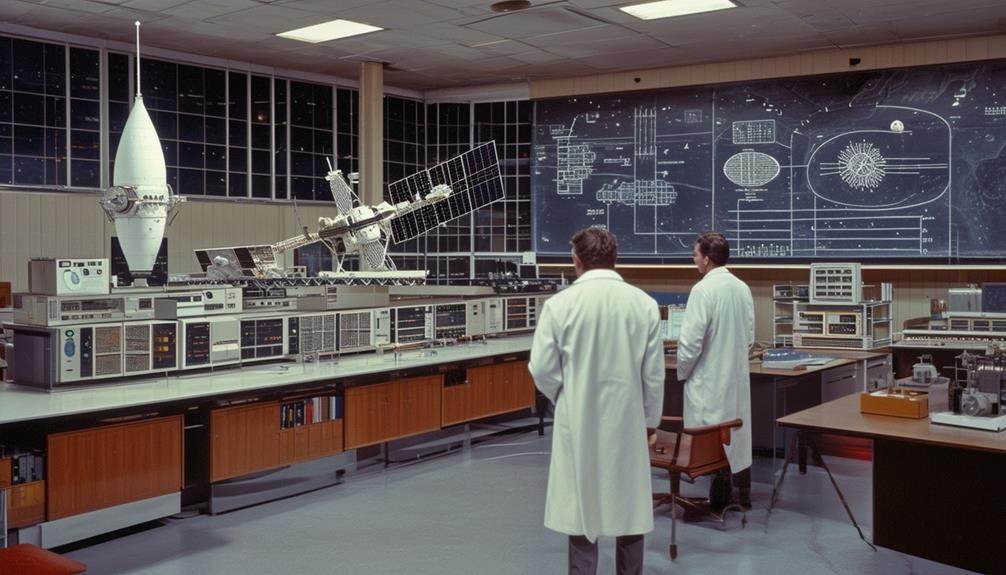
During the 1960s space race, NASA's implementation of AI to automate data analysis revolutionized spacecraft telemetry management. By utilizing AI algorithms, NASA efficiently processed the extensive data generated by space missions. This automation not only expedited the extraction of critical insights but also enhanced accuracy, ensuring mission success.
The sheer volume of data from early space missions required rapid and precise analysis. AI enabled NASA to quickly identify anomalies in spacecraft telemetry, facilitating real-time decisions crucial for mission safety and success. The technology didn't just speed up the process; it also improved the accuracy of data analysis, uncovering trends and potential risks that manual methods might have missed.
Automation empowered NASA's engineers to manage the complexities of space operations more effectively. AI systems detected issues before they became critical problems, adding a necessary layer of safety during the competitive space race era. The ability to automate data analysis represented a significant advancement in space technology, illustrating how AI could transform the approach to complex, data-driven tasks.
Enhancing Mission Planning
AI technology played a pivotal role in revolutionizing NASA's mission planning during the 1960s Space Race. By leveraging computer algorithms, NASA could perform complex trajectory calculations and simulations, essential for successful space missions.
Here are four key ways AI improved mission planning:
- Optimizing Mission Parameters: AI systems fine-tuned mission parameters, ensuring every aspect was optimized for success.
- Real-Time Adjustments: AI enabled real-time adjustments to spacecraft navigation and control, keeping missions on track despite unexpected challenges.
- Data Analysis: Rapid analysis of vast data sets facilitated efficient decision-making during critical mission phases.
- Simulations and Predictions: AI-powered simulations allowed engineers to predict outcomes and plan accordingly, reducing the risk of mission failure.
Autonomous Decision-Making
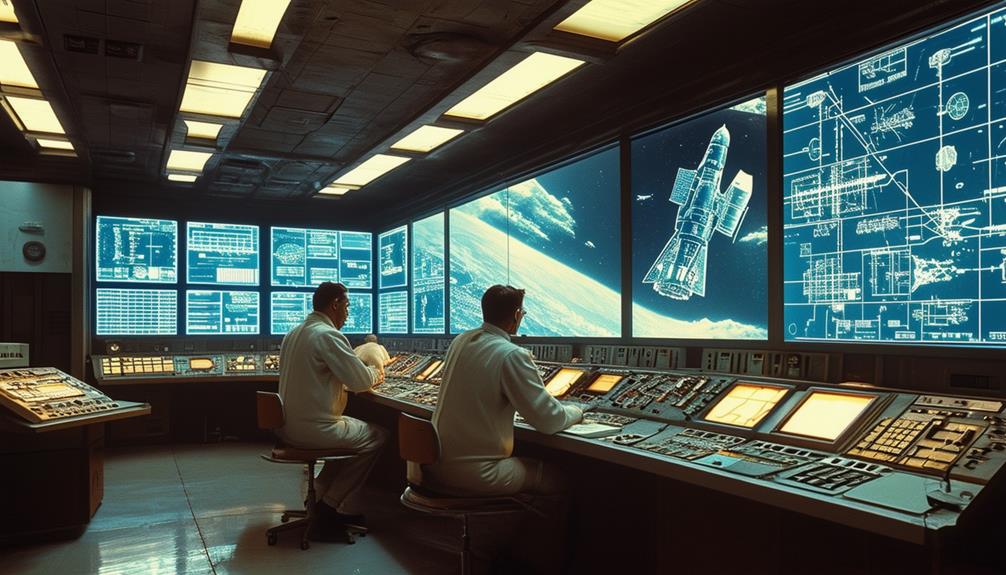
In the 1960s, autonomous decision-making saw significant advancements through early AI algorithms, particularly in aerospace. NASA's development of the Apollo Guidance Computer enabled spacecraft to navigate complex environments autonomously. This technology provided real-time data analysis and decision-making, crucial for mission success and astronaut safety.
Early AI Algorithms
During the 1960s, early AI algorithms played a pivotal role in automating decision-making processes for spacecraft systems. These AI systems were essential for space missions, handling tasks such as trajectory calculations, navigation, and course corrections. By automating these critical functions, NASA significantly reduced the workload on astronauts and enhanced the likelihood of mission success.
The AI algorithms of this era were groundbreaking, laying the foundation for future advancements in artificial intelligence and autonomous spacecraft operations. They ensured more precise and reliable space missions by enabling swift and accurate critical decisions.
Here are four key tasks that early AI algorithms managed:
- Trajectory Calculations: AI systems computed the spacecraft's path, ensuring it remained on course.
- Navigation: These systems determined the spacecraft's position relative to celestial bodies.
- Course Corrections: AI algorithms adjusted the spacecraft's route to avoid obstacles or correct deviations.
- System Diagnostics: They monitored onboard systems, detecting and addressing potential issues.
NASA's pioneering work in integrating AI into their space systems during the Space Race represented a significant technological leap. This integration not only improved mission success rates but also paved the way for future innovations in AI and autonomous decision-making in space exploration.
Spacecraft Navigation Systems
NASA's development of the Apollo Guidance Computer (AGC) represented a seminal advancement in autonomous decision-making for spacecraft navigation systems. Integral to the Apollo missions, the AGC utilized integrated circuits and sophisticated algorithms to autonomously navigate the spacecraft. It operated the Primary Guidance, Navigation, and Control System (PGNCS) to compute trajectories, make real-time adjustments, and execute critical maneuvers, such as lunar landings, with minimal human intervention.
The AGC's capability to process large volumes of data and perform intricate calculations autonomously was groundbreaking. It paved the way for future advancements in AI-driven spacecraft navigation systems. These early sophisticated algorithms allowed the AGC to manage tasks that would have been unfeasible to handle manually during the intense conditions of space travel.
The table below highlights the key features and impacts of the AGC:
| Feature | Impact |
|---|---|
| Integrated Circuits | Enhanced processing power |
| Autonomous Decision-Making | Minimized need for human intervention |
| Real-Time Adjustments | Increased accuracy in navigation |
| PGNCS Program | Enabled complex maneuvers, including lunar landings |
NASA's pioneering work in the 1960s established the foundation for contemporary autonomous technologies in space exploration, demonstrating how advanced AI algorithms and spacecraft navigation systems can achieve extraordinary accomplishments.
Legacy and Future Impact
The advancements in AI that NASA achieved during the Space Race have left a lasting legacy, continuing to drive innovation in both space exploration and broader technological fields. The United States Space Program's AI breakthroughs in the 1960s were transformative, reshaping mission planning and execution. They laid the groundwork for today's autonomous spacecraft operations and robotic investigations, which are essential for modern space missions.
The profound impact of these early AI developments is evident through several key contributions:
- Autonomous Spacecraft Operations: NASA's pioneering AI work enabled spacecraft to make independent decisions, crucial for long-duration missions.
- Robotic Investigations: AI advancements from the Space Race set the stage for sophisticated robotic missions, enhancing our ability to explore distant planets and moons.
- Complex Decision-Making: Early AI systems developed by NASA improved mission efficiency by managing complex decision-making processes that human operators could not handle in real-time.
- Technology Integration: The integration of AI technologies during the Space Race continues to influence current and future space exploration strategies, ensuring more reliable and efficient missions.
NASA's early adoption of AI technologies during the Space Race continues to shape the future, proving that those pioneering efforts were far ahead of their time.
Conclusion
NASA's pioneering efforts in the 1960s significantly advanced AI, particularly in spacecraft control systems and mission planning. By automating data analysis and enabling autonomous decision-making, NASA not only improved mission efficiency but also laid the groundwork for future advancements in machine learning and robotics. These innovations continue to influence modern space exploration, demonstrating that the technological strides made during the Space Race remain relevant and impactful today.
Related posts