The Role of Alan Turing in the Development of AI
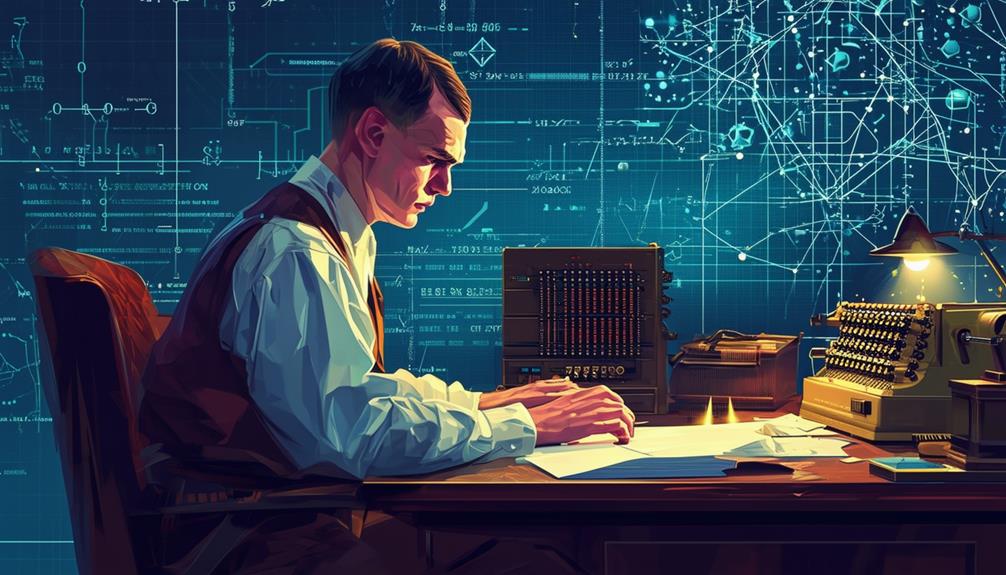
Alan Turing's contributions are foundational to the field of artificial intelligence. His theoretical work, including the invention of the Turing Machine and the development of the Turing Test, laid the groundwork for modern computing and AI. Additionally, his wartime efforts in deciphering the Enigma code influenced his vision for intelligent machines. Exploring Turing's multifaceted legacy reveals how his pioneering ideas continue to drive advancements in AI, shaping the technology of today and the future.
Turing's Early Life

Alan Turing, born on June 23, 1912, in Maida Vale, London, displayed exceptional mathematical talent from an early age. Raised in an affluent British family, he benefited from an environment that nurtured his intellectual growth. Turing's problem-solving abilities distinguished him even as a child.
At King's College, Cambridge, Turing rapidly made his mark in the field of mathematics. There, he delved deeply into mathematical theory, laying the foundation for his groundbreaking work in computer science. His early exploration of the concept of a Turing machine was a monumental step in understanding computability, essentially forming the blueprint for modern computers.
Turing's brilliance extended beyond theoretical contributions. During World War II, he played a crucial role in deciphering the Enigma machine, a sophisticated German encryption device. His innovative thinking and problem-solving skills were instrumental in breaking the code, significantly aiding the Allied war effort. These early achievements were a prelude to his later, even more influential work in artificial intelligence and computer science.
The Turing Machine
Imagine a simple machine that can solve any computational problem, no matter how complex—that's the essence of the Turing machine. Proposed by Alan Turing, this theoretical device consists of a tape divided into storage cells for data and memory. The machine reads symbols on the tape and executes instructions based on its current state, a process fundamental to computer science and artificial intelligence.
Turing demonstrated that his machine could compute anything that is computable, laying the foundation for modern computing. The Turing machine's capability to perform any calculation made it a universal computing device, a groundbreaking concept that set the stage for advanced computational systems.
Furthermore, Turing's work led to the concept of the Halting Problem, which addresses whether a machine can determine if a computation will terminate or run indefinitely. This problem has had a profound influence on computer science.
Turing's theoretical insights were not merely academic exercises; they provided a blueprint for the design of actual computers. His innovative ideas continue to shape the field of artificial intelligence, making him a pivotal figure in the history of computing.
The 1950 Paper
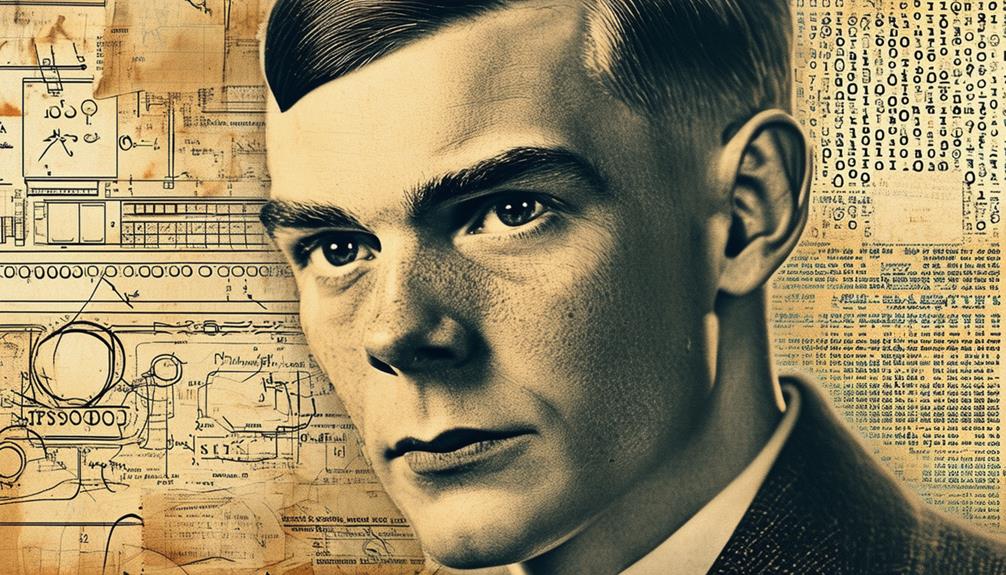
In his groundbreaking 1950 paper, 'Computing Machinery and Intelligence,' Alan Turing proposed that machines could one day think and reason like humans. This bold vision laid the cornerstone for the field of artificial intelligence. Turing meticulously outlined a logical framework for constructing intelligent machines capable of solving complex problems.
He emphasized the importance of computers evolving to store and execute commands, a crucial approach for the pursuit of artificial intelligence. Turing argued that, with the right programming, a machine could exhibit intelligent behavior. Despite the high costs of computing in the early 1950s, which limited AI research to prestigious institutions, Turing's ideas sparked significant interest and debate.
The practical implications of Turing's 1950 paper were profound. It provided a roadmap for future AI research. For instance, the Logic Theorist, funded by the RAND Corporation, was an early AI program developed based on Turing's concepts. This program demonstrated that machines could perform tasks previously thought to require human intelligence, validating Turing's visionary ideas.
The Turing Test
The Turing Test, introduced by Alan Turing in 1950, challenges one to determine whether they are conversing with a human or a machine. Turing proposed this test to assess machine intelligence by evaluating if a machine can demonstrate behavior indistinguishable from that of a human. During the test, a human judge interacts with both a machine and a human without knowing which is which. If the machine successfully convinces the judge that it is human, it passes the Turing Test.
This test is more than just an exercise; it serves as a crucial benchmark in the pursuit of general intelligence within artificial systems. By focusing on natural language processing, knowledge representation, and reasoning abilities, the Turing Test pushes the boundaries of AI capabilities. Turing's innovative idea established a fundamental standard for the development of artificial intelligence.
Ultimately, the Turing Test is not merely about deceiving humans; it aims to elevate machine intelligence to a level where it can engage in meaningful, human-like conversations. This test remains a significant milestone in AI research, bringing us closer to creating machines that think, learn, and interact as humans do.
Breaking Enigma Code
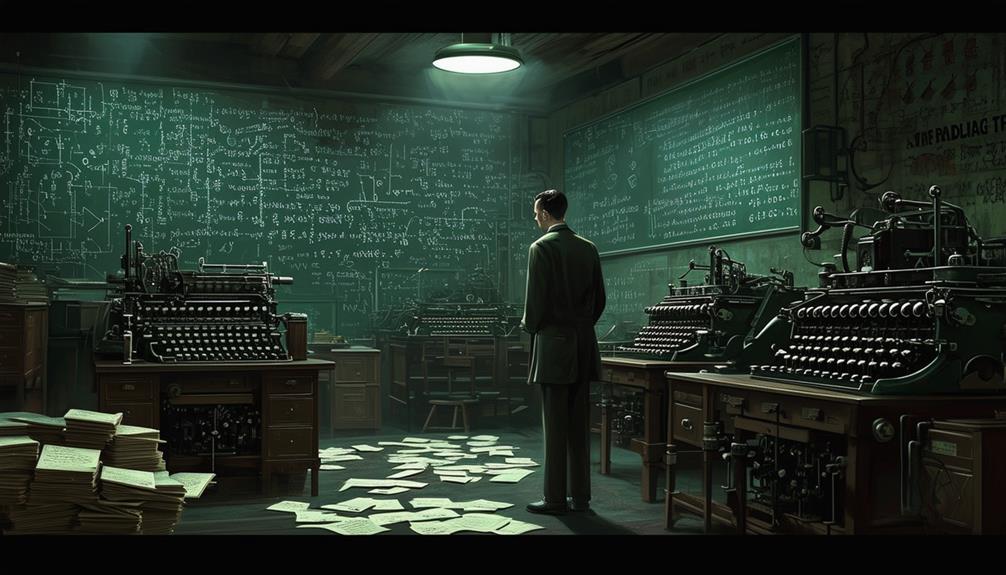
While Alan Turing's Turing Test set a benchmark for artificial intelligence, his groundbreaking work during World War II in breaking the Enigma code was equally transformative. At Bletchley Park, Turing played a pivotal role in decrypting German military communications encoded by the Enigma machine, which scrambled messages into seemingly unbreakable codes, posing a substantial challenge to the Allies.
Turing's expertise in cryptanalysis led to the development of the Bombe, an electro-mechanical device designed to decipher Enigma-encrypted messages. By identifying patterns and exploiting weaknesses in the German Enigma, Turing and his team were able to decode essential information, providing the Allies with a strategic advantage. This breakthrough wasn't just a triumph in cryptography; it showcased Turing's inventive thinking and problem-solving skills.
The success in breaking the Enigma code significantly aided the Allies in their war efforts, shortening the conflict and saving countless lives. Turing's contributions had a lasting impact on intelligence operations and laid the foundation for future advancements in both cryptography and computing. His work during this period exemplifies how machine intelligence can be harnessed to solve complex problems, reinforcing his pivotal role in the development of AI.
Contributions to Cryptography
Turing's breakthrough with the Enigma code wasn't just a wartime success; it revolutionized cryptographic techniques and laid the groundwork for modern standards. His pioneering methods in securing and decoding information set the stage for advancements in artificial intelligence and computing.
Enigma Code Breakthrough
During World War II, Alan Turing played a pivotal role in breaking the Enigma code, a feat that revolutionized cryptography and provided crucial intelligence for the Allies. By deciphering the complex messages encoded by the German military, Turing's work significantly contributed to the Allied victory. His development of the Bombe machine, an electromechanical device designed to expedite the decryption process, showcased his unparalleled problem-solving abilities.
Turing's contributions extended beyond the Enigma code; they laid the groundwork for modern cryptographic techniques. His work at Bletchley Park, the British codebreaking center, was instrumental in intercepting and decoding German communications, enabling the Allies to anticipate and counter enemy movements effectively.
Here's a summary of Turing's contributions to the Enigma code breakthrough:
| Contribution | Description | Impact on War |
|---|---|---|
| Enigma Code Breaking | Decryption of German military communications | Provided vital intel |
| Bombe Machine Development | Mechanized the codebreaking process | Increased efficiency |
| Cryptographic Techniques | Advanced methods in cryptography | Laid groundwork for AI |
| Bletchley Park Efforts | Central hub for Allied cryptanalysis | Unified codebreaking |
Turing's achievements in breaking the Enigma code not only altered the course of World War II but also highlighted his exceptional capabilities in cryptography. His legacy continues to influence the fields of cryptography and artificial intelligence today.
Turing's Cryptographic Techniques
Building upon his groundbreaking work with the Enigma code, Alan Turing's cryptographic techniques revolutionized the field of cryptography and set the stage for modern cybersecurity. At Bletchley Park, Turing led a team of brilliant minds in the quest to break the German Enigma machine encryption. His creative approaches and mathematical prowess allowed them to decrypt intercepted German messages, providing invaluable intelligence to the Allies.
The significance of Turing's contributions at Bletchley Park cannot be overstated. By developing methods to decipher the complex codes used by the Axis powers, he demonstrated the power of cryptographic techniques in wartime efforts. Turing's insights were not just about breaking codes; they laid the groundwork for the cryptographic standards we rely on today.
The success of Turing and his team in cracking the Enigma machine not only influenced the outcome of World War II but also underscored the crucial role of cryptography in national security. Turing's pioneering work in cryptanalysis was a cornerstone that propelled the advancement of cybersecurity practices, ensuring that encrypted communication remains an essential component of our technological era.
Influence on AI Research

Alan Turing's groundbreaking ideas profoundly influenced the trajectory of AI research, setting the stage for future innovations. His theoretical work, especially his 1950 paper, introduced the concept that machines could utilize information and reasoning to solve problems. This idea became fundamental to AI research, guiding the development of intelligent systems capable of mimicking human thought processes.
Turing's logical framework emphasized the construction and evaluation of intelligent machines. This perspective inspired significant advancements in AI, such as the creation of expert systems designed to perform specialized tasks. These systems laid the groundwork for modern AI applications, illustrating how machines could assist humans in complex problem-solving.
The pivotal 1956 Dartmouth Summer Research Project on AI, where the term 'artificial intelligence' was coined by John McCarthy, was heavily influenced by Turing's ideas. His advocacy for machine intelligence and proof of concept were crucial in obtaining funding and support for early AI endeavors. By demonstrating the potential of intelligent machines, Turing inspired a generation of researchers to explore the possibilities of AI.
In essence, Turing's vision and theoretical contributions provided the foundation upon which much of AI research is built, propelling the field towards its current advancements and future possibilities.
Theoretical Foundations
Alan Turing's exploration of the theoretical foundations of AI began with his seminal 1950 paper, where he proposed that machines could utilize information and reasoning to solve problems. Turing's vision was revolutionary, suggesting that machines could emulate human cognitive abilities through logical frameworks and stored commands. He emphasized that for machines to achieve artificial intelligence, they needed to evolve to store and execute commands effectively.
Turing's ideas extended beyond creating machines capable of performing tasks; he envisioned building systems that could learn and adapt—concepts now integral to machine learning. His work redefined the perception of machines, portraying them not merely as calculators but as entities capable of understanding and responding to complex problems similarly to humans.
In the early 1950s, AI research encountered significant challenges due to the high cost of computing, limiting participation to prestigious institutions. Turing's theoretical contributions provided the essential proof of concept needed to advocate for funding, crucial for AI's advancement. By articulating a clear, logical framework, Turing helped convince prominent individuals and institutions to invest in the future of artificial intelligence.
Legacy in AI
Few individuals have left as profound a mark on the field of artificial intelligence as Alan Turing. His groundbreaking concept of machine intelligence, detailed in his 1950 paper "Computing Machinery and Intelligence," serves as a cornerstone for AI research. Turing proposed that machines could simulate any formal reasoning process, laying the foundation for modern AI, computational logic, and machine learning.
Turing's legacy is not limited to theoretical work. His practical achievements, such as breaking the Enigma code during World War II, underscore the real-world impact of his ideas on cryptography and computational problem-solving. These accomplishments highlight the breadth of his influence, spanning AI, theoretical biology, and cryptography.
The Turing Award, established in his honor, epitomizes his lasting impact. Often referred to as the "Nobel Prize of Computing," it acknowledges individuals who have made significant contributions to computing and AI. This reflects Turing's enduring legacy, as his visionary ideas on machine intelligence and computational capabilities continue to inspire and shape AI research and development, maintaining their relevance to this day.
Conclusion
Alan Turing's innovations, from the Turing Machine to the Turing Test, laid the groundwork for modern AI. His contributions to cryptography and codebreaking during World War II were also crucial for cybersecurity. Turing's visionary ideas about machine learning and reasoning continue to inspire contemporary AI advancements. His legacy highlights how one brilliant mind can shape the future of technology and artificial intelligence.