The Mechanics of Autonomous Drones: From Navigation to Stabilization
Understanding the mechanics of autonomous drones involves key elements like navigation and stabilization. You'll find that these drones use sensor fusion, combining data from cameras, GPS, and LIDAR for precise positioning and environmental awareness. Advanced algorithms help determine ideal flight paths, adapting to dynamic conditions in real-time. Stabilization techniques, including gyroscopic correction and vibration dampening, guarantee smooth operation. As these drones navigate complex terrains, they respond to environmental challenges, like weather changes and obstacles. If you keep exploring, you'll uncover more about the revolutionary advancements driving this technology.
Overview of Autonomous Drones
Autonomous drones are transforming multiple industries by performing tasks without direct human control. You'll find drone applications spanning agriculture, delivery services, and surveillance, among others. With the rapid market growth, these drones are becoming more sophisticated, thanks to technological advancements. However, as you explore this world, you'll encounter regulatory challenges that often dictate where and how these drones can operate.
Safety measures are vital to ensuring that autonomous drones can function effectively without posing risks to people or property. As you consider their military uses, ethical considerations become paramount. Balancing innovation with moral responsibilities is fundamental, especially in defense scenarios where lives are at stake.
On a lighter note, hobbyist trends are also rising, with individuals flying drones for recreation, photography, and racing. This growing interest reflects the diverse capabilities and appeal of autonomous drones. Regardless of your interest in how they can revolutionize industries or just wanting to enjoy flying one for fun, understanding the broader implications of these technologies is key. Embracing the potential of autonomous drones means steering through a complex landscape of possibilities and challenges.
Key Components of Navigation
Maneuvering the skies requires a well-integrated set of components that work seamlessly together. At the heart of effective navigation lies sensor fusion, where data from diverse sensors—like cameras, LiDAR, and GPS—combine to provide a thorough view of the environment. This integration improves navigation accuracy, allowing your drone to make informed decisions.
Machine learning plays a vital role in interpreting this sensor data. By analyzing patterns, your drone can enhance its obstacle avoidance capabilities, adapting to dynamic environments in real time. As it processes signals, the drone can optimize its path, ensuring efficient flight dynamics while avoiding potential hazards.
Moreover, terrain mapping is fundamental for understanding the landscape. Your drone can create detailed maps of its surroundings, enabling it to navigate through complex terrains effectively. The combination of these elements—sensor fusion, obstacle avoidance, and path optimization—ensures that your drone remains stable and on course.
Role of GPS Technology
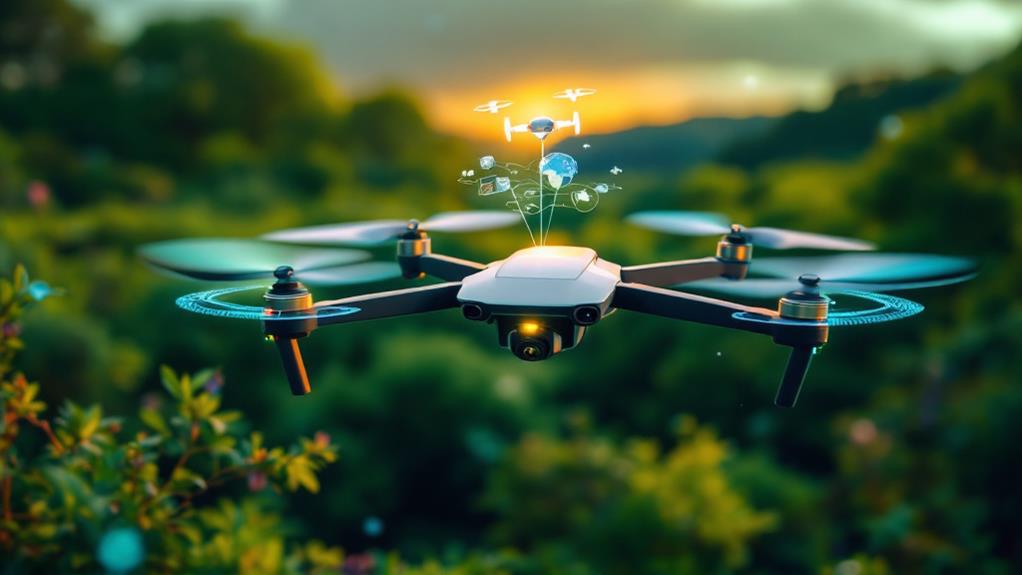
Utilizing GPS technology is fundamental for the precise positioning and navigation of drones. It enables you to achieve GPS accuracy through the reception of satellite signals, allowing for accurate location tracking. This capability is significant for tasks such as geo-fencing, where you define virtual boundaries for your drone's operation, ensuring it stays within designated areas.
One challenge you may encounter is signal interference, which can disrupt GPS functionality. To counter this, implementing navigation redundancy is critical; by integrating supplementary systems, such as inertial measurement units (IMUs), you improve your drone's reliability. This way, if GPS signals are lost or degraded, your drone can still maintain stable flight.
Moreover, system integration plays a considerable role in optimizing your drone's performance. By combining GPS data with other sensors, you can achieve mapping precision, enabling your drone to navigate complex environments and execute tasks seamlessly. In addition, GPS technology is a cornerstone of autonomous drone operations, providing the necessary tools for effective navigation and ensuring your drone can perform its missions with confidence and accuracy.
Sensor Systems and Their Functions
In the domain of drone technology, sensor systems play a significant role in improving operational capabilities. You'll find that these systems combine multiple sensors through sensor fusion to create a thorough understanding of the drone's environment. For instance, LIDAR systems and camera integration work together for precise obstacle detection, allowing your drone to navigate safely.
Inertial measurement units (IMUs) are essential for stability and orientation, guaranteeing your drone maintains its flight path. To improve reliability, data redundancy is implemented, so if one sensor fails, others can take over without loss of functionality. Environmental sensors, such as temperature sensors, gather critical data that helps in adjusting flight operations according to conditions.
You can't overlook the importance of sensor calibration, which guarantees accuracy in readings. Signal processing techniques are fundamental for interpreting the data collected, enabling the drone to make informed decisions in real-time. By understanding these sensor systems and their functions, you'll appreciate how they contribute to the complete effectiveness and safety of autonomous drone operations.
Algorithms for Flight Path Planning

With a robust sensor system in place, your autonomous drone can effectively gather and interpret data about its environment, paving the way for advanced algorithms that govern flight path planning. These algorithms, such as pathfinding algorithms, are essential for determining the best route to your destination while considering diverse factors.
You'll often utilize optimization techniques to improve trajectory planning, ensuring your drone flies efficiently and safely. Obstacle avoidance becomes a priority as your drone navigates complex environments. By employing predictive modeling, it anticipates potential obstacles and adjusts its course proactively.
Dynamic routing allows your drone to adapt its flight path in real-time, responding to changes in the environment, such as moving obstacles or varying weather conditions. Machine learning plays an important role here, enabling your drone to learn from past flights and enhance its decision-making processes over time.
Ultimately, these sophisticated algorithms work together to create a seamless flight experience, allowing your drone to operate autonomously while effectively managing the challenges it encounters. By understanding and implementing these algorithms, you'll improve your drone's ability to navigate efficiently and safely.
Real-Time Data Processing
Real-time data processing is vital for the effective operation of autonomous drones. You rely on this capability to guarantee that your drone can react promptly to its environment, making split-second decisions that are critical for navigation and safety. By employing advanced algorithms, drones can perform data fusion, combining input from multiple sensors like GPS, cameras, and LiDAR. This fusion allows your drone to create a thorough understanding of its surroundings, enhancing situational awareness.
To achieve this, computational efficiency is key. You want your drone to process data rapidly without sacrificing accuracy. High-performance processors and optimized software play a significant role here, enabling your drone to handle large volumes of data while maintaining low latency. When your drone encounters obstacles or changing conditions, this efficient processing guarantees it can adjust its flight path in real time, minimizing the risk of collisions.
Stabilization Techniques in Flight
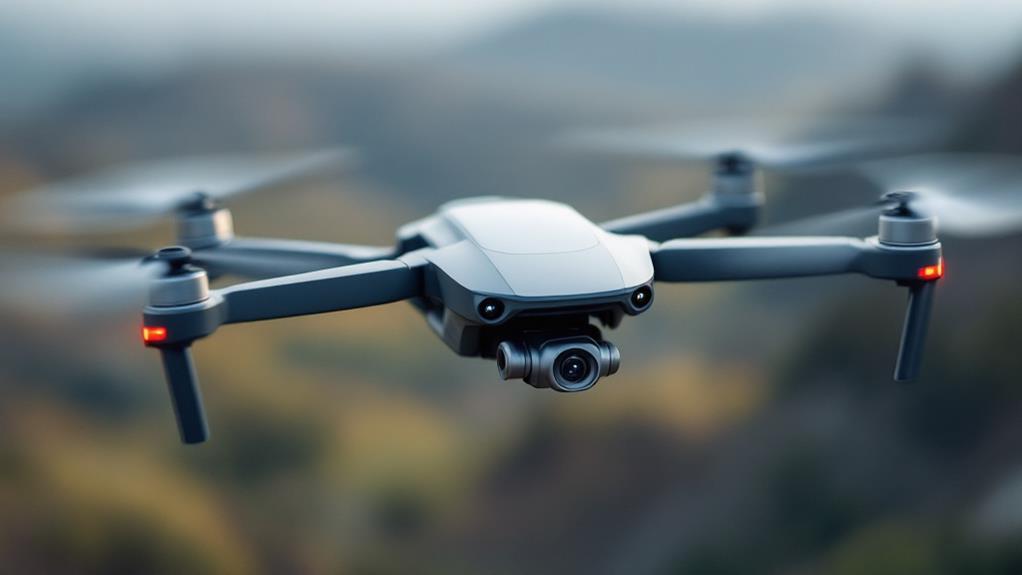
Maintaining steady flight is fundamental for autonomous drones, especially when maneuvering through complex environments. To achieve this, drones utilize gyroscopic stabilization, which detects and corrects any unwanted tilting or rotation. You'll find that vibration dampening techniques play a significant role in minimizing disturbances caused by the drone's own motors or external factors, guaranteeing smooth operation.
Effective flight control relies on altitude maintenance and motion tracking to keep the drone stable at varying heights. By integrating multiple sensors, drones can employ sensor fusion to combine data from gyroscopes, accelerometers, and barometers, providing a thorough view of their surroundings. This integration, along with sophisticated software integration, enables the drone to make real-time adjustments.
Feedback loops are crucial in this process, as they allow the drone to continuously monitor its position and make necessary corrections. Stability algorithms analyze incoming data to predict and counteract potential disturbances, such as wind resistance. By implementing these techniques, you assure your autonomous drone maintains a stable and reliable flight path, even in challenging conditions, enhancing its overall performance and safety.
Environmental Adaptation Strategies
Many autonomous drones need to adapt to varying environmental conditions to operate effectively. To achieve this, they rely on environmental sensing technologies that gather data about their surroundings, enabling them to make informed decisions. Adaptive control systems help you manage flight characteristics based on real-time inputs, ensuring stability in changing conditions.
When maneuvering through diverse terrains, drones perform terrain analysis to identify obstacles and optimize flight paths. Their weather responsiveness allows them to adjust to factors like wind or rain, enhancing safety and performance. Moreover, obstacle avoidance systems play an essential role in preventing collisions, ensuring smooth operation in complex environments.
To enhance energy efficiency, these drones often implement smart flight strategies that conserve battery life while completing missions. Habitat mapping capabilities allow for effective ecological monitoring, making drones invaluable for environmental research. Noise reduction technologies further minimize their ecological impact, allowing for discreet operations in sensitive areas.
Challenges in Autonomous Navigation
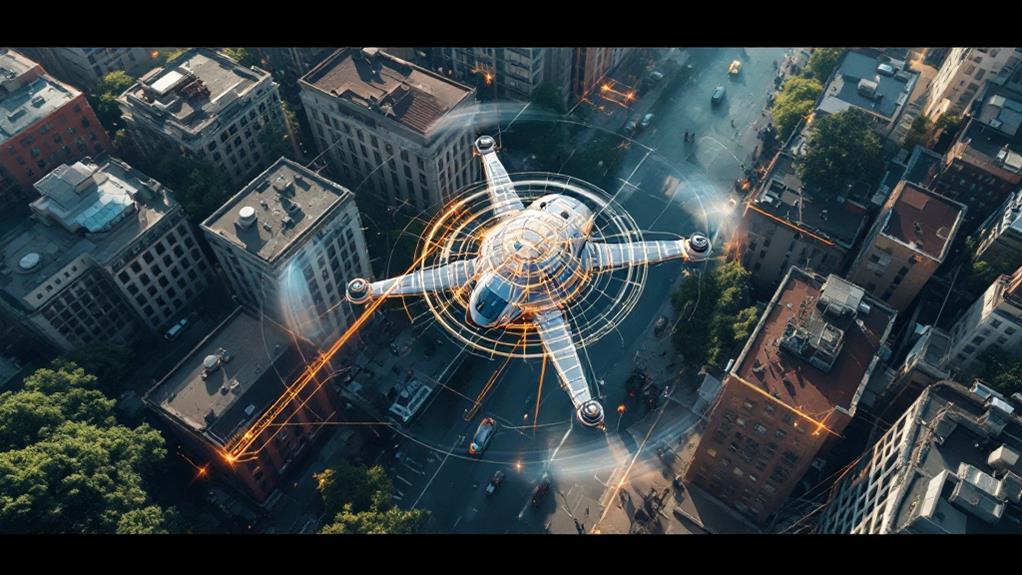
Maneuvering through complex environments presents a significant challenge for autonomous drones. You need advanced systems that enable effective navigation, including reliable obstacle detection and accurate terrain mapping. When facing diverse obstacles, drones must process real-time data to avoid collisions and navigate safely.
Here are four key challenges you'll encounter in autonomous navigation:
- Dynamic Obstacles: Moving objects like pedestrians or vehicles can appear suddenly, requiring fast decision-making to guarantee safety.
- GPS Limitations: In areas with poor GPS signals, like urban canyons or dense forests, drones struggle to maintain accurate positioning.
- Variable Terrain: Uneven surfaces or unpredictable weather conditions can complicate terrain mapping, making it hard to establish a stable flight path.
- Sensor Fusion: Integrating data from multiple sensors (like cameras and LiDAR) is essential, but it can lead to processing delays or errors if not done correctly.
Future Trends in Drone Technology
As we look into the future of drone technology, several exciting trends are emerging that promise to revolutionize how these devices operate and integrate into our daily lives. Swarm technology is gaining traction, allowing drones to work collaboratively, enhancing efficiency in tasks like delivery and surveillance. You'll see significant market growth, driven by advancements in battery technology and new materials that improve performance and durability.
However, with these innovations come integration challenges. Regulatory developments will play a significant role in ensuring safe operations, as public perception shifts with increased drone visibility. Ethical considerations will also be important; you'll need to navigate privacy concerns and responsible usage as drones become commonplace.
AI applications are set to transform drone capabilities, enabling smarter navigation and autonomous decision-making. This will lead to more sophisticated deployment strategies, allowing drones to adapt to different environments and tasks effectively. As these trends unfold, it is necessary to stay informed and engaged, preparing for a future where drones are an integral part of both commercial and personal landscapes. Embracing these changes will help you harness the full potential of drone technology in your life and work.
Related posts