
The Importance of Inertial Measurement Units (IMUs) in Robotics

In robotics, inertial measurement units (IMUs) play an important role in ensuring accurate motion sensing. They capture real-time data on acceleration and angular velocity, making them fundamental for navigation in diverse applications. You'll find IMUs in drones for stabilizing flight, in robotic arms for precise movements, and in self-driving cars for safe navigation. Their integration improves performance by enabling immediate adjustments, enhancing stability on uneven surfaces. However, challenges like calibration and environmental interference exist. Understanding these elements is significant for grasping their impact on robotics, so there's much more to investigate about their importance and future developments.
What Are IMUS?
Inertial Measurement Units, or IMUs, are commonly used devices that measure a combination of acceleration and angular velocity. They play an important role in robotics by providing real-time data about a robot's motion and orientation. When you work with IMUs, you'll often need to implement different IMU calibration techniques to guarantee accurate readings. Calibration helps correct biases, scale factors, and misalignments that can skew your data, leading to better performance in your robotic applications.
One of the key benefits of using IMUs is their ability to integrate with other sensors through a process called IMU sensor fusion. This method combines data from multiple sensors, such as GPS and magnetometers, to improve the general accuracy and reliability of your robot's navigation system. By leveraging sensor fusion, you can mitigate the limitations of individual sensors, resulting in smoother and more precise movement.
Understanding IMUs is fundamental for harnessing their full potential in robotics. With effective calibration and sensor fusion, you can optimize your robot's performance, making it more adept at traversing complex environments. So, immerse yourself in the world of IMUs and investigate the possibilities they bring to your robotic projects.
Components of IMUs
To fully understand how IMUs function in robotics, it's important to investigate their components. At the core of an IMU, you'll find numerous sensor types, primarily accelerometers and gyroscopes. Accelerometers measure linear acceleration, while gyroscopes track rotational movement. Together, these sensors provide significant information about an object's position and orientation in space.
In addition to these primary sensors, some IMUs also incorporate magnetometers. These sensors measure the magnetic field, helping to correct drift in orientation data from the gyroscopes. This combination of sensor types is fundamental for achieving accurate navigation and motion tracking.
Data fusion plays a critical role in IMUs, too. By integrating data from multiple sensor types, an IMU can produce a more reliable and thorough understanding of an object's motion. This process, often involving algorithms like Kalman filters, helps smooth out noise and inconsistencies from individual sensors.
How IMUs Work

Understanding how IMUs work is essential for leveraging their capabilities in robotics. An IMU typically combines accelerometers and gyroscopes to measure motion and orientation. Accelerometers detect linear acceleration, while gyroscopes measure angular velocity. By processing this data, you can determine the device's position and orientation in space.
However, raw data from IMUs can be noisy and subject to drift over time. That's where IMU calibration techniques come into play. These techniques help correct errors and enhance accuracy, ensuring your robot maintains reliable navigation and control. Regular calibration compensates for sensor biases and temperature variations, improving the comprehensive performance of the unit.
To further refine the data, you can implement sensor fusion methods. By combining data from multiple sensors—like GPS or magnetometers—with the IMU data, you create a more accurate and robust estimate of the robot's position and orientation. This process allows your robot to mitigate the limitations inherent in individual sensors, resulting in enhanced performance in dynamic environments.
Incorporating these techniques not only increases the reliability of your robot's navigation system but also opens up new possibilities for advanced robotic applications.
Applications in Robotics
IMUs play a vital role in multiple robotic applications, enhancing their ability to navigate and interact with the environment. You'll find these units significant in tasks ranging from autonomous vehicles to industrial robots. With their precise motion tracking, IMUs facilitate accurate robot navigation, enabling robots to understand their position and orientation in real-time.
Consider the following impactful applications:
- Autonomous Drones: They rely on IMUs for stable flight and navigation in complex environments.
- Robotic Arms: IMUs help guarantee precise movements, important for tasks like surgery or assembly.
- Self-Driving Cars: IMUs work alongside other sensors in a process known as sensor fusion, providing critical data for safe navigation.
- Mobile Robots: They use IMUs to maintain balance and orientation while traversing uneven terrain.
Benefits of Using IMUs
There's no denying the numerous benefits that come with using inertial measurement units (IMUs) in robotics. Initially, IMUs excel in motion tracking, allowing you to monitor a robot's movement with precision. By integrating sensor fusion techniques, you can improve data accuracy, combining readings from multiple sensors for a clearer picture of the robot's dynamics.
One significant advantage is stability improvement. IMUs provide essential orientation sensing data, helping robots maintain balance and navigate uneven terrain effortlessly. This is particularly valuable in applications where stability is essential, like drones and robotic arms.
Additionally, the real-time feedback offered by IMUs facilitates immediate adjustments, boosting responsiveness during operation. Size reduction is another key benefit; compact IMUs fit seamlessly into a range of robotic designs without compromising performance.
Lastly, energy efficiency is crucial in robotics, and IMUs contribute to this by enabling effective energy management strategies. By optimizing motion tracking and orientation sensing, you can reduce power consumption, prolonging the robot's operational time. Ultimately, the integration of IMUs in robotics not only improves performance but also opens doors to groundbreaking applications across diverse fields.
IMUs in Autonomous Vehicles
The role of inertial measurement units in robotics extends considerably into the domain of autonomous vehicles. IMUs are fundamental for ensuring that these vehicles can navigate safely and efficiently. By integrating IMUs with other sensors through sensor fusion, you improve data accuracy and enhance motion tracking, which are indispensable for real-time processing and effective path planning.
In the context of autonomous vehicles, consider these key aspects:
- Vehicle Stability: IMUs help maintain balance and control, especially during sharp turns or sudden stops.
- Navigation Systems: They provide precise feedback for localization techniques, allowing the vehicle to understand its position relative to its environment.
- Environmental Sensing: IMUs work alongside cameras and LIDAR to interpret the surroundings, improving situational awareness.
- System Integration: They play a significant role in connecting all components, ensuring seamless operation.
With these capabilities, IMUs empower autonomous vehicles to adapt to dynamic environments, guaranteeing a safer and more reliable driving experience. Embracing the power of IMUs is imperative for advancing the future of autonomous transportation.
IMUs for Drones
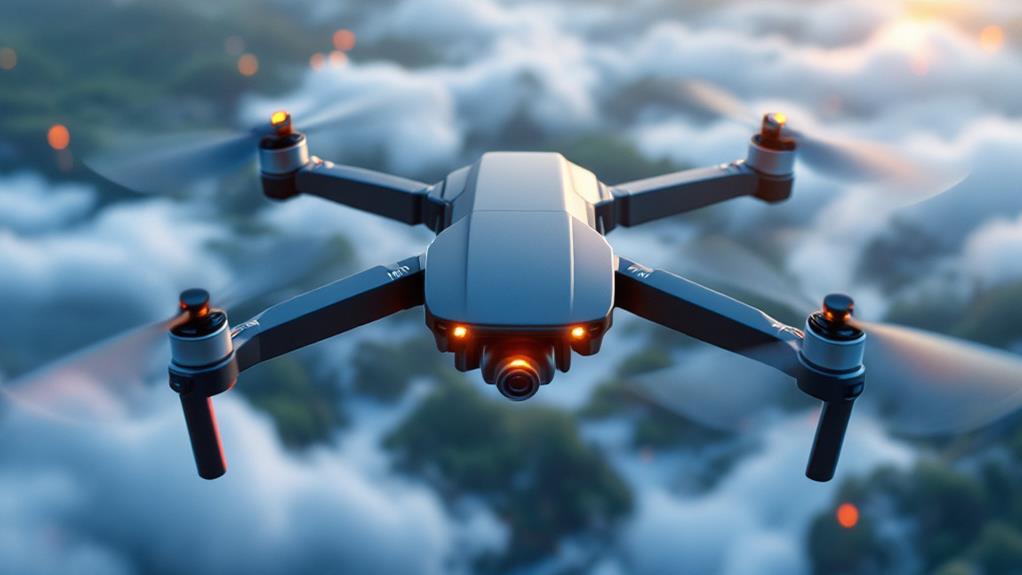
Utilizing inertial measurement units (IMUs) is crucial for improving the stability and control of drones during flight. These advanced sensors continuously track the drone's orientation, acceleration, and angular velocity, allowing you to make real-time adjustments. With precise data from IMUs, you can notably enhance drone stabilization, ensuring a smoother flight even in challenging conditions.
When you're flying a drone, fluctuations in wind or sudden movements can disrupt its stability. IMUs help counteract these disturbances by providing critical feedback to the flight control system. This enables the drone to maintain its intended path, regardless of whether you're maneuvering through tight spaces or capturing aerial footage.
Moreover, integrating IMUs with other sensors, like GPS and barometers, improves your flight control even further. This combination helps in accurately determining altitude and positioning, which is crucial for tasks like surveying or mapping.
In short, IMUs are indispensable for drone operations, making them a key component in modern flight technology. By leveraging these sensors, you can achieve higher levels of precision and reliability, fundamental for both recreational and professional drone applications.
Challenges and Limitations
When integrating inertial measurement units (IMUs) into robotic systems, you'll encounter several challenges and limitations that can impact performance. These hurdles can affect everything from navigation accuracy to system reliability.
- Sensor calibration: Inaccurate calibration can lead to drifting errors, complicating your data analysis.
- Environmental interference: Magnetic fields and vibrations from surroundings can distort sensor readings, creating unpredictable behavior.
- Cost factors: High-quality IMUs can be pricey, making it tough to stay within budget while ensuring performance.
- Size constraints: Small robots often struggle to accommodate larger IMUs, limiting your design options.
You'll also grapple with data fusion complexities, where merging data from multiple sensors requires robust algorithms. This adds to the computational demands, potentially draining battery life faster than anticipated. System integration can be another hurdle, as aligning IMUs with existing hardware and software can lead to unforeseen compatibility issues.
While IMUs are invaluable for robotic applications, addressing these challenges is essential for achieving ideal performance and reliability. By understanding these limitations, you can better plan your integration strategies and improve your robotic designs.
Future Trends in IMUs

Emerging trends in inertial measurement units (IMUs) are set to revolutionize robotics, improving accuracy, efficiency, and functionality. One significant trend is sensor miniaturization, which allows you to integrate more compact and lightweight IMUs into a range of robotic systems. This miniaturization not only saves space but also reduces energy consumption, making robots more efficient and easier to deploy in varied environments.
Additionally, advancements in sensor technology lead to improved accuracy, enabling robots to navigate complex terrains with precision. As IMUs become more sophisticated, you'll notice enhancements in data fusion algorithms, allowing for seamless integration of data from multiple sensors. This means your robots can make better real-time decisions, boosting their overall performance.
Moreover, the trend toward open-source IMUs is fostering collaboration and innovation within the robotics community. By sharing knowledge and resources, you'll be able to access cutting-edge technologies more easily, further driving progress in robotic applications. In summary, as these trends unfold, you can expect a new generation of robots that are smarter, more capable, and better equipped to tackle real-world challenges. The future of IMUs in robotics looks promising, and you'll want to stay ahead of these developments.
Related posts