The History of NASA’s Robotic Exploration of Mars: From Sojourner to Perseverance
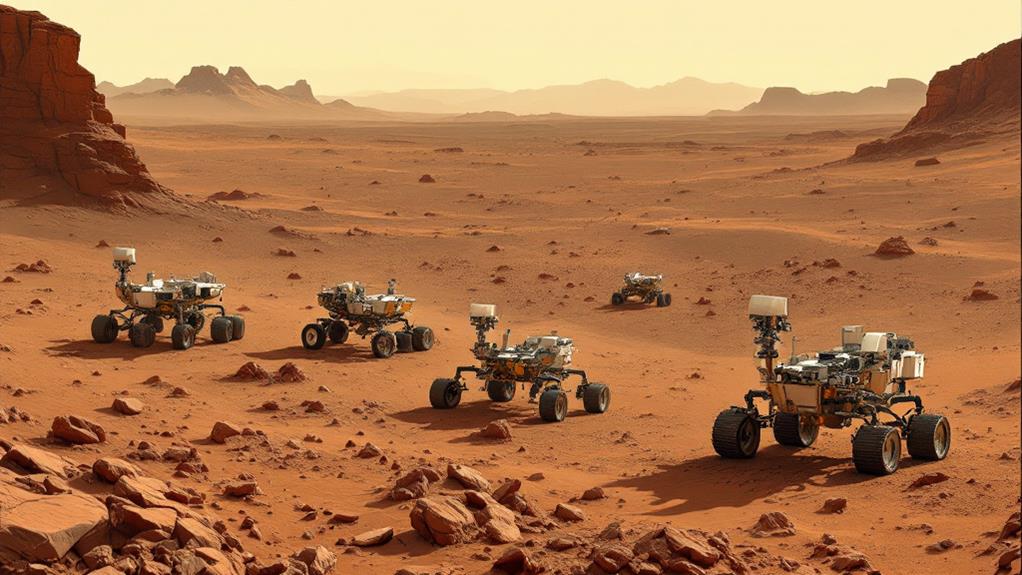
NASA's robotic exploration of Mars began with the Sojourner rover in 1997, marking a significant leap in our understanding of the Red Planet. Following Sojourner, missions like Spirit, Opportunity, and Curiosity built upon that foundation, uncovering crucial information about Mars' geology and past water presence. With the launch of Perseverance in 2020, NASA aimed to search for ancient life and collect soil samples for future analysis. Each mission showcased technological innovations and revealed new insights, paving the way for human exploration. Stick around to learn how these missions shaped our knowledge and future ambitions on Mars.
Early Exploration Initiatives
When you think about the early exploration of Mars, it's fascinating to see how far we've come. Mars exploration milestones, like the Mariner missions in the 1960s, paved the way for understanding our neighboring planet. These robotic missions aimed to capture images and gather data, revealing Mars' surface features and atmosphere. They faced numerous robotic mission challenges, including harsh conditions and communication delays, but they set the groundwork for future exploration.
In the 1970s, Viking 1 and 2 reached the Martian surface, marking significant advances in our quest to understand the planet. These missions not only provided detailed images but also conducted experiments to search for signs of life. You can appreciate how these pioneering efforts taught scientists about the complexities of Mars and the need for advanced technology in robotic exploration.
As each mission built on the successes and failures of its predecessors, they forged a path to more sophisticated explorations. The lessons learned from these early initiatives continue to guide current and future missions, highlighting the importance of perseverance and innovation in robotic exploration of Mars.
The Sojourner Rover
In 1997, the Sojourner rover made history as the initial successful robotic rover to examine the surface of Mars. You'd marvel at how this small, wheeled traveler, measuring just 65 centimeters long, transformed our understanding of the Martian landscape. Sojourner's achievements were monumental; it transmitted over 550 images back to Earth and analyzed rocks and soil for signs of past water, paving the way for future missions.
Sojourner technology showcased NASA's innovation at the time. Equipped with a rock analysis tool, it could determine the chemical composition of Martian rocks, providing critical data about the planet's geology. Its ability to communicate with the Mars Pathfinder lander allowed for real-time data sharing, a groundbreaking feature for that time period.
You'd appreciate how Sojourner's autonomous navigation capabilities let it travel over 100 meters on the Martian surface, demonstrating that rovers could traverse distant terrains without constant human intervention. The success of Sojourner not only marked a significant moment in space exploration but also set the stage for more advanced missions, highlighting the potential of robotic investigation in unraveling the mysteries of Mars.
Spirit and Opportunity Rovers
Following the groundbreaking success of the Sojourner rover, NASA launched the Spirit and Opportunity rovers in 2003, marking a new phase in Martian exploration. These twin rovers utilized advanced rover technology, greatly enhancing our ability to traverse and analyze the Martian surface. Designed to last just 90 days, Spirit and Opportunity far exceeded expectations, operating for years and providing invaluable data.
As you follow their expedition, you'll see how both rovers faced numerous mission challenges, including harsh weather conditions and difficult terrain. Spirit, for instance, became stuck in a sandy patch, but engineers worked tirelessly to devise solutions, showcasing the resilience of both the mission team and the rover technology. Opportunity, on the other hand, undertook an impressive trek across the Meridiani Planum, uncovering hematite and evidence of past water, which reshaped our understanding of Mars.
Together, Spirit and Opportunity not only returned over 200,000 images but also provided essential clues about Martian geology and climate. Your curiosity about Mars deepens as you appreciate how these rovers laid the groundwork for future explorations, proving that perseverance truly pays off in the quest for knowledge.
Advancements With Curiosity
Curiosity, launched in 2011, represents a significant leap forward in robotic exploration of Mars. This rover has pushed the boundaries of rover technology, enabling revelations that were once thought impossible. Here are three key advancements you should know about:
- Enhanced Mobility: Curiosity features a more robust suspension system that allows it to traverse varied terrains, including steep slopes and rocky surfaces.
- Advanced Instruments: The rover is equipped with a suite of scientific tools, such as the ChemCam, which can analyze the composition of rocks from a distance.
- Autonomous Navigation: Curiosity can navigate its path autonomously, reducing the need for constant communication with Earth and allowing for efficient exploration.
These Curiosity advancements have not only improved the rover's functionality but also expanded our understanding of Mars. With its ability to analyze soil and atmosphere, Curiosity has provided critical data, paving the way for future missions. It serves as an indication of how far rover technology has come, helping scientists unravel the mysteries of the Martian landscape and assess its potential for past life.
Mars Science Laboratory Mission
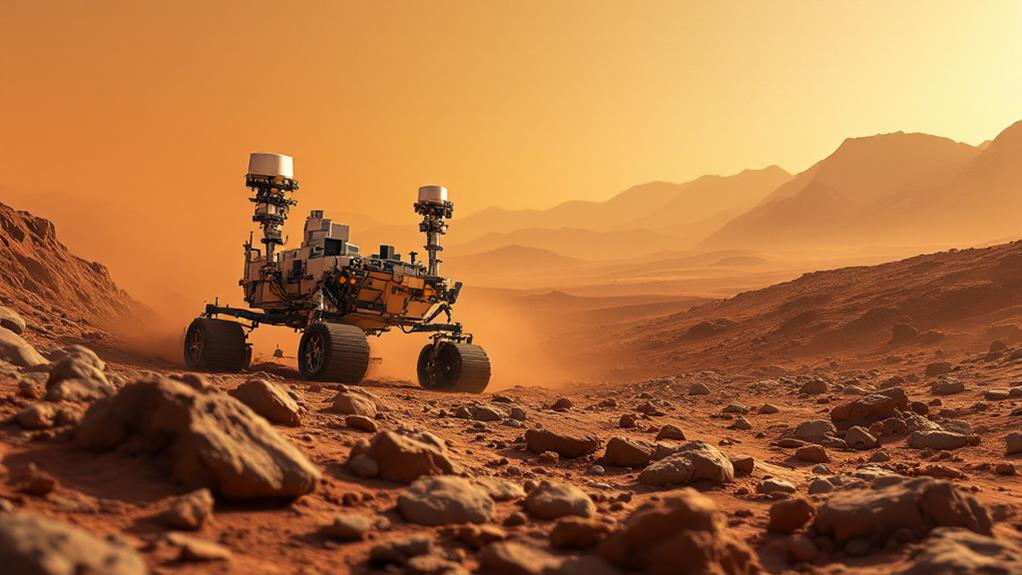
The Mars Science Laboratory mission, which includes the Curiosity rover, marks a new period in our quest to investigate the Red Planet. Launched in 2011, Curiosity's primary goal is to assess Mars' habitability by analyzing its geology and climate. With its advanced instruments, the rover can collect and analyze Mars samples, providing essential data about past water presence and potential life.
Curiosity's rover autonomy plays a significant role in its success. Unlike earlier missions, this rover can navigate complex terrains and make decisions without waiting for commands from Earth. This autonomy allows it to cover more ground, conduct experiments, and gather data efficiently. As you follow Curiosity's expedition, you'll witness its groundbreaking revelations, like the detection of organic molecules and evidence of ancient riverbeds.
The mission has been a game-changer, enhancing our understanding of Mars and paving the way for future exploration. Curiosity's achievements not only reveal the planet's history but also inspire the next generation of scientists and engineers. The knowledge gained from the Mars Science Laboratory mission will certainly influence upcoming missions, including those aiming to bring Mars samples back to Earth.
Technologies Behind Mars Rovers
Creative technologies drive the success of Mars rovers, enabling them to investigate the planet's surface with unprecedented efficiency. These innovations improve their capabilities, ensuring they can operate independently and gather essential data.
- Robotic Navigation: Rovers utilize advanced robotic navigation systems, allowing them to traverse diverse terrains with precision and avoid obstacles.
- Autonomous Systems: Equipped with autonomous systems, rovers can make real-time decisions, maximizing their exploration potential without waiting for instructions from Earth.
- Scientific Instruments: Cutting-edge scientific instruments enable rovers to conduct detailed analyses of Martian soil, rocks, and atmosphere, providing critical insights into the planet's history.
Communication technologies facilitate seamless data transmission back to Earth, ensuring scientists can monitor the rovers' findings instantly. Power sources, like solar panels and radioisotope thermoelectric generators, keep these machines running even in harsh conditions. Terrain mapping improves exploration accuracy, while advanced rover design incorporates mobility systems that adapt to rugged landscapes. Remote sensing capabilities allow for thorough environmental assessments, ensuring every mission yields significant scientific returns. By integrating these technologies, Mars rovers continue to push the boundaries of our understanding of the Red Planet.
Perseverance Rover Launch
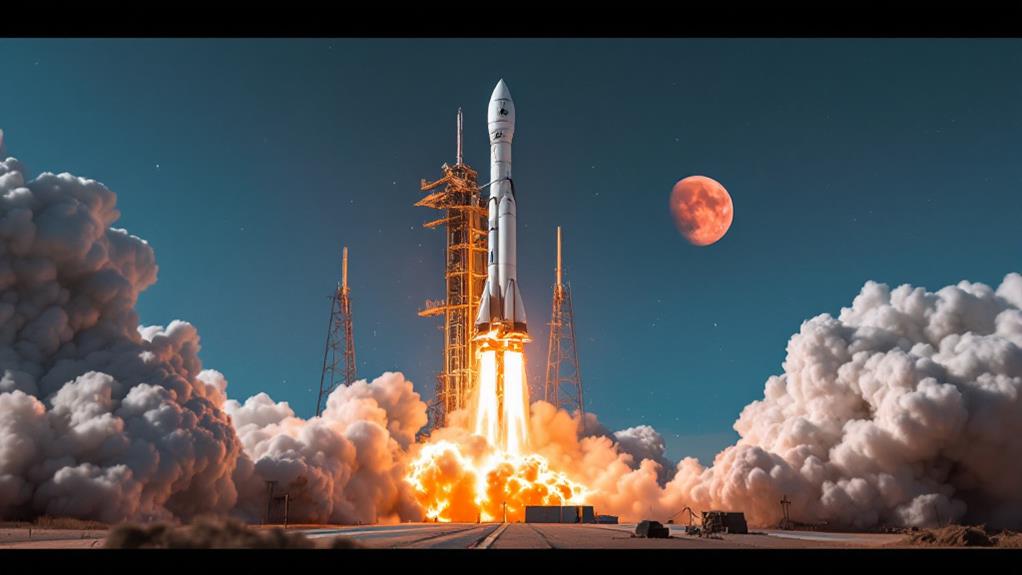
After showcasing the impressive technologies behind Mars rovers, let's focus on the launch of the Perseverance rover, a significant milestone in Mars exploration. The launch took place on July 30, 2020, from Cape Canaveral, Florida, marking the beginning of a highly anticipated mission. You might recall the precise launch timeline, as it was carefully calculated to align with the ideal window for reaching Mars.
Perseverance's mission objectives were ambitious yet clear. Designed to search for signs of ancient life, it aimed to collect soil and rock samples for future return to Earth. You'll also appreciate its role in testing new technologies that could pave the way for human exploration. The rover carries advanced instruments, including the Ingenuity helicopter, which has successfully demonstrated powered flight on another planet.
As you follow Perseverance's expedition, you'll witness groundbreaking advancements in our understanding of Mars. From its launch to its landing in Jezero Crater, every step was thoroughly planned, showcasing humanity's relentless pursuit of knowledge about our cosmic neighbor. With each moment, you're part of this incredible exploration story.
Key Discoveries From Missions
Mars exploration missions have revealed remarkable findings that reshape our understanding of the planet. Here are three key revelations that stand out:
- Martian Geology: Rover missions have uncovered varied geological formations, illustrating the planet's complex history and volcanic activity.
- Atmospheric Studies: Data from rovers and orbiters have provided insights into Mars' thin atmosphere, showing seasonal changes and the presence of dust storms.
- Potential for Life: Sample analysis from multiple missions has identified organic molecules, hinting at Mars' potential for past life.
Using advanced rover technology and landing techniques, scientists have successfully deployed instruments capable of conducting atmospheric studies and detailed Martian geology assessments. Each mission built upon the successes and lessons of previous ones, leading to better comparisons of findings over time. The scientific instrumentation aboard these rovers has enabled sophisticated analyses of surface materials, revealing critical clues about water's presence and the planet's habitability.
Through these revelations, the exploration of Mars continues to inspire curiosity and drive creative research, enhancing our understanding of not just Mars, but the broader cosmos as well.
Future of Mars Exploration
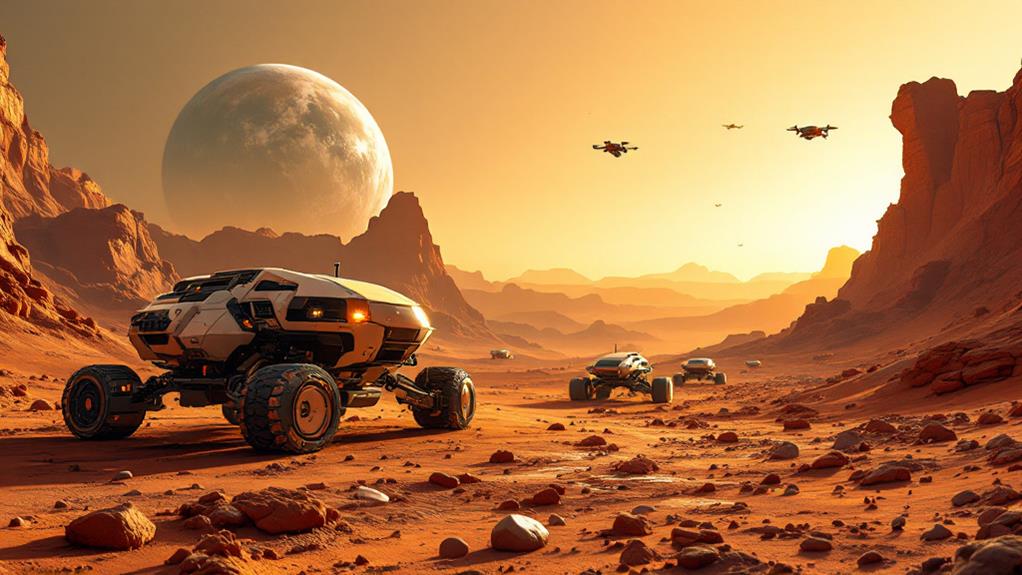
Exciting advancements in technology are shaping the future of Mars investigation. As you look ahead, consider how future missions aim to achieve Mars colonization. Human exploration is on the horizon, with plans for astronauts to set foot on the Red Planet in the coming decades. These missions will focus on establishing sustainable habitats that can support life and research.
International collaboration is becoming significant, as countries unite to share resources and expertise. By pooling knowledge, we can tackle complex scientific goals more efficiently. Robotic advancements will play an important role, scouting locations, conducting experiments, and preparing for human arrival. They'll help us gather data on Mars' atmosphere and geology, fundamental for understanding its potential for life and habitability.
Moreover, scientists are investigating terraforming concepts that could make Mars more Earth-like. These ideas may include altering the atmosphere or introducing specific organisms to create a more sustainable environment. As you follow these developments, keep an eye on how they pave the way for a future where humans and robots work together to probe and inhabit Mars, revealing the mysteries of our neighboring planet.
The Legacy of Robotic Missions
As we look toward the future of human exploration, it's essential to reflect on the legacy of robotic missions that have paved the way for our understanding of the Red Planet. These missions have not only improved our knowledge but also set the stage for future exploration. Here are three key contributions:
- Robotic Innovations: From Sojourner's six-wheeled design to Perseverance's advanced AI, each mission has pushed the boundaries of technology, creating tools that make exploration more efficient and effective.
- Science and Revelation: The wealth of data collected by rovers and orbiters has revealed evidence of past water, complex geology, and even organic compounds, shaping our understanding of Mars' potential for life.
- Addressing Exploration Challenges: Robotic missions have tackled immense challenges, including harsh environments and communication delays, providing invaluable lessons for future human missions.
These robotic missions have not only expanded our scientific horizons but also laid the groundwork for humanity's next steps on Mars. By overcoming exploration challenges, they've shown us that with innovation and persistence, we can access the secrets of the universe.