The First AI Programs: Samuel's Checkers and Newell & Simon's General Problem Solver
The origins of artificial intelligence can be traced back to Samuel's Checkers program and Newell & Simon's General Problem Solver, both pivotal developments from the early 1950s. Samuel's Checkers program demonstrated the potential for computers to learn and improve through experience by employing machine learning techniques. Meanwhile, Newell & Simon's General Problem Solver employed heuristic methods to simulate human problem-solving processes across a variety of domains. These early programs laid the groundwork for modern AI, influencing contemporary approaches and technologies. Let's explore the mechanics of these pioneering efforts and their enduring impact on the field of artificial intelligence.
Origins of Samuel's Checkers
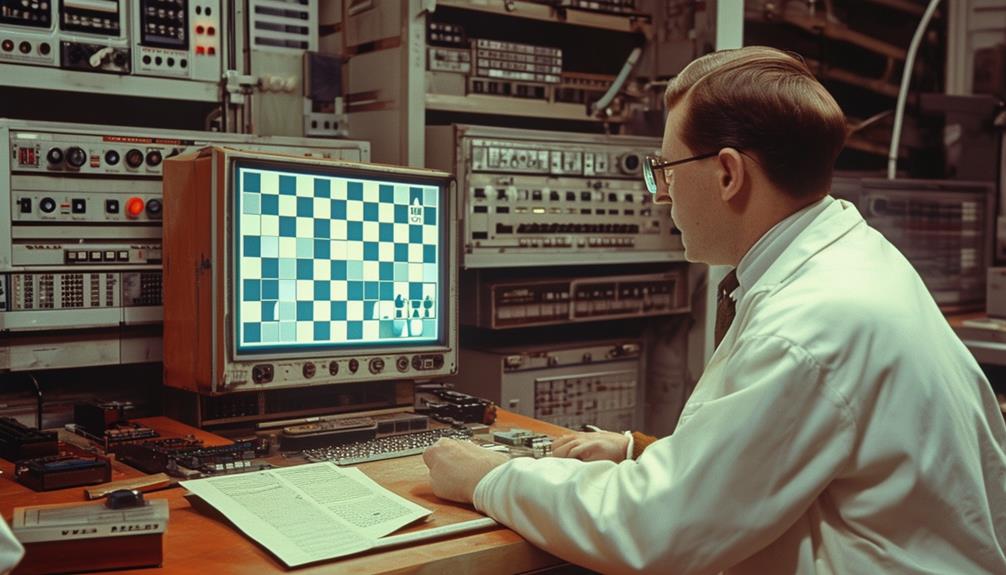
Arthur Samuel's pioneering work on the initial computer checkers-playing program in 1952 marked a significant milestone in artificial intelligence. Samuel's program was more than a simple game; it employed machine learning techniques to improve its gameplay over time. This was groundbreaking because it allowed the computer to enhance its checkers-playing skills through experience, learning from its mistakes and successes.
Samuel's approach was both inventive and practical. He used a heuristic method to evaluate board positions, enabling the program to make educated guesses about the best moves. This heuristic approach was crucial for the program's ability to adapt and improve.
Arthur Samuel's work laid the foundation for machine learning in AI, demonstrating that computers could learn and adapt in strategic decision-making tasks. His checkers program wasn't just a game; it was a pioneering demonstration of machine learning's potential. By creating a system that could learn from experience, Samuel opened the door to future developments in artificial intelligence that continue to impact our world today.
Mechanics of Self-Learning
When exploring the mechanics of self-learning in AI, you'll encounter pivotal concepts such as algorithms and data training. These systems deploy advanced algorithms to analyze extensive datasets and adapt based on feedback. Techniques like reinforcement learning and neural networks enable AI to continuously enhance its performance.
Algorithms and Data Training
Self-learning algorithms, such as Samuel's Checkers and Newell & Simon's General Problem Solver, utilize data training to enhance their decision-making abilities. By employing machine learning techniques, these algorithms analyze data, recognize patterns, and update their knowledge base to improve future performance. Data training consists of providing examples and feedback to the system, enabling it to refine its strategies based on past experiences and outcomes.
In the case of Samuel's Checkers, the algorithm improved by playing thousands of games against both itself and human opponents. This iterative process allowed it to enhance its gameplay incrementally, leading to better decision-making over time.
Newell & Simon's General Problem Solver used heuristics and search algorithms to address a wide range of problems. By learning from each solution, it adapted its methods to become increasingly efficient.
Key aspects of these self-learning mechanisms include:
- Pattern Recognition: Identifying patterns in data to inform decision-making.
- Feedback Loop: Continuously refining strategies based on feedback from past outcomes.
- Heuristic Application: Applying heuristics to guide problem-solving processes.
These foundational principles of self-learning are integral to modern machine learning, illustrating how algorithms can autonomously evolve and improve through data training.
Adaptive Learning Techniques
Adaptive learning techniques empower AI systems to enhance their performance autonomously by leveraging experience and feedback. These methods enable AI to adjust their behavior over time without requiring explicit programming changes. By employing self-learning mechanisms, AI programs can continually improve their strategies and decision-making processes.
Adaptive learning relies on advanced algorithms like neural networks and reinforcement learning. Neural networks mimic the human brain's structure, allowing AI to process complex patterns and learn from vast datasets. Reinforcement learning involves AI learning optimal behaviors by receiving rewards or penalties for its actions. The goal is to develop AI systems that continuously learn and adapt, effectively solving increasingly complex problems.
Here is a breakdown of key adaptive learning techniques:
| Technique | Description |
|---|---|
| Neural Networks | Mimic brain structures to process data and recognize patterns |
| Reinforcement Learning | AI learns optimal behaviors through reward-based feedback |
| Continuous Learning | Systems evolve over time by integrating new information |
| Self-Learning Algorithms | AI autonomously refines strategies, enhancing decision-making |
| Feedback Mechanisms | Provide real-time data to guide and improve AI performance |
These techniques collectively aim to produce AI systems that are more efficient, versatile, and capable of handling a broader range of tasks.
Newell & Simon's Vision
Newell and Simon's vision for AI focused on replicating human thought processes through cognitive simulation. They developed problem-solving models that utilized symbolic reasoning to address various challenges. This pioneering work laid the foundation for future AI advancements.
Cognitive Simulation Approach
How did Newell and Simon's cognitive simulation approach revolutionize our understanding of human problem-solving behavior? By modeling human thought processes through logical rules and heuristics, they provided a groundbreaking framework that both mimicked and aimed to understand and replicate human problem-solving strategies in computer programs.
Their General Problem Solver (GPS) was a pioneering effort in this domain. By representing problems as states and operators and employing means-ends analysis, GPS could generate subgoals to systematically work toward solutions. This approach underscored the potential of using computer programs to simulate intelligent problem-solving behavior, laying the groundwork for future AI research on symbolic reasoning.
Their work introduced several key concepts:
- Logical rules: GPS used a structured set of rules to navigate problem spaces, reflecting how humans use logic to solve problems.
- Problem-solving strategies: Means-ends analysis and subgoal generation were central strategies that helped GPS tackle a variety of problems.
- Symbolic reasoning: Newell and Simon's research highlighted the importance of symbolic representation in understanding and simulating human thought processes.
Through their cognitive simulation approach, Newell and Simon didn't just advance AI—they transformed our comprehension of the intricacies of human reasoning.
Problem-Solving Models
Newell and Simon envisioned problem-solving models that utilized symbolic representation and logical deduction to emulate human thought processes. They designed the General Problem Solver (GPS) to mimic human strategies through logical rules and search algorithms. This innovative system aimed to tackle problems by breaking them down into states, operators, and goals within a defined search space.
In working with problem-solving models, you'll notice that GPS employed means-ends analysis, a method that evaluates the difference between the current state and the goal state, then applies operators to reduce this difference. This approach, combined with heuristic information, guided the search process toward efficient solutions. It's akin to having a map and a compass, assisting the machine in navigating through complex problem spaces.
Newell and Simon's problem-solving models were not just theoretical; they laid the groundwork for modern AI systems that focus on decision-making processes. Their approach demonstrated how machines could be programmed to handle tasks requiring logical deduction and strategic planning. As you explore contemporary AI, you'll find that many core principles still draw heavily from their pioneering work, underscoring the enduring impact of their vision on the field of artificial intelligence.
Heuristic Search Algorithms
Heuristic search algorithms streamline problem-solving by prioritizing the most promising paths, thereby saving time and resources. These algorithms use informed guesses, or heuristics, to efficiently guide the search process. Instead of exhaustively exploring all possible options, heuristic search algorithms focus on the most likely solutions. This approach is invaluable in tasks such as route planning, puzzle solving, and optimization problems.
In artificial intelligence, heuristics help make decisions by estimating which actions are most likely to achieve the desired outcome. This methodology is implemented in various algorithms, each designed for specific problem types. For example, the A* search algorithm combines the strengths of uniform-cost search and greedy best-first search, balancing path cost with heuristic estimation. Greedy best-first search, by contrast, prioritizes expanding the most promising node based solely on a heuristic function. Simulated annealing mimics the physical process of annealing in metallurgy, allowing the algorithm to escape local optima by occasionally accepting less optimal solutions.
Here are three key benefits of using heuristic search algorithms:
- Efficiency: They significantly reduce the search space.
- Scalability: They can manage complex problems that would be infeasible for traditional methods.
- Flexibility: They adapt to various types of problems using diverse heuristics.
Impact on AI Development

The early AI programs, such as Samuel's checkers and the General Problem Solver (GPS) by Newell & Simon, played pivotal roles in the evolution of AI. Samuel's checkers program was revolutionary in its application of machine learning, using self-play to enhance its gameplay. This set a historical precedent for how machines could learn from experience, directly influencing subsequent research in neural networks, a foundational element of modern AI.
Conversely, the General Problem Solver emphasized symbolic reasoning by applying heuristics to solve complex problems. This approach demonstrated that machines could tackle tasks strategically, simulating human cognitive processes. GPS laid the groundwork for many contemporary AI problem-solving techniques.
These pioneering efforts didn't merely impact their immediate successors; they fundamentally altered the trajectory of AI research. Samuel's program underscored the potential of adaptive learning, while GPS highlighted the power of symbolic reasoning. Both have left an indelible mark on the field, shaping the development of today's intelligent systems and sophisticated algorithms. Their contributions to AI development are both profound and enduring.
Legacy and Inspirations
Samuel's checkers program and the General Problem Solver (GPS) have left a lasting legacy, inspiring generations of AI researchers and revolutionizing the field. Samuel's checkers program was groundbreaking, showcasing the potential of machine learning algorithms to achieve expert-level play in a complex game. By enabling the program to improve through self-play, Samuel demonstrated how machines could learn and adapt, laying the groundwork for future AI advancements.
Newell and Simon's General Problem Solver (GPS) was equally transformative. GPS introduced the concept of using heuristics and search strategies to tackle a wide array of problems, not just games. This approach became foundational in AI, influencing the development of expert systems and cognitive architectures. GPS's ability to mimic human decision-making processes through symbolic manipulation highlighted AI's potential to solve real-world problems.
- Impact on AI Education: These early programs are still studied in AI courses, providing historical context and foundational knowledge.
- Inspiration for Modern AI: Concepts from these programs can be seen in contemporary AI and machine learning algorithms.
- Cognitive Science Link: GPS's methods bridged AI with cognitive science, fostering interdisciplinary research.
Conclusion
You've explored the pioneering efforts of Samuel's Checkers and Newell & Simon's General Problem Solver. These early AI programs did more than solve problems; they laid the groundwork for contemporary AI concepts such as machine learning and heuristic search. Their innovative use of self-learning and problem-solving techniques has inspired generations of researchers. As you delve deeper into AI, remember these trailblazing efforts that transformed theoretical concepts into today's advanced technologies.
Related posts