
The Evolution of AI in Video Games

The evolution of AI in video games illustrates significant technological advancement. Early arcade games featured simple, predictable enemy patterns. In contrast, today's games incorporate sophisticated AI that learns and adapts to a player's behavior, offering unique challenges with each session. This shift from basic rule-based systems to advanced machine learning techniques has transformed the gaming landscape. Looking ahead, AI in gaming promises even more exciting possibilities that could further redefine interactive experiences.
Early Beginnings
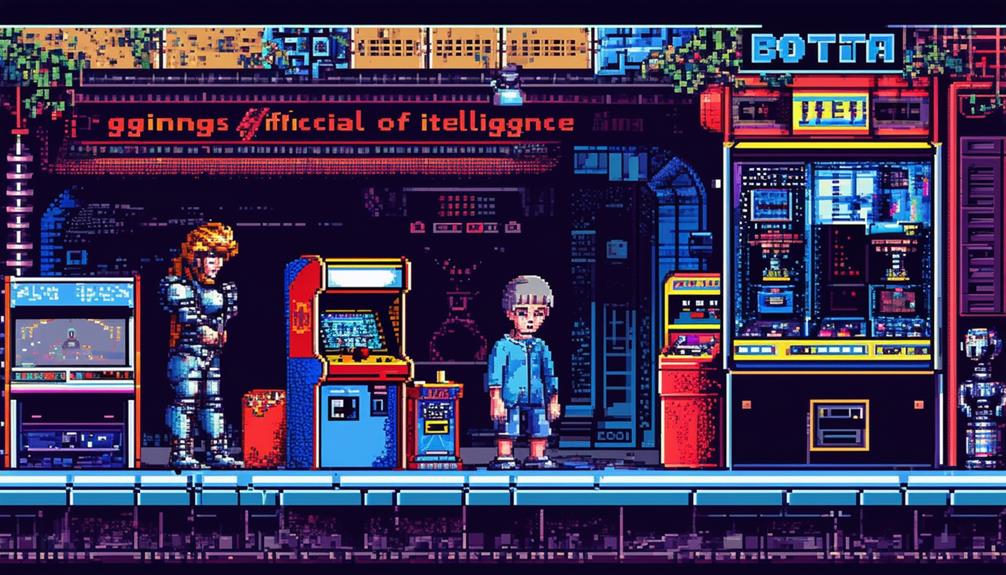
In the early days of video gaming, enemy movements relied heavily on stored patterns, providing predictable challenges for players. As technology advanced, the development of artificial intelligence (AI) began to revolutionize how games used enemy behavior. Space Invaders (1978) pioneered this shift by introducing simulated random movements that kept players on their toes, marking a significant transition from static patterns to more dynamic interactions.
Finite State Machines (FSMs) played a pivotal role in early video game AI. FSMs allowed developers to create a set of predefined states, such as attacking, healing, or retreating, that an enemy could transition between based on specific conditions. This added complexity and unpredictability to enemy behavior, enhancing the gaming experience.
The Sims (2000) took AI to a new level by enabling players to control characters' behaviors through need-based formulas and player-defined characteristics. This development made in-game interactions feel closer to real-world dynamics.
As AI continued to evolve, combat games began featuring more realistic opponents, further blurring the lines between virtual and real-world experiences. Machine learning and other advanced AI techniques have since been incorporated, pushing the boundaries of what's possible in video game AI.
Rule-Based Systems
Early video game AI utilized simple logic, but the introduction of rule-based systems brought a structured approach using if-then rules to dictate NPC behavior. These systems depended heavily on predefined logic and conditions, allowing developers to create predictable and consistent NPC actions. For example, in Pac-Man, the ghosts' movements followed straightforward rules: if Pac-Man is in a certain position, then the ghost moves in a specific direction. This made the ghosts' behavior both challenging and understandable for players.
Similarly, in Space Invaders, the aliens' behaviors were dictated by rule-based systems. The aliens moved in a set pattern, speeding up as more were eliminated. These if-then rules were simple yet effective, making the game progressively harder while maintaining a consistent logic that players could anticipate.
Rule-based AI systems were prevalent in early video games due to their simplicity and ease of implementation. They provided a foundation for NPC behaviors that, while limited, were sufficient for creating engaging and challenging gameplay experiences. These foundational concepts paved the way for more complex AI systems as video game technology evolved.
Pathfinding Algorithms

Early pathfinding techniques laid the groundwork for advanced algorithms like A*, which revolutionized NPC navigation. Today's games use sophisticated methods to tackle real-time pathfinding challenges, ensuring smooth and realistic movement. Understanding these advancements highlights the significant progress AI in gaming has achieved.
Early Pathfinding Techniques
Early video games like Tanktics laid the groundwork for modern pathfinding by employing fundamental algorithms such as Dijkstra's. These early algorithms were pivotal in computing the most efficient routes for NPCs to navigate through virtual environments. Dijkstra's algorithm, for example, enabled NPCs to find the shortest path to their destination by evaluating the cost of each possible route, ensuring logical and efficient movement.
As video games evolved, the introduction of the A* algorithm brought significant improvements to NPC navigation. Unlike Dijkstra's, A* considers both the cost to reach the next point and an estimated cost to the destination, making it more effective. This advancement allowed NPCs to better navigate obstacles and dynamically adjust their paths, enhancing their behavior and realism within the game world.
These early techniques laid a solid foundation for the sophisticated pathfinding algorithms used in modern video games. Today, NPCs can traverse complex virtual environments with remarkable accuracy, avoiding obstacles and reacting intelligently to changes in their surroundings. Understanding these early methods helps appreciate the technological advancements that have made today's NPCs so lifelike and responsive.
Advanced A* Algorithm
The A* algorithm has revolutionized NPC navigation in video games by combining the efficiency of Dijkstra's algorithm and the foresight of Greedy Best-First Search. By considering both the cost of reaching a node and the estimated cost to the destination, A* ensures efficient pathfinding, making it ideal for real-time applications. This dual consideration enables NPCs to navigate complex environments with remarkable efficiency and realistic movement.
In video games, A* excels for several reasons:
- Efficiency: A* optimizes pathfinding by balancing cost and distance, reducing unnecessary computations.
- Realistic Movement: NPCs move more naturally and believably, enhancing player immersion.
- Dynamic Adjustments: The algorithm allows for real-time changes as game conditions evolve, ensuring NPCs can adapt to new obstacles or objectives.
- Versatility: A* is applicable across various game genres and complexities, from simple 2D maps to intricate 3D worlds.
With A*, NPC navigation becomes smoother and more responsive, directly enhancing the player's experience. The algorithm's ability to dynamically adjust paths in real-time means that NPCs can react intelligently to changing environments, making games more engaging and challenging.
Real-Time Pathfinding Challenges
Navigating dynamic and unpredictable game environments in real-time poses significant challenges for pathfinding algorithms. As AI continues to evolve, real-time strategy games require increasingly sophisticated solutions to ensure that non-player characters (NPCs) can navigate efficiently. Traditional algorithms such as Dijkstra's and A* have been foundational in optimizing NPC movement patterns through complex environments.
In these games, NPCs must adapt to changing terrains and obstacles. Pathfinding algorithms need to balance computational efficiency and performance to prevent NPCs from lagging or making inefficient moves. Grid-based pathfinding, which breaks down environments into manageable cells, enables algorithms to quickly find the most efficient routes without overwhelming the system.
Decision trees are frequently used to guide NPCs in their choices and responses to obstacles. These decision trees enhance NPCs' ability to react to dynamic changes, making their movements appear more natural and intelligent. This approach goes beyond merely avoiding walls or hazards; it aims to create an immersive experience where NPCs seem genuinely responsive and strategic.
Finite State Machines
Finite State Machines (FSMs) streamline AI behavior management in video games by breaking down behaviors into distinct states and defining transitions between them. This approach optimizes the control flow of video game AI, making AI development more manageable and efficient.
FSMs have been instrumental in crafting complex enemy behaviors in popular games like Halo 2. They are utilized across various genres, from RTS games to sports simulations, where they guide AI actions and decision-making processes. Here's how FSMs impact Video Game AI:
- Control Flow: FSMs provide a clear structure for managing AI behaviors, ensuring smooth transitions and efficient control.
- AI Development: By simplifying the development process, FSMs enable the creation of sophisticated AI without unnecessary complexity.
- Enemy Behaviors: Games like Halo 2 use FSMs to produce intricate enemy behaviors, enhancing player engagement.
- RTS and Sports Simulations: FSMs are crucial in these genres, guiding AI decisions and actions, from strategic maneuvers in RTS games to realistic player movements in sports simulations.
Machine Learning Integration

Integrating machine learning into video game AI enables it to adapt dynamically to player interactions, resulting in a more immersive and challenging experience. Techniques such as Reinforcement Learning and neural networks allow modern games to develop intelligent AI that evolves based on player actions. For instance, deep learning models enhance non-player characters (NPCs) by learning from gameplay patterns and adjusting their strategies to maintain player engagement.
AI opponents benefit significantly from Monte Carlo tree search, which improves decision-making in complex scenarios by evaluating numerous possible moves and selecting the most effective one. Reinforcement Learning further refines these strategies, enabling AI to learn from both successes and mistakes in real-time.
Incorporating machine learning also leads to more lifelike and unpredictable behavior trees in NPCs, making their actions appear more natural and enriching the gaming experience. By combining these advanced techniques, developers can create AI that feels genuinely intelligent and responsive.
Summary:
| Technique | Application in Games |
|---|---|
| Deep Learning Models | Enhancing NPC behavior |
| Reinforcement Learning | Real-time strategy adjustment |
| Monte Carlo Tree Search | Effective decision-making for AI opponents |
| Neural Networks | Dynamic adaptation to player interactions |
In essence, machine learning integration transforms AI in video games, ensuring each gaming session is uniquely engaging and interactive.
Procedural Content Generation
Machine learning has revolutionized AI behavior in games, while procedural content generation (PCG) has redefined the creation of game environments and elements. By using algorithms instead of pre-stored patterns, developers can generate vast and unique worlds without manually designing every detail. Early examples of PCG include games like Minecraft and No Man's Sky, where landscapes and ecosystems are dynamically generated.
Procedural generation offers several advantages:
- Dynamic and Diverse Gaming Experiences: Each playthrough feels fresh as game content is uniquely generated every time.
- Enhanced Replayability: Players are encouraged to return, knowing they'll encounter new experiences in each session.
- Reduced Development Time: Developers save time and resources by not manually crafting each element.
- Scalability: Games can be expanded without significant increases in development effort.
AI tools have further evolved to assist in procedural generation, making the process more efficient and flexible. This results in games that are not only expansive but also rich in variety and detail. Procedural content generation is a powerful technique that has fundamentally transformed the way we experience video games.
Future Trends in AI

Emerging trends in AI are continually pushing the boundaries of what's possible in video game development. Modern games now harness major AI advancements to create more immersive and dynamic experiences. For instance, AI methods like behavior trees and planners are being refined to make non-player characters (NPCs) more lifelike and responsive. These NPCs can dynamically shift their behaviors based on player actions, creating a more engaging and unpredictable gameplay experience.
Generative AI is also making waves, promising to revolutionize game features such as level design and story generation. However, it requires large datasets to learn from, raising questions about job security and ethical considerations in game development. Despite these concerns, the potential for AI-driven content creation is immense, potentially reducing development time and costs.
Another exciting trend is the use of AI in a coaching or managerial role, where AI systems guide players to improve their skills or manage in-game resources more effectively. This can make games more accessible and enjoyable for a broader audience. As research continues, expect AI to play an even greater role in shaping the future of video games, making them more adaptive and personalized than ever before.
Conclusion
The evolution of AI in video games has progressed from basic enemy behaviors to advanced machine learning systems. Early innovations included rule-based systems, pathfinding algorithms, finite state machines, and procedural content generation. These advancements have made games more immersive and challenging. Looking ahead, AI in gaming promises even more exciting innovations, such as behavior trees and generative AI. Prepare yourself, as the future of gaming will be smarter and more engaging than ever before!