The Contributions of Herbert Simon to AI
Herbert Simon is a seminal figure in the field of Artificial Intelligence. His pioneering concepts, such as bounded rationality and heuristic problem-solving, were not merely theoretical. They laid the groundwork for practical AI applications, including the Logic Theorist and the General Problem Solver. Beyond algorithms, Simon integrated principles from political science into AI, enriching our understanding of human cognition in machines. His contributions continue to shape modern AI research and cognitive psychology, leaving a lasting legacy that impacts the field to this day.
Early Life and Education

Born in 1916 in Milwaukee, Wisconsin, Herbert A. Simon's educational journey laid the foundation for his interdisciplinary approach to artificial intelligence (AI). Simon's early academic pursuits were marked by a robust and diverse educational background. He studied political science at the University of Chicago, earning his PhD in 1943. This training was crucial, giving him a unique perspective on AI that integrated political science concepts.
Simon was a true interdisciplinary scholar, seamlessly blending ideas from various fields. His education in political science significantly influenced his AI research, particularly in understanding human decision-making processes. This foundation would later prove invaluable when he joined the faculty at Carnegie Mellon University, where he expanded his research to include computer science.
Simon's broad educational base allowed him to approach problems from multiple angles, leading to significant contributions in AI. His interdisciplinary mindset was instrumental in merging political science theories with computational methods, resulting in innovative solutions in artificial intelligence. His early educational experiences were pivotal in developing the pioneering ideas that would eventually shape the AI landscape.
Foundational AI Concepts
As you explore Simon's foundational AI concepts, you'll encounter the principle of bounded rationality, which explains the limitations of human decision-making. Heuristic problem-solving and decision-making models are crucial for understanding how AI simulates human thought processes. Simon's insights in these areas have significantly influenced the development of AI technologies.
Bounded Rationality Principle
Herbert Simon's principle of bounded rationality revolutionizes artificial intelligence (AI) by acknowledging the cognitive limits and constraints inherent in human decision-making. Unlike traditional economic theories that assume perfect rationality, Simon's concept recognizes that decisions are often made with limited information and cognitive resources. This approach provides a more realistic model of decision-making in the real world.
Incorporating bounded rationality into AI models allows for the creation of systems that better mimic human decision-making processes. These models take into account the same constraints and limitations humans face, leading to more practical and effective problem-solving approaches. For example, AI systems can be designed to manage incomplete information and limited cognitive resources, mirroring human strategies.
Simon's contributions have significantly impacted AI development, enabling the creation of systems that are both theoretically sound and practically applicable in real-world scenarios. Embracing bounded rationality enhances the understanding and replication of the complexity of human decision-making in artificial intelligence.
Heuristic Problem Solving
Pioneering the field of heuristic problem-solving, Herbert A. Simon focused on developing AI methods that emphasize efficiency and practicality. He introduced the concept of 'satisficing' as a decision-making strategy, which targets achieving satisfactory solutions rather than ideal ones. This approach is particularly valuable in complex scenarios where finding the perfect solution is computationally impractical.
Simon's work laid the groundwork for cognitive systems that emulate human decision-making processes. By incorporating human-like reasoning into computational systems, he made AI more effective and relatable. His collaboration with Allen Newell led to the creation of the General Problem Solver (GPS), a system designed to tackle a broad range of problems using predefined rules. The GPS was revolutionary because it demonstrated how heuristic problem-solving could efficiently address diverse challenges.
The integration of satisficing into AI allowed these systems to operate more like humans, enhancing their capability to handle real-world applications. Simon's emphasis on efficiency and practicality in heuristic problem-solving has had a lasting impact on AI, enabling the development of smarter, more adaptable computational systems. His contributions continue to shape contemporary approaches to problem-solving in AI.
Decision-Making Models
Building on his pioneering work in heuristic problem-solving, Herbert Simon developed influential decision-making models that emphasize bounded rationality and satisficing, fundamentally altering the perception of human cognition in AI. Bounded rationality suggests that individuals make decisions based on limited information and cognitive constraints. Instead of seeking optimal solutions, they aim for satisfactory ones, a concept Simon termed 'satisficing.' This approach mirrors human behavior in real-life scenarios, where perfect information and unlimited cognitive resources are rarely available.
Simon's decision-making models were instrumental in shaping the development of early AI programs like the Logic Theorist and the General Problem Solver. These AI systems were designed to emulate human thought processes by incorporating heuristics—simple rules or strategies that guide decision-making under constraints. By acknowledging these cognitive limitations, Simon's models provided a more realistic framework for understanding human cognition and how it can be simulated in AI.
The concepts of bounded rationality and satisficing have had a lasting impact on AI research. They underscore the importance of designing AI systems that can operate effectively within constraints similar to those experienced by humans, thus making AI more robust and adaptable in complex environments.
The Logic Theorist

Herbert Simon's collaboration with Allen Newell in 1955 on The Logic Theorist was pioneering. This program not only tackled problems in propositional logic but also successfully proved 38 of the first 52 theorems in Whitehead and Russell's Principia Mathematica. By employing heuristic search algorithms, it demonstrated artificial intelligence's ability to solve complex problems and laid a crucial foundation for future AI research.
Foundational AI Program
Herbert Simon and Allen Newell ignited the AI revolution in 1956 with the development of the Logic Theorist, a pioneering program designed to prove mathematical theorems and emulate human problem-solving. This groundbreaking project at Carnegie Mellon University marked a pivotal moment in artificial intelligence history. The Logic Theorist was not merely another piece of software; it was one of the first AI programs to demonstrate machine intelligence by modeling human reasoning.
The Logic Theorist showcased how computers could tackle complex problems in a manner akin to human thought processes. Designed to solve mathematical theorems, the program required a level of sophistication and innovation unprecedented in AI at the time. Simon and Newell's creation demonstrated that machines could perform tasks previously believed to necessitate human intelligence.
Their work received substantial recognition and laid the foundation for future AI research. By exhibiting human-like problem-solving capabilities, the Logic Theorist set the stage for subsequent advancements in artificial intelligence and machine learning. Simon's contributions, particularly through the Logic Theorist, remain a cornerstone in the evolution of AI.
Proving Mathematical Theorems
The Logic Theorist, developed by Herbert Simon and Allen Newell in 1956, was a groundbreaking AI program that successfully proved mathematical theorems, illustrating the potential of computers to emulate human problem-solving abilities. By employing heuristics and pattern recognition, the Logic Theorist generated proofs, marking a significant advancement in artificial intelligence. This program went beyond mere calculations; it mimicked human reasoning processes in theorem proving, laying the groundwork for future AI and cognitive models.
Simon and Newell's work demonstrated that computers could engage in complex cognitive tasks, not just simple calculations. The Logic Theorist's success in recognizing patterns and using heuristics to solve problems established a foundation for subsequent AI developments. It revealed that machines could be designed to tackle problems in ways similar to human approaches, transforming the field of artificial intelligence.
Human Decision-Making Models
Understanding human decision-making models requires recognizing the realistic approaches advocated by Herbert Simon, who emphasized the role of organizational structures and problem-solving strategies. Simon challenged traditional views with his concept of bounded rationality, which highlights that human cognition operates within limits. He argued that people use satisficing—opting for an acceptable solution rather than the optimal one—because our cognitive capacities and available information are restricted. His work laid the groundwork for integrating artificial intelligence with cognitive psychology to mirror human decision-making.
Simon developed hierarchical and associative models to explain how individuals process information and make choices. He believed that understanding organizational structures provides insights into how decisions are made within groups and institutions. His realistic decision-making approaches underscored the importance of context and constraints.
Key Concepts:
- Bounded Rationality: Simon's theory that humans make decisions within cognitive and informational limitations.
- Satisficing: Choosing a 'good enough' solution rather than the optimal one.
- Problem-Solving Strategies: Techniques used by individuals and organizations to navigate complex decisions.
Simon's pioneering programs, such as the Logic Theorist and General Problem Solver, used AI to model human problem-solving, demonstrating the potential of AI to replicate aspects of human cognition and behavior. His contributions continue to have a profound influence on both fields.
Bounded Rationality Theory
Herbert Simon's bounded rationality theory revolutionized our understanding of decision-making under constraints. Contrary to the notion of perfect rationality, Simon argued that individuals make decisions based on limited information, cognitive limitations, and time constraints. Rather than seeking optimal solutions, people often settle for what he termed 'satisficing'—choosing solutions that are good enough given the circumstances.
This concept has significantly impacted fields like behavioral economics and organizational behavior. In behavioral economics, it elucidates why individuals sometimes make seemingly irrational choices. In organizational behavior, it provides a framework for understanding decision-making in complex environments where perfect information is seldom available.
Simon's insights also influenced research in human problem-solving and artificial intelligence. By recognizing that both humans and machines operate under constraints, researchers began to develop more realistic models and algorithms that better mimic actual decision-making processes. This paradigm shift has led to advancements in AI that account for cognitive limitations and satisficing behaviors, mirroring human decision-making.
Herbert Simon's contributions continue to shape our understanding and approach to decision-making across multiple disciplines, offering a more realistic viewpoint on how choices are made in real-world settings.
Legacy in AI Research
Herbert Simon's pioneering work in artificial intelligence laid the foundation for numerous advancements in the field, establishing his legacy as a visionary thinker. His contributions profoundly influenced modern AI research, shaping our understanding of human cognition and problem-solving. Simon's collaboration with Allen Newell led to the development of groundbreaking programs like the Logic Theorist and General Problem Solver, which were instrumental in demonstrating how computers could simulate human thought processes.
Simon's impact on AI research is highlighted by several key achievements:
- Receiving the prestigious A.M. Turing Award in 1975, which recognized his exceptional contributions to the field.
- Innovatively using computer simulations to study human decision-making processes, revolutionizing both AI and psychology.
- Expanding the applications of artificial intelligence, thereby influencing diverse disciplines and practical domains.
Influence on Cognitive Psychology
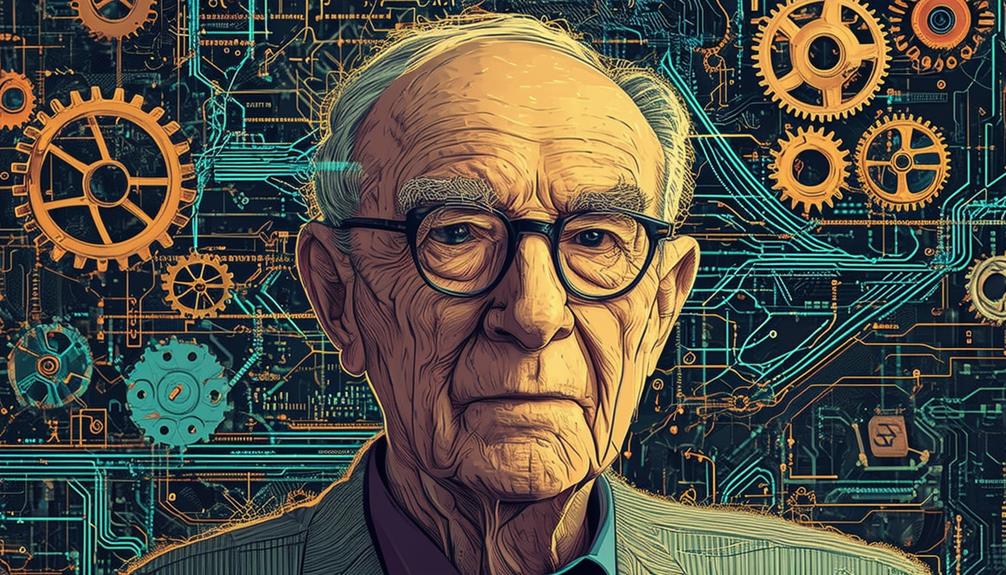
Simon's pioneering work in artificial intelligence (AI) has profoundly impacted cognitive psychology, offering valuable insights into human thought and problem-solving processes. Collaborating with Allen Newell, Simon developed models that simulate these processes, creating groundbreaking tools such as the Logic Theorist and the General Problem Solver. These tools have been instrumental in leveraging computers to enhance our understanding of human cognition.
Simon's research emphasized the importance of organizational structures and hierarchical mental processes in human problem-solving. He revealed that human decision-making is not merely linear but involves complex, layered thinking. This understanding has led to significant advancements in cognitive psychology and behavioral economics by providing a robust framework for studying human decision-making.
A concise overview of Simon's influence is as follows:
| Key Area | Contribution | Impact |
|---|---|---|
| Cognitive Psychology | Models of human problem-solving | Enhanced understanding of human cognition |
| AI Development | Logic Theorist, General Problem Solver | Tools for simulating human thought |
| Decision-Making | Hierarchical mental processes | Insights into decision-making processes |
| Organizational Structures | Emphasis on structured thinking | Improved study of organizational behavior |
| Behavioral Economics | Framework for human decision-making | Advanced research in economic behavior |
Simon's contributions have laid a solid foundation for understanding human cognition and behavior, influencing a broad range of fields beyond AI.
Awards and Recognitions
Herbert A. Simon's groundbreaking work at the intersection of artificial intelligence and cognitive psychology earned him numerous prestigious awards, most notably the Nobel Prize in Economics in 1978 and the ACM A.M. Turing Award in 1975. His Nobel Prize recognized his profound insights into the decision-making process, fundamentally reshaping our understanding of economic behavior. The Turing Award honored his pivotal contributions to the field of artificial intelligence.
Simon's collaboration with Allen Newell was particularly significant. Together, they developed pioneering AI programs such as the Logic Theorist and the General Problem Solver, which were instrumental in modeling human problem-solving processes. Their work laid a foundational framework for future advancements in AI research.
To summarize his achievements:
- Nobel Prize in Economics (1978): Awarded for his profound insights into economic decision-making.
- ACM A.M. Turing Award (1975): Celebrated his significant contributions to artificial intelligence.
- AI Programs Development: Collaborated with Allen Newell on groundbreaking AI programs.
Herbert A. Simon's numerous accolades and recognitions reflect his enduring impact on AI research and cognitive psychology. His pioneering work continues to influence the field, solidifying his legacy as a key figure in advancing our understanding of both human cognition and artificial intelligence.
Conclusion
Herbert Simon's pioneering work laid the foundation for modern AI by introducing key concepts like bounded rationality and heuristic problem solving. These ideas revolutionized our understanding of human cognition in artificial systems. Simon's developments, such as the General Problem Solver and the Logic Theorist, demonstrated machine intelligence and human-like problem-solving abilities. His influence extends beyond AI, impacting cognitive psychology and decision-making models. Simon's legacy continues to shape and inspire contemporary AI research.
Related posts