Shakey the Robot: the First General-Purpose Mobile Robot During the 1970S
When you think about the origins of mobile robotics, Shakey the Robot stands out as a pivotal figure. Developed by the Stanford Research Institute in the late 1960s and early 1970s, Shakey was the first robot capable of autonomously navigating and making decisions. It could understand basic English commands, recognize objects, and plan its path using sonar range finders and the STRIPS planner. These early innovations laid the groundwork for the future of robotics. Curious about how Shakey's capabilities influenced modern technology? Let's delve further.
Early Development
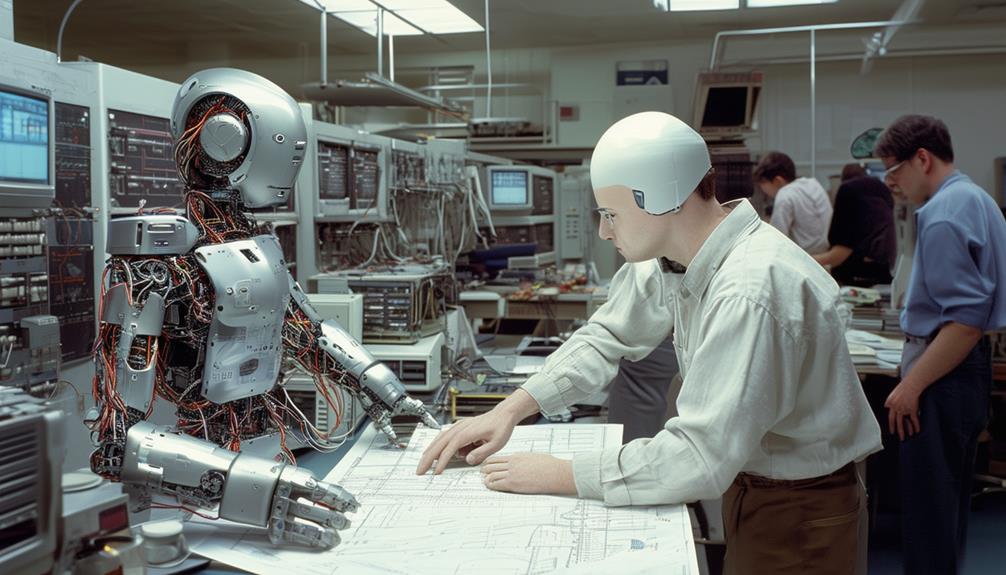
During the early development phase, Shakey the Robot was created by a dedicated team at the Stanford Research Institute from 1966 to 1972. This groundbreaking project laid the foundation for modern robotics. Shakey was the first mobile, semi-autonomous robot capable of understanding and executing over 100 English commands, representing a significant leap in dynamic planning and interaction capabilities.
At the Computer History Museum, Shakey is prominently displayed, symbolizing the dawn of the robotics age. The robot's ability to navigate and make decisions in a dynamic environment challenged traditional perceptions and set the stage for a future trillion-dollar industry. The researchers at the Stanford Research Institute were pioneers, pushing the boundaries of robotics.
DARPA played a crucial role by providing essential funding, recognizing the potential in developing a semi-autonomous robot capable of responding to complex commands in real-time. Shakey was not just a technological marvel; it was a precursor to today's advanced robotic systems, paving the way for future innovations.
Funding and Support
The success of Shakey the Robot was largely due to substantial financial backing from DARPA, which provided $750,000 in the 1960s—equivalent to over $5 million today. This government support was crucial for Shakey's groundbreaking research. Without DARPA's funding, Shakey's creators could not have advanced robotics technology to develop the first general-purpose mobile robot.
DARPA's financial backing enabled the research team to explore new horizons in robotics. The funding covered not only materials and equipment but also the salaries of the talented researchers who were instrumental in Shakey's development. By investing in Shakey, DARPA highlighted the critical role of government support in advancing technological frontiers.
This financial support provided the necessary resources for experimentation, iteration, and innovation. The researchers had the freedom to explore uncharted territories in mobile robotics without the constant pressure of financial constraints. Ultimately, DARPA's support created an environment where Shakey could thrive, paving the way for future advancements in robotics. This pivotal financial backing underscores the vital role of government funding in driving technological innovation and progress.
Innovative Technologies
You'll be amazed by Shakey's revolutionary navigation system, which utilized the A* search algorithm for optimal path planning. Its problem-solving capabilities, powered by the STRIPS planner, were groundbreaking for its time. Shakey's early artificial intelligence demonstrated the potential for robots to think and adapt, significantly influencing the future of robotics.
Revolutionary Navigation System
Shakey the Robot revolutionized mobile robotics with its advanced navigation system, enabling autonomous navigation through rooms and corridors. Developed at the Artificial Intelligence Center, Shakey's system was a pioneering achievement in robotics. Utilizing sonar range finders, collision detection sensors, and a TV camera, Shakey could accurately map its surroundings and avoid obstacles. These groundbreaking technologies allowed Shakey to plan paths and interact effectively with its environment, showcasing the potential of autonomous robots.
At Shakey's core, a computer processed sensor data to enable real-time decision-making and adaptive movement. This capability marked a significant advancement in mobile robotics, laying the groundwork for future innovations. Shakey's autonomous navigation and environment interaction demonstrated the practical applications of AI in robotics, inspiring subsequent developments in the field.
Basic Problem-Solving Abilities
Imagine instructing a robot in English to navigate a room, pick up an object, and return—a set of tasks made possible by Shakey the Robot's advanced problem-solving technologies. Shakey's ability to comprehend over 100 English commands was revolutionary, leveraging early natural language processing (NLP) to facilitate communication in English.
Shakey's problem-solving prowess was built on the STRIPS planner and the A* algorithm. The STRIPS planner decomposed complex tasks into manageable steps, while the A* algorithm ensured optimal path planning for efficient navigation. These technologies allowed Shakey to interact with objects in its environment seamlessly.
Here is a breakdown of Shakey's system:
| Component | Function | Outcome |
|---|---|---|
| English Commands | User input in natural language | Shakey understands tasks |
| STRIPS Planner | Decomposes tasks into actionable steps | Effective problem-solving skills |
| A* Algorithm | Computes optimal paths | Efficient navigation |
| Early NLP | Processes language input | Communication in English |
Shakey's ability to execute commands highlighted the essential interplay between natural language processing and problem-solving capabilities. By integrating these pioneering technologies, Shakey set a benchmark in robotics, demonstrating how robots could perform complex tasks and interact with their surroundings using simple English commands.
Early Artificial Intelligence
In the realm of early artificial intelligence, groundbreaking technologies like the STRIPS planner and A* algorithm revolutionized problem-solving and navigation for robots. Shakey the Robot, a pioneering project funded by DARPA, showcased these advancements in Robotics and AI. Shakey utilized the STRIPS planner to decompose complex tasks into manageable steps, enhancing its capability to plan and execute missions efficiently. This planning and navigation method remains a cornerstone in Computer Science today.
Moreover, the A* search algorithm, developed for Shakey, optimized pathfinding, ensuring the robot could navigate its environment effectively. This algorithm is still fundamental in modern Robotics and AI for efficient path planning. Shakey's software legacy extended further, incorporating early natural language processing capabilities that enabled basic human-robot interaction—a precursor to today's sophisticated AI communication systems.
Shakey's contributions to AI can be summarized as:
- Planning and Navigation Methods: STRIPS planner and A* search algorithm laid the groundwork for future AI systems.
- Computer Vision: Pioneering technology that allowed Shakey to interpret and interact with its environment.
- Natural Language Processing: Early systems that enabled basic human-robot communication.
These advancements not only propelled early AI research but also established foundational technologies still relevant today.
Command Processing
In the 1970s, robotics experienced a groundbreaking advancement with the development of Shakey the Robot, a system capable of understanding and executing over 100 English commands. Shakey was designed to interpret and act upon these commands, showcasing an unprecedented level of sophistication. This ability to handle intricate instructions marked a significant milestone in robotics, highlighting Shakey's role as the pioneering general-purpose mobile robot.
By processing human instructions, Shakey could autonomously navigate its environment. It is remarkable how this robot could respond to commands such as 'move to the box,' 'push the block,' or even more complex sequences. This command processing capability wasn't just about basic movements; it involved understanding the context and executing tasks accordingly.
Shakey's success in command processing laid the groundwork for future developments in robotics. The robot's ability to comprehend and respond to human input demonstrated the potential for machines to interact more naturally with humans. As a mobile robot, Shakey's command processing system enabled it to function independently, setting a precedent for future autonomous systems. This breakthrough in interpreting and acting upon commands was pivotal for the evolution of intelligent robotics.
Computer Vision
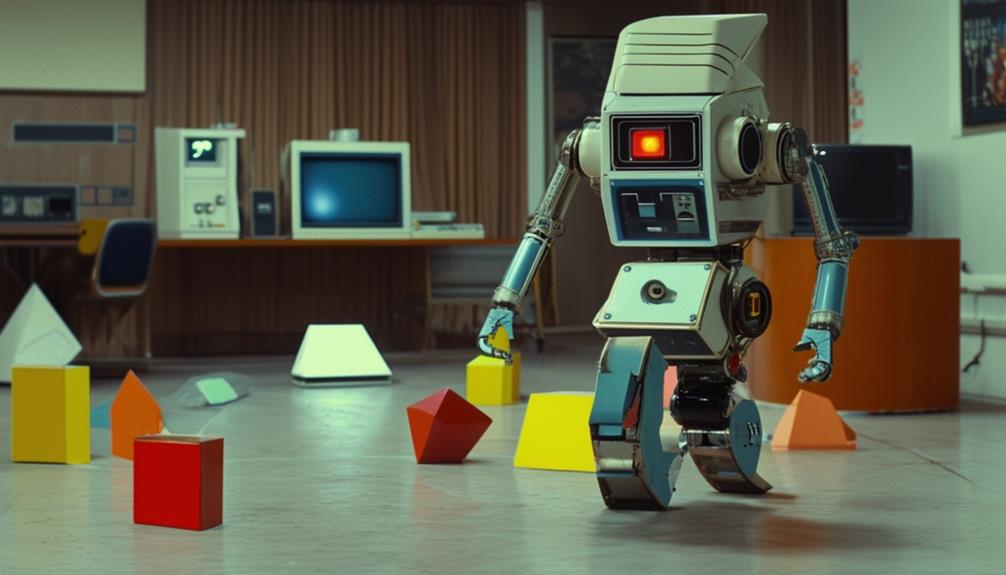
Shakey's computer vision system utilized image processing techniques like the Hough Transform, which were crucial for object recognition. These methods enabled Shakey to detect and identify objects within its environment effectively. The advancements made by Shakey laid the groundwork for the sophisticated robotic vision systems we use today.
Image Processing Techniques
Shakey the Robot's pioneering use of image processing techniques, such as the Hough Transform Algorithm, revolutionized robotic object detection and analysis. Leveraging these advanced computer vision capabilities, Shakey set the stage for modern object identification in robotics. The Hough Transform Algorithm was crucial for enabling Shakey to identify co-linear points in images, a fundamental step in object detection and analysis.
Shakey's vision systems were intricately linked with its STRIPS (Stanford Research Institute Problem Solver) model, enhancing its planning and problem-solving abilities. This integration allowed the robot to not only see but also understand and interact with its environment. The image processing techniques Shakey employed were groundbreaking at the time and laid the foundation for future advancements in robotic vision systems.
Key Contributions:
- Object Identification: Shakey's ability to detect and recognize objects using the Hough Transform Algorithm.
- Planning and Problem-Solving: The STRIPS model enhanced Shakey's navigation and interaction capabilities.
- Manipulation Capabilities: Improved object handling through precise image processing.
These innovations in image processing made Shakey more than just a mobile robot; it became a pioneer in intelligent robotics, influencing future developments in robotic vision and manipulation capabilities.
Object Recognition Challenges
Identifying objects in a dynamic environment posed significant challenges for early robotics, exemplified by Shakey the Robot. Shakey utilized a TV camera for object recognition, enabling it to detect and interact with items such as blocks and movable obstacles in its surroundings. This innovation was groundbreaking for the 1970s, allowing Shakey to navigate and manipulate its environment autonomously.
The TV camera provided essential visual input, which Shakey processed to identify objects. This capability was crucial for performing autonomous tasks, as it allowed Shakey to understand and respond to its surroundings without human intervention. Object recognition involved not just seeing objects but also interpreting visual data to interact with and modify the environment.
Shakey's advancements in computer vision and object recognition laid the groundwork for future robotics. By overcoming these early challenges, Shakey demonstrated the potential for robots to use visual input to perform complex, autonomous tasks. These foundational technologies have evolved, leading to more sophisticated systems in modern robotics, but Shakey's pioneering efforts remain a cornerstone in the history of robotic object recognition.
Path Planning
How did Shakey the Robot revolutionize the field of path planning in robotics during the 1970s? Shakey introduced groundbreaking innovations that shaped the future of robotic path determination by utilizing the A* route-finding algorithm, becoming a cornerstone in mobile robotics. This method allowed Shakey to calculate the shortest path from point A to point B, traversing rooms and corridors with unprecedented precision.
One of Shakey's significant contributions was the implementation of the STRIPS planner. This planner broke down complex tasks into simpler, manageable actions, enabling Shakey to perform automated planning and execution. The combination of the A* algorithm and the STRIPS planner laid the groundwork for future robotic path planning systems.
Key advancements included:
- A* Route-Finding Algorithm: Enabled Shakey to determine the shortest and most efficient paths.
- STRIPS Planner: Facilitated the breakdown of tasks for streamlined execution.
- Mobile Robotics: Showcased early advancements in traversing physical spaces.
Shakey's path planning capabilities set the stage for sophisticated path determination algorithms seen in modern robotics. The robot's ability to autonomously navigate complex environments demonstrated the potential of automated planning and execution, revolutionizing how robots interact with their surroundings.
Research Impact

The development of Shakey the Robot profoundly influenced the fields of robotics, artificial intelligence, and computer science. Shakey's project introduced the concept of logical reasoning and goal-based agents, revolutionizing how robots could be programmed to achieve specific objectives. By implementing these advanced AI concepts, Shakey demonstrated that robots could perform complex tasks autonomously, setting a new benchmark for future research.
One of Shakey's most notable contributions was in algorithm development, specifically the A* route-finding algorithm. Emerging from this project, A* remains a cornerstone in pathfinding and navigation for modern robotics. Its efficiency and reliability have ensured continued use in diverse applications ranging from video games to autonomous vehicles.
Shakey's impact extends beyond algorithm development. The project's software innovations in vision, pathfinding, and object manipulation are still evident in present-day robotics, underscoring its lasting influence. In recognition of this significant impact, Shakey was awarded the IEEE Milestone in Electrical Engineering and Computing, cementing its place in the annals of technological history.
Legacy and Influence
Shakey the Robot's legacy endures through its significant impact on subsequent robotics projects and innovations. This influence is evident in the development of the Centibots, a project derived from Shakey's pioneering advancements. Shakey's groundbreaking work in artificial intelligence has indelibly shaped the field, particularly in automated planning and task execution.
Key components of Shakey's programming, such as the STRIPS planner and the A* search algorithm, have revolutionized robotics and beyond:
- STRIPS Planner: Transformed logical, goal-based problem-solving in robotics.
- A* Search Algorithm: Remains fundamental in pathfinding, influencing numerous applications beyond robotics.
- Centibots: Inspired by Shakey, highlighting its lasting impact on collaborative multi-robot systems.
Shakey's enduring influence was formally recognized with its induction into the Robot Hall of Fame at Carnegie Mellon University in 2004. This accolade underscores Shakey's pivotal role in shaping the realms of robotics and artificial intelligence, ensuring its legacy continues to inspire future generations of roboticists and AI researchers.
Media Coverage and Awards

In 1969, Shakey captivated public and media attention when SRI presented its groundbreaking abilities in a widely viewed video. This demonstration attracted extensive coverage from major publications such as the New York Times, Life, and National Geographic Magazine, showcasing Shakey's pioneering capabilities. The public was fascinated by this unprecedented leap in robotics.
Shakey's achievements were also highly recognized by the scientific community. The IEEE Milestone in Electrical Engineering and Computing acknowledged Shakey's profound impact on robotics and AI. Furthermore, the Association for the Advancement of Artificial Intelligence honored Shakey's legacy by naming its prestigious awards the "Shakeys," reflecting Shakey's pivotal role in advancing artificial intelligence.
In 2004, Shakey's influence was further cemented with its induction into the Robot Hall of Fame at Carnegie Mellon University, emphasizing its status as a pioneering figure in robotics history. These recognitions have had a lasting impact, inspiring numerous other robotics projects and paving the way for future advancements in AI and automated planning. Shakey's legacy is a testament to the power of innovation, continually inspiring new generations of roboticists.
Conclusion
Shakey the Robot revolutionized robotics in the 1970s with groundbreaking innovations in navigation, object recognition, and English command processing. Pushing the boundaries of what was possible, Shakey's advancements influenced countless developments in mobile robotics, cementing its place as a true pioneer. Understanding Shakey's journey highlights how far robotics has come and points to the exciting advancements that lie ahead.
Related posts