Robotics in the Automotive Industry: Automation and Efficiency During the 1980s
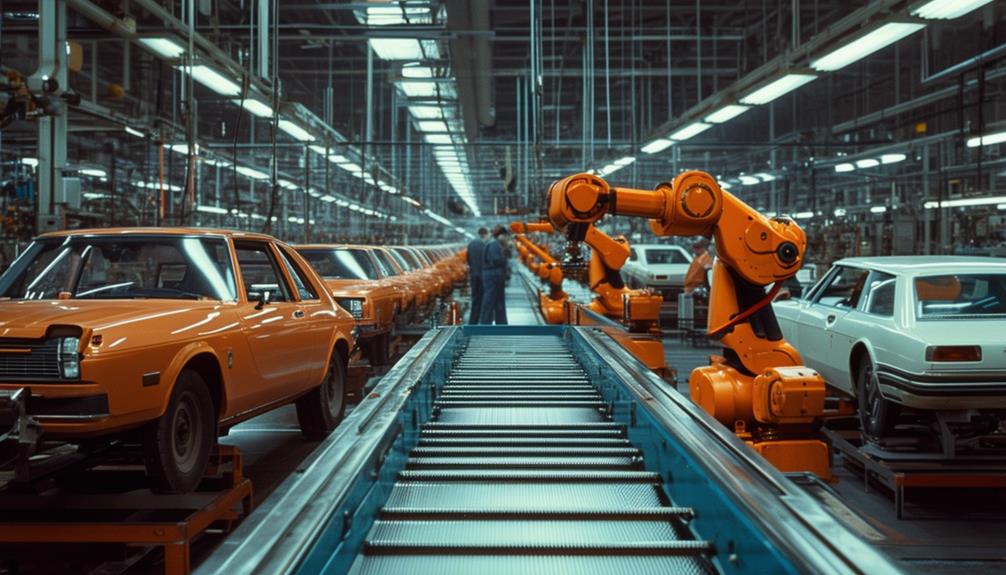
Imagine you're overseeing an automotive factory in the 1980s, and robotic arms are suddenly introduced, revolutionizing car manufacturing. These machines handle welding, painting, and assembly with unmatched precision and speed. Leading companies like General Motors and Ford rapidly adopt this technology, resulting in more efficient production lines and higher quality vehicles. What made these robotic advancements groundbreaking, and how did they reshape the industry's future? There's much more to explore about the profound impact of this technological shift.
Evolution of Automotive Robotics

The evolution of automotive robotics experienced a significant transformation in the 1980s, revolutionizing the industry with advanced automation and heightened efficiency. During this era, industrial robots became central to automotive manufacturing, driving pivotal changes in production processes. The incorporation of robotic arms into assembly lines enhanced precision and minimized reliance on manual labor, achieving a level of consistency and accuracy unattainable through manual methods.
Japanese and European companies were at the forefront of this robotic revolution, integrating greater intelligence and sophistication into their systems. The widespread adoption of robotics during the 1980s saw automakers deploying these advanced machines for tasks such as welding, painting, and assembly. Automating these repetitive and intricate tasks led to marked improvements in efficiency and productivity throughout the industry.
Early Adoption of Automation
In the 1980s, the automotive industry rapidly adopted robotics to boost efficiency and productivity. Leading companies like Ford, General Motors, and Chrysler pioneered the use of advanced technologies for welding and assembly tasks. However, these advancements also presented challenges, particularly in workforce adaptation and the need for new skill sets.
Initial Robotics Implementation
In the 1980s, automotive giants like General Motors and Ford revolutionized automotive manufacturing by adopting industrial robots to enhance production efficiency and quality. These companies integrated robotic arms into their production lines, fundamentally transforming vehicle assembly. The robots were primarily assigned repetitive tasks such as welding and painting, which human workers found tedious and time-consuming.
The introduction of industrial robots in the automotive industry wasn't solely about speed; it also significantly improved quality control. Robotic arms performed tasks with a precision and consistency that were difficult for humans to achieve, leading to higher production standards and fewer defects.
For companies like General Motors and Ford, adopting these automation technologies was transformative. It streamlined processes, reduced errors, and enabled more efficient car production. Consequently, the 1980s became a pivotal decade where the automotive industry set a precedent in robotics adoption, influencing other sectors. By focusing on repetitive tasks, these early adopters successfully combined production efficiency with improved quality, laying the groundwork for future technological advancements.
Technological Advancements Impact
The adoption of automation technologies in the 1980s revolutionized automotive manufacturing by significantly enhancing production efficiency and quality. The integration of industrial robots into the automotive sector marked a pivotal shift in vehicle production. These technological advancements enabled manufacturers to automate repetitive and labor-intensive tasks such as welding, painting, and assembly, thereby streamlining manufacturing processes.
By embracing robotic automation, automotive companies in the 1980s achieved unprecedented levels of production efficiency. Industrial robots performed tasks with greater precision and consistency than human workers, reducing errors and enhancing the overall quality of the final product. This shift not only accelerated production timelines but also minimized waste, leading to cost savings and more effective resource management.
The early adoption of automation during this period laid a robust foundation for future technological advancements in the industry. As manufacturers integrated more sophisticated robotic systems, they benefited from increased efficiency and improved operational capabilities. These changes transformed the automotive landscape, setting new standards for productivity and quality that continue to influence modern manufacturing practices. Robotic automation in the 1980s was undeniably a game-changer for the automotive industry.
Workforce Adaptation Challenges
The early adoption of automation in the 1980s automotive industry posed significant challenges for workforce adaptation. As robots replaced manual labor tasks, many workers faced job displacement. To mitigate this, companies implemented retraining programs to upskill employees for new roles within automated manufacturing processes. These initiatives were crucial but not without their difficulties.
Resistance to automation was substantial among the workforce. Many employees feared losing job security, leading to reluctance in accepting new technologies. Effective communication strategies became essential for management to alleviate these fears and facilitate smoother transitions. By clearly explaining the benefits of automation and the necessity of retraining, companies could reduce some of the anxiety associated with these changes.
The shift towards automation in the 1980s profoundly impacted workforce dynamics and skill requirements in the automotive industry. While robots increased efficiency, they also required workers to quickly adapt to new roles and technologies. Balancing immediate productivity gains with long-term workforce stability remained a significant challenge throughout this transformative decade.
Key Technologies in the 1980s

In the 1980s, industrial robots became integral to automotive assembly lines due to advancements in computer numerical control (CNC) systems. Electric servo-driven robots revolutionized automation by enhancing efficiency and precision. Companies like FANUC led this transformation, enabling sophisticated tasks such as welding, painting, and assembly, thereby improving productivity and quality control.
Early Robotics Integration
Electric servo-driven robots revolutionized automotive manufacturing in the 1980s, setting new standards for precision and efficiency. The integration of industrial robotics into production lines was transformative for the automotive industry. Robots like FANUC's Model 1 greatly enhanced manufacturing efficiency by automating tasks with unprecedented precision and speed.
The automation technologies of the 1980s focused on improving both the speed and reliability of production processes. This early robotics integration marked a shift toward more advanced and sophisticated robotic systems. By automating repetitive and precise tasks, these robots reduced human error, increased production rates, and ensured consistent quality.
This era laid the groundwork for the modern robotics landscape in the automotive industry. The advancements in electric servo-driven robots during the 1980s showcased the potential for continued innovation and set the stage for further developments in automation technologies. The early adoption of these robots demonstrated the industry's commitment to enhancing manufacturing efficiency and paved the way for more integrated and advanced systems in the future.
Assembly Line Automation
During the 1980s, assembly line automation in the automotive industry experienced a significant leap forward with the adoption of advanced robotics and computer vision systems. Industrial robots became essential for tasks like welding, painting, and material handling, streamlining operations and drastically improving efficiency by reducing cycle times and increasing production output.
The integration of computer vision systems and robotic controllers significantly enhanced the quality of automotive manufacturing. These technologies minimized defects and errors, ensuring higher standards of consistency and reliability for each vehicle. The introduction of reprogrammable robots added flexibility to the production process, allowing for quicker changeovers and adaptation to different production needs. This adaptability made it easier for manufacturers to respond to market demands.
The shift towards more flexible and reprogrammable robots marked a major transformation in the automotive industry during the 1980s. Assembly line automation not only boosted production output but also elevated the overall quality of vehicles. By embracing these advanced technologies, the automotive industry set a new benchmark for efficiency and innovation during this pivotal decade.
Industrial Robot Advancements
Building on earlier innovations, the 1980s marked significant advancements in industrial robots, emphasizing efficiency, speed, and intelligence. Key technologies of the decade improved robotic arms, enhancing their precision and versatility. A significant leap occurred in programming capabilities, allowing industrial robots to perform more complex tasks and smoother operations.
During this period, sensors and feedback systems became integral, enabling robots to adapt in real-time to their environments. These sensors allowed robots to detect discrepancies and adjust their actions accordingly, leading to higher efficiency and fewer errors. Additionally, advancements in grippers and end-of-arm tooling expanded the robots' capabilities, allowing them to handle a broader variety of parts and materials, thereby making them indispensable in manufacturing processes.
The integration of these technologies meant that industrial robots in the 1980s were not only faster and more efficient but also smarter and more adaptable. These advancements laid the groundwork for the highly automated and intelligent manufacturing systems in use today.
Impact on Production Lines
The 1980s marked a transformative period for automotive production lines with the widespread adoption of robotic automation, significantly enhancing efficiency and precision. In the automotive industry, robotic automation revolutionized production by increasing speed and streamlining processes. This shift not only accelerated production but also minimized errors and boosted overall productivity. Robots could perform tasks with a level of accuracy and consistency unattainable by human workers, leading to higher output and reduced costs.
The introduction of robotics in the 1980s set new standards for modern manufacturing practices. By integrating robots, manufacturers achieved unprecedented levels of efficiency and precision, resulting in a more reliable and faster production process. This ensured that cars were built better and quicker. Production lines became optimized, allowing for the seamless assembly of components and reducing the time from raw materials to finished vehicles.
Role of Welding Robots

Welding robots revolutionized automotive production lines by delivering high-quality welds with exceptional precision and speed. Introduced in the 1980s, these robots became a cornerstone of automation in the automotive industry, significantly enhancing efficiency. Capable of continuous operation without breaks, welding robots reduced labor costs and increased productivity.
These robots were meticulously programmed to handle specific components, ensuring each weld met exact standards. This precision was crucial for maintaining uniformity and high manufacturing quality. Prior to automation, welding was labor-intensive and susceptible to human error, but welding robots introduced a new level of consistency.
The integration of welding robots transformed automotive production lines by accelerating assembly processes and improving quality control. This advancement allowed for quicker vehicle production with fewer defects, leading to higher customer satisfaction. The adoption of welding robots in the 1980s laid the groundwork for modern automotive manufacturing, where automation remains essential for maintaining efficiency and quality.
Advances in Assembly Robots
In the 1980s, assembly robots advanced significantly, enabling them to perform complex tasks and greatly enhancing automotive production lines. These technological improvements introduced unprecedented levels of efficiency and precision to the industry. Robots became integral to manufacturing lines, executing tasks such as chassis assembly, engine installation, and component handling with remarkable accuracy.
This shift towards automation was transformative. Automotive companies quickly adopted assembly robots to streamline production processes and reduce reliance on manual labor. This transition not only accelerated production but also improved vehicle quality. The precision of these robots ensured that each part was assembled accurately, minimizing errors and inconsistencies.
Painting and Finishing Automation

In the 1980s, automotive manufacturers transformed their painting and finishing processes by integrating robotic automation. This shift significantly enhanced the efficiency and consistency of these critical tasks. Robotic systems ensured a uniform application of paint, markedly improving quality control over traditional manual methods. By mitigating human error, these robots consistently achieved a flawless finish, essential for maintaining high standards.
Moreover, robotic automation optimized the use of resources and materials. The precision of robotic systems ensured that paint was applied accurately and evenly, minimizing waste and maximizing material utilization. This not only conserved resources but also resulted in cost savings.
The deployment of robots also accelerated production speeds. Automated systems operated continuously without breaks, substantially increasing the pace of the painting and finishing stages in car manufacturing. This boost in speed did not compromise quality; rather, it ensured that every vehicle adhered to stringent quality standards.
Benefits of Robotic Integration
The integration of robots in the automotive industry has significantly boosted production efficiency and reduced costs. By incorporating robotic systems, companies can achieve continuous 24/7 production, eliminating the need for breaks or rest periods. This uninterrupted operation results in more vehicles being produced, thereby enhancing overall output and efficiency.
Industrial robots excel in handling repetitive tasks with unparalleled speed and precision. This capability not only minimizes the likelihood of errors but also reduces production costs. Automation streamlines manufacturing processes, optimizing workflows and ensuring each step is performed flawlessly. These advancements have revolutionized the automotive industry, paving the way for even more sophisticated technologies in the future.
Consider these key benefits of robotic integration:
- Increased Production Efficiency: Robots operate faster and more accurately than humans, significantly boosting the production rate.
- 24/7 Production: Robotic systems enable round-the-clock production, maximizing output.
- Cost Reduction: Robots' precision in handling repetitive tasks reduces errors and minimises wasted materials.
- Optimized Workflows: Automation enhances manufacturing processes, ensuring seamless and efficient operations.
Legacy of 1980s Robotics
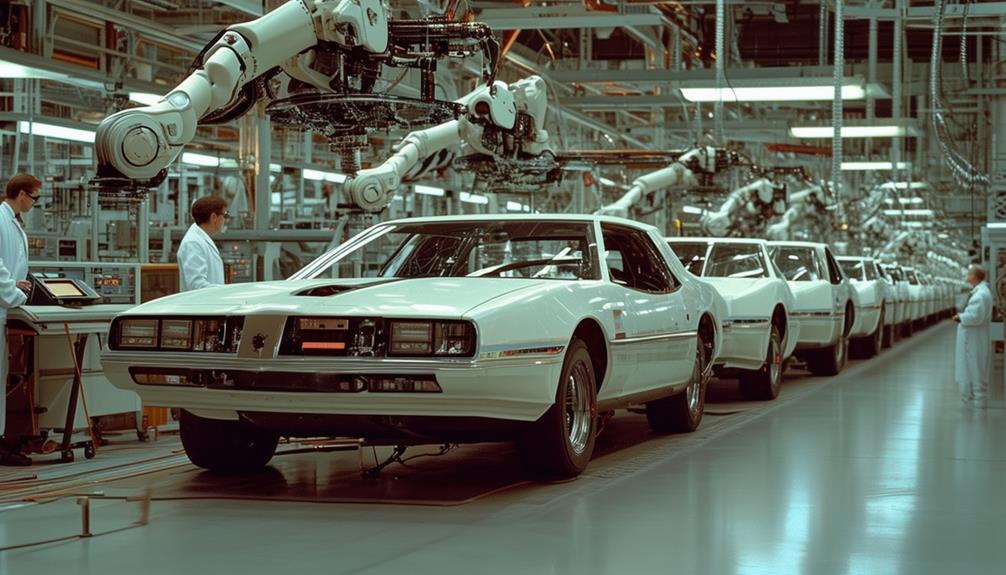
The 1980s laid essential groundwork for today's advanced robotics in the automotive industry, with companies like Ford and General Motors pioneering the use of robotic arms and automation systems. During this transformative decade, integrating robotics into manufacturing processes significantly enhanced efficiency and precision. Automotive giants invested heavily in robotic technologies to streamline production lines and reduce costs.
The adoption of robotic arms in the 1980s revolutionized vehicle manufacturing, leading to unprecedented levels of productivity and precision. These advancements resulted in more consistent and high-quality production, setting new industry standards. The innovations from this era not only improved factory operations but also paved the way for the sophisticated automation systems we see today.
Conclusion
The 1980s marked a pivotal era in automotive manufacturing with the introduction of robotic arms for tasks like welding, painting, and assembly. Companies such as General Motors and Ford revolutionized their production lines, significantly enhancing efficiency and quality. These advancements not only transformed the industry at the time but also laid a robust foundation for future innovations. Today's automotive industry continues to build on these early strides in automation, maintaining the momentum of progress initiated in that transformative decade.
Related posts