Raj Reddy: Advancements in Speech Recognition and AI
Raj Reddy's name stands out as a pioneering force in the field of speech recognition and AI advancements. His work with systems like Hearsay I and II, Harpy, and Dragon laid the groundwork for technologies we now take for granted. Reddy's development of the blackboard model and task-oriented architectures has been instrumental in shaping modern AI. What drove his relentless pursuit of innovation, and how has his research influenced today's AI landscape? There's much more to uncover about his remarkable path and its lasting impact.
Early Life and Education

Raj Reddy, born on June 13, 1937, in Katoor, India, consistently demonstrated a passion for learning that would eventually lead him to become a pioneer in artificial intelligence (AI) and speech recognition. His academic journey began with a Bachelor of Engineering in Civil Engineering from Guindy College of Engineering in 1958. However, his interests soon shifted towards computer science, a field that would define his career.
After completing his MTech at the University of New South Wales in 1960, Reddy pursued a PhD in Computer Science at Stanford University. Mentored by John McCarthy, a prominent figure in AI, Reddy's fascination with computers and AI deepened significantly. He earned his PhD in 1966, setting the stage for his groundbreaking contributions.
Early in his career, Reddy worked at IBM in Australia as an Applied Science Representative, where he applied his burgeoning computer science expertise. In 1966, he joined Stanford University as an Assistant Professor of Computer Science, marking the beginning of his academic path. By 1969, he had become an Associate Professor at Carnegie Mellon University, where his contributions to AI and speech recognition would flourish. This educational background provided a robust foundation for his future innovations.
Career Milestones
Raj Reddy's career milestones reveal how his early achievements laid the foundation for his pioneering contributions to AI and computer science. From joining IBM in 1960 to his transformative work at Carnegie Mellon University, his journey is marked by significant accomplishments. Let's delve into the key moments that defined his impact on the field.
Early Career Highlights
In the early 1960s, Raj Reddy began his career at IBM in Australia, where he built a solid foundation in technology and computer science. By the late 1960s, he transitioned into academia as an Assistant Professor at Stanford University, allowing him to delve deeper into computer science and artificial intelligence.
A pivotal moment in Raj's career came when he joined Carnegie Mellon University (CMU). At CMU, he established himself as a pioneer in AI and significantly influenced computer science and robotics. His early career moves—from IBM to Stanford, and then to CMU—were instrumental in shaping his path and the future of AI research.
At CMU, Raj's leadership and innovative thinking led to numerous advancements in AI, leaving a lasting impact on both the university and the global AI community. His early career highlights reflect a trajectory of continuous learning, evolution, and pioneering work, laying a strong foundation for his later achievements.
Major Research Contributions
Raj Reddy's pioneering work in continuous speech recognition systems stands out as a cornerstone in the advancement of AI technology. Notable systems like Hearsay I, Hearsay II, Harpy, and Dragon are direct results of his groundbreaking research. Reddy's development of the blackboard model in speech recognition has had a lasting impact, shaping the design of modern systems and architectures.
Beyond speech recognition, Reddy's collaborative efforts with Ed Feigenbaum significantly defined the field of applied artificial intelligence. Through task-oriented architectures, Reddy demonstrated AI's power in specific applications, achieving historic milestones in voice control of robots and large-vocabulary speech recognition.
Additionally, Reddy's contributions to autonomous robotic systems have been transformative. His research laid the groundwork for future advancements in AI and computer science, pushing the boundaries of autonomous technologies. Whether in speech recognition or robotics, Reddy's work has been instrumental in shaping the AI landscape.
Pioneering AI Research
Let's explore the pioneering work that laid the groundwork for modern AI and speech recognition. Raj Reddy's early innovations, including systems like Hearsay I and Dragon, revolutionized how machines understand human language. His research not only advanced speech recognition but also profoundly influenced today's AI technologies.
Early AI Innovations
Raj Reddy's groundbreaking work in continuous speech recognition systems, such as Hearsay I and II, laid the foundation for today's voice-controlled technologies. By exploring artificial intelligence and speech recognition, Reddy made revolutionary contributions. He pioneered continuous speech recognition, a feat previously deemed impossible. Additionally, he investigated the blackboard model, a critical AI framework that has influenced various task-oriented architectures.
- Hearsay I and II: Early speech recognition systems by Reddy that set the stage for future advancements.
- Harpy and Dragon systems: Built upon Reddy's work, these systems improved accuracy and expanded vocabulary in speech recognition.
- Blackboard model: Introduced an innovative problem-solving architecture in AI, enabling collaboration among multiple knowledge sources.
- Applied artificial intelligence: Alongside Ed Feigenbaum, Reddy defined this field, focusing on practical AI applications.
- Task-oriented architectures: His research influenced the development of specialized systems designed for specific tasks.
Reddy's early AI innovations have had a lasting impact, demonstrating that with visionary research, artificial intelligence can significantly enhance human-machine interactions.
Breakthroughs in Speech Recognition
The field of speech recognition has experienced groundbreaking advancements that have transformed human-machine interactions and natural language processing. Central to these innovations is Raj Reddy, whose work at Carnegie Mellon University laid the foundation for continuous speech recognition. Reddy's development of systems such as Hearsay I, Hearsay II, Harpy, and Dragon marked significant milestones in the evolution of speech technology.
One of Reddy's most influential contributions is the blackboard model, a conceptual framework that integrates various knowledge sources, forming a cornerstone in the development of large-vocabulary speech recognition systems. In collaboration with Ed Feigenbaum, Reddy also helped shape the field of applied artificial intelligence, steering the direction of AI research.
Reddy's innovations extended to practical demonstrations in voice control of robots, showcasing the applications of speech recognition in robotics. These demonstrations underscored the potential for enhanced human-computer interaction, a critical focus in contemporary AI research. Reddy's work has paved the way for significant advancements in natural language processing, enabling machines to understand and respond to human speech with remarkable accuracy and fluidity.
Impact on Modern AI
Raj Reddy's pioneering research has profoundly influenced the evolution of modern AI, particularly in speech recognition and autonomous systems. His groundbreaking work on the Hearsay I and Hearsay II systems laid the foundation for contemporary speech recognition technology. Reddy's development of task-oriented architectures and contributions to the blackboard model have become crucial in the field of applied artificial intelligence.
Reddy's innovations have sparked numerous developments in modern AI:
- Hearsay I and Hearsay II: These systems pioneered advanced speech recognition technologies, enhancing human-computer interaction.
- Task-Oriented Architectures: His work streamlined AI system design, enabling more efficient problem-solving.
- Autonomous Robotic Systems: Reddy's research paved the way for robots capable of performing complex tasks independently.
- Blackboard Model: This model, widely adopted in AI research, facilitates collaborative problem-solving among various AI components.
- Applied Artificial Intelligence: Together with Ed Feigenbaum, Reddy defined this field, impacting a broad array of AI applications seen today.
Reddy's contributions have established a robust framework that continues to drive advancements in AI, ensuring its relevance and applicability across diverse domains.
Societal Impact of AI
AI is revolutionizing industries and transforming society, but it also raises critical ethical concerns that require our attention. The National Academy of Engineering acknowledges AI's significant advancements in sectors such as healthcare, finance, and transportation. However, the rapid adoption of AI brings up ethical issues, particularly regarding job displacement, privacy, and algorithmic biases. These challenges underscore the need for robust regulations and ethical frameworks to ensure societal well-being.
To balance AI's capabilities with human control, proactive measures are essential. Responsible AI research seeks to refine algorithms, hardware, and software to address global challenges and promote equitable AI use. This involves developing technologies that minimize biases and ensure fair distribution of AI benefits across all societal segments.
Job displacement is a major concern, as automation could render some roles obsolete while creating new opportunities. Facilitating smooth transitions for workers into these new roles is crucial. By focusing on responsible AI development and implementing regulations, we can mitigate risks and optimize AI's positive societal impact. Emphasizing ethical considerations is key to guiding AI's future, ensuring it serves humanity effectively and fairly.
Awards and Recognition
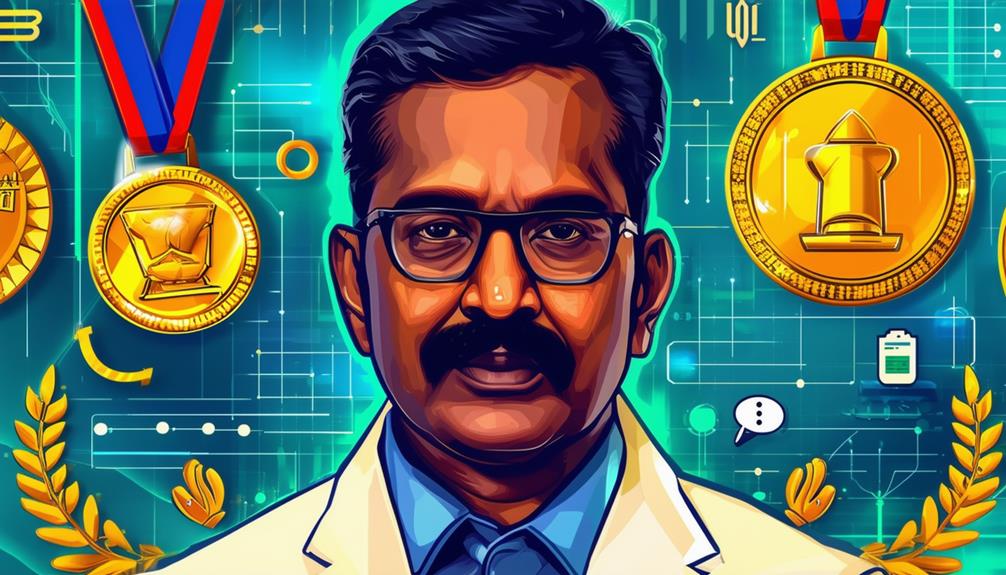
Raj Reddy's monumental contributions to artificial intelligence and computer science have earned him numerous prestigious awards and recognitions, underscoring the profound impact of his work on technology and society.
- ACM Turing Award: Often referred to as the 'Nobel Prize of Computing,' Reddy received this accolade in 1994 for his significant technical contributions to computer science and artificial intelligence.
- Vannevar Bush Award: Awarded in 2006, this honor recognizes his exceptional impact on the field of artificial intelligence.
- French Legion of Honour: France honored him for his pioneering contributions to robotics and intelligent systems.
- Padma Bhushan: One of India's highest civilian awards, acknowledging his substantial influence on technology.
- Memberships and honorary doctorates: Reddy is a distinguished member of the US National Academy of Engineering and the American Academy of Arts and Sciences. He has also received numerous honorary doctorates from esteemed universities worldwide.
These accolades highlight Reddy's lasting impact on the field of artificial intelligence. His co-authored papers have not only driven technological advancements but have also shaped the global infrastructure for universal access to information. Through these numerous awards and recognitions, Reddy's legacy in AI is firmly established, reflecting a career dedicated to innovation and excellence.
Future of AI
As technology advances at an unprecedented pace, the future of artificial intelligence holds transformative potential for multiple sectors. From healthcare to finance and transportation, AI is set to revolutionize how industries operate. For instance, advancements in speech recognition can improve communication tools and assistive technologies, thereby enhancing societal well-being. However, the rise of AI is not without ethical concerns. Issues like privacy breaches, algorithmic biases, and potential job displacement are significant challenges. As AI systems become more integrated into daily life, balancing their capabilities with human oversight is critical. This balance ensures that the technology serves humanity's best interests rather than undermining them.
Proactive measures are necessary to address these implications. Implementing robust regulations can help manage the risks associated with artificial intelligence. Furthermore, education plays a crucial role in preparing the workforce for an AI-driven future. By focusing on reskilling and upskilling, new job opportunities can emerge, mitigating the negative effects of job displacement. Establishing ethical frameworks is equally significant. These frameworks guide the development and deployment of AI technologies, ensuring they align with societal values. By addressing these aspects, we can harness the full potential of AI while safeguarding ethical standards and societal well-being.
Conclusion
Raj Reddy's pioneering work in speech recognition and AI has significantly impacted technology and society. From his early research to influential systems like Hearsay and Harpy, Reddy's innovations have laid the groundwork for contemporary advancements. His contributions underscore the immense potential of AI to enhance human-computer interaction and autonomous systems. Looking forward, Reddy's legacy will continue to inspire and shape the dynamic field of artificial intelligence.