
Patrick Winston: Influences on AI and Machine Learning

Among the pioneers who have shaped AI and machine learning, Patrick Winston stands out for his groundbreaking contributions and profound influence. His work on learning algorithms and knowledge representation has significantly impacted the field, particularly through his emphasis on common-sense reasoning in AI problem-solving. Winston's influence extends beyond his research; his mentorship has inspired countless researchers to push the boundaries of cognitive AI. His legacy continues to drive innovation, making a lasting impact on the development and evolution of artificial intelligence.
Early Contributions to AI
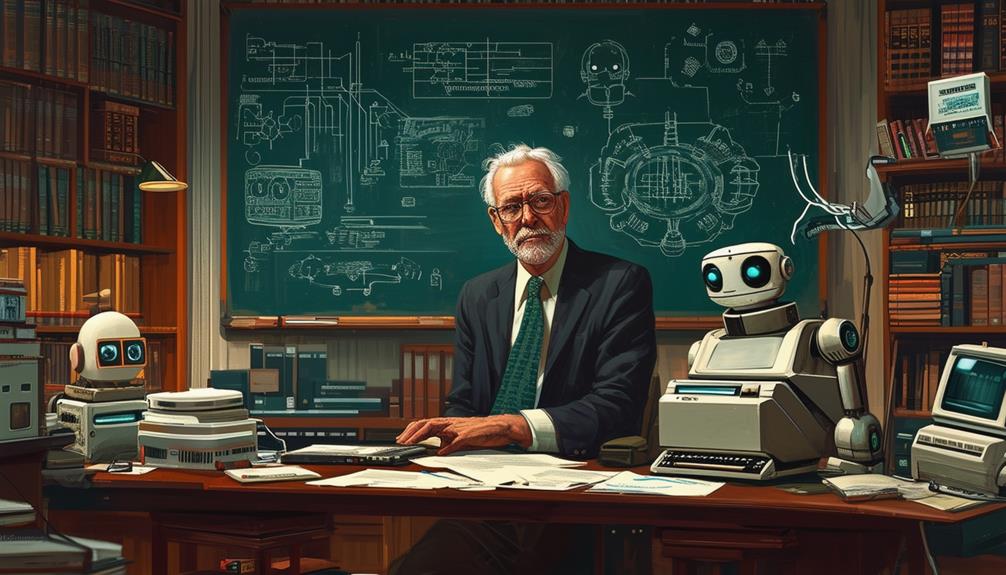
Patrick Winston's fascination with AI was ignited by Marvin Minsky's insightful lectures at MIT. Minsky's pioneering ideas in artificial intelligence deeply inspired Winston, setting him on a path of groundbreaking research. As a graduate student, Winston focused on machine vision, developing a system to recognize arches. This early work showcased his ability to tackle complex AI problems and laid the foundation for his future contributions.
Winston's journey didn't end there. He was instrumental in shaping the MIT AI Lab, serving as its director for 25 years. Under his leadership, the lab became a hub of innovation, fostering an environment of creativity and freedom. Researchers at the MIT AI Lab delved into various facets of AI, including machine vision, machine learning, and robotics, leading to significant advancements in the field.
Minsky's influence on Winston was profound, evident in Winston's dedication to expanding AI's capabilities. By focusing on machine vision early in his career, Winston set the stage for a lifetime of contributions that would impact AI research for decades.
Common-Sense Reasoning
Winston emphasized the essential role of common-sense reasoning in enabling AI systems to effectively navigate and interpret everyday situations. According to him, for AI to truly emulate human intelligence, it must possess the ability to apply common-sense knowledge and logical inference. Without this, AI systems would struggle with tasks that humans find trivial, such as understanding context or making everyday decisions.
Winston's focus on common-sense reasoning aimed to bridge the gap between human intelligence and machine capabilities. He argued that integrating common-sense reasoning into AI models is not just advantageous but indispensable. It enhances AI's problem-solving abilities and decision-making processes, making them more dependable and versatile.
Through his research, Winston developed methods to incorporate logical inference into AI systems, enabling them to reason about the world similarly to humans. This approach significantly advanced AI's ability to understand and interact with real-world environments. By embedding a layer of common-sense reasoning, Winston's work ensured that AI could handle more intricate and nuanced scenarios, thus pushing the boundaries of what machine learning can achieve.
Learning Algorithms

Learning algorithms are essential for advancing AI and machine learning, enabling systems to efficiently acquire and apply new knowledge. Patrick Winston highlighted their significance in AI development, particularly in creating systems capable of learning structured information, which enhances AI capabilities.
Winston's approach to learning algorithms was notable for its reliance on rule-based methods rather than solely statistical ones. This technique allowed AI systems to effectively understand and utilize structured information. By mimicking human learning processes, these systems became more intelligent and adaptable.
A fundamental belief of Winston was the necessity of training AI models with high-quality data. He argued that the performance of learning algorithms is directly influenced by the accuracy and relevance of the data they process. Using precise data enables AI systems to learn more accurately and make superior decisions, a principle that remains critical in modern AI research and development.
Winston's contributions to learning algorithms continue to impact contemporary AI. His emphasis on structured learning and the use of quality data ensures that AI systems evolve meaningfully and effectively.
Problem-Solving Techniques
When tackling problem-solving in AI, heuristic search strategies, knowledge representation models, and cognitive architecture principles prove highly valuable. These approaches help decompose complex issues and systematically explore solutions. By integrating these methods, you can enhance the efficiency and accuracy of your AI systems.
Heuristic Search Strategies
In complex problem-solving scenarios, heuristic search strategies efficiently navigate vast search spaces by prioritizing the most promising paths. These methods leverage domain-specific knowledge to make informed decisions, increasing the likelihood of quickly finding a solution. Heuristic search strategies employ rules of thumb to guide algorithms, focusing on areas with a higher potential for success.
Popular algorithms that utilize heuristic information include A* search, Greedy Best-First Search, and Depth-First Iterative Deepening. A* search combines path cost and heuristic estimates to find the shortest path, while Greedy Best-First Search prioritizes paths that appear immediately promising.
Using these strategies, solutions are often reached faster than with traditional methods. However, heuristics do not always guarantee the best result; they are designed to enhance search efficiency, not ensure perfection. By incorporating heuristic information, search algorithms can bypass less promising paths, solving problems more effectively and conserving computational resources. This makes heuristic search strategies invaluable in fields requiring swift and efficient problem-solving.
Knowledge Representation Models
Effective knowledge representation models are essential for enhancing problem-solving techniques in AI and machine learning. The way knowledge is represented can significantly impact an AI system's efficiency and effectiveness in solving problems. Patrick Winston was a pioneer in this field, advocating for structured programming over purely statistical methods.
Winston emphasized creating models that mirrored human narrative and symbolic language, recognizing that structured methods are crucial for computers to process and learn from data effectively. By organizing knowledge in a structured manner, AI systems can better understand context and make informed decisions, akin to human reasoning.
In problem-solving, these models enable AI to decompose complex issues into manageable components, analyze them, and develop solutions. Structured programming ensures that AI can reason logically and adapt to new information, rather than relying solely on patterns and probabilities.
Winston's contributions have had a lasting impact on the field, shaping the design and implementation of modern AI systems. Incorporating robust knowledge representation models enhances an AI's problem-solving capabilities, making it more intelligent and versatile.
Cognitive Architecture Principles
Patrick Winston's cognitive architecture principles revolutionized problem-solving techniques by teaching computers to emulate human intelligence through structured learning methods. As a Professor of AI at MIT, Winston's work at the AI Lab concentrated on the use of data representation, particularly hierarchies, to enhance a computer's problem-solving capabilities. By developing computer models that comprehended narrative and symbolic language, he enabled machines to grasp abstract concepts such as ambition and revenge through stories.
Winston's influence is evident in the way modern AI systems handle complex tasks. His approach emphasized that computers could learn from structured narratives, providing a framework for understanding and solving problems in a human-like manner. The use of data representation hierarchies was particularly groundbreaking, allowing computers to organize information in a way that mirrors human cognitive processes.
Winston's cognitive architecture principles laid the foundation for advanced AI problem-solving techniques. By focusing on how machines could learn and process information similarly to humans, he significantly advanced the field of artificial intelligence. His contributions continue to impact the development and refinement of AI systems for various intricate tasks.
Teaching and Mentorship

Exceptional teaching and mentorship can demystify complex AI and machine learning concepts, making them accessible and engaging. As a professor, Patrick Winston excelled in this by transforming abstract ideas into relatable narratives. His renowned 'How to Speak' lecture series exemplifies his ability to communicate effectively. Winston believed in the power of storytelling, advocating for the use of numbered outlines and repetition to aid understanding.
In his role as a mentor, Winston guided numerous graduate students, including Caroline Aronoff and Dylan Holmes, offering invaluable advice for their research and academic careers. He did more than impart knowledge; he fostered a culture of creativity and freedom, essential for innovation in AI.
Winston's educational philosophy highlighted several key principles:
- Learning through examples: He used the Martian analogy to explain near-miss learning, underscoring the importance of learning from both successes and failures.
- Academic integrity: He emphasized the necessity of maintaining high ethical standards in research.
- Advancing knowledge through analysis: His approach encouraged deep analysis and critical thinking.
- Fostering creativity: By creating a supportive environment, he allowed students to explore and innovate freely.
Winston's teaching and mentorship have had a lasting impact on AI and machine learning, making these fields more approachable and inspiring future generations of researchers.
Research Impact
Winston's groundbreaking research in cognitive AI has profoundly shaped the field, emphasizing structured learning and narrative understanding. By focusing on how humans comprehend stories, Patrick Winston moved beyond statistical approaches to create computer models that investigate symbolic language and themes such as ambition and revenge. His work has paved the way for advancements in embodied intelligence systems, which are now integral in industries such as aviation and robotics.
Winston's insights also extend to cultural dimensions, demonstrating how Eastern and Western readers interpret narratives differently. This cultural perspective has enriched cognitive AI, making it more adaptable and nuanced. Additionally, his co-founding of Ascent Technologies and Boston Dynamics has significantly advanced AI technology and its applications.
To appreciate the breadth of Winston's impact, consider the following:
| Focus Area | Contribution |
|---|---|
| Structured Learning | Prioritized over statistical methods |
| Narrative Understanding | Investigated human comprehension of stories |
| Embodied Intelligence Systems | Influenced industries like aviation and robotics |
Patrick Winston's research not only advanced theoretical frameworks but also had practical applications, influencing how AI systems are developed and utilized today. His emphasis on structured learning and cognitive AI continues to resonate, shaping the future of artificial intelligence.
Legacy in AI

When considering the legacy in AI, foundational contributions, pedagogy, and influential publications play pivotal roles. Visionaries like Patrick Winston not only advanced AI research but also shaped how future generations approach the field. His work and mentorship have left an enduring impact on both theoretical and practical aspects of AI.
Foundational AI Contributions
Patrick Winston, who led the MIT AI Lab for 25 years, made pivotal contributions to the cognitive and narrative dimensions of artificial intelligence. As an AI professor, he emphasized programming computers to think and learn in structured ways, connecting events through cognitive models. His work transcended theoretical boundaries, finding practical applications in industries such as airlines and robotics.
Winston's research explored how machines could understand and generate narratives, focusing on the symbolic language humans use to communicate stories. This exploration underscored AI's potential to emulate human intelligence by grasping the intricacies of narrative structures.
Key highlights of Winston's foundational contributions include:
- Cognitive Models: Developed computational models to study human narrative abilities and symbolic language.
- Machine Learning: Emphasized structured learning processes, enabling machines to learn efficiently.
- Industry Applications: Applied AI research to practical fields like robotics and airline systems.
- Cultural Insights: Explored differences in how Eastern and Western cultures interpret stories, highlighting both the universality and diversity of human cognition.
Winston's legacy in AI is a testament to his visionary approach, bridging human cognitive processes and machine learning.
Teaching and Mentoring
Renowned for his exceptional teaching and mentoring skills, Patrick Winston mastered the art of conveying complex AI concepts through simplified storytelling. He believed in making innovative ideas accessible to everyone, often using narratives to illustrate key points. His lectures, particularly the popular 'How to Speak' series at MIT, offered invaluable communication tips and techniques for delivering engaging presentations.
Winston's teaching approach wasn't just about explanation; it was about refining stories to make them memorable. He utilized numbered outlines, repeated key points, and injected humor to make learning both effective and enjoyable. His methods not only imparted AI knowledge but also taught students to think critically and creatively within the field.
As a mentor, Winston fostered an environment of creativity and freedom at the MIT AI Lab. He guided researchers in exploring machine vision, machine learning, and robotics, encouraging innovative thinking. His legacy is vividly reflected in the success of companies like Ascent Technologies and Boston Dynamics, both rooted in research nurtured under his mentorship.
Through his unique blend of storytelling and mentorship, Patrick Winston left an indelible mark on AI education, inspiring a generation of researchers and innovators.
Influential Publications
Patrick Winston's influential publications on cognitive systems and AI advancements have left an indelible mark on the field. His pioneering work at MIT on the integration of language and vision in computational models has been revolutionary. Co-authoring studies on story understanding, Winston underscored the importance of symbolic compositional models, which allow machines to process and generate human-like inferences and narratives.
Winston's research frequently centered on reverse-engineering human reinforcement and cognitive patterns, making his contributions vital to the evolution of sophisticated AI systems. Notable publications in this area include:
- Narrative Facility: Investigating how AI can comprehend and generate human-like stories.
- Symbolic Language Models: Delving into the use of symbols to represent complex ideas and relationships.
- Vision and Intelligence: Exploring the integration of visual data with language for enhanced machine understanding.
- Human-Like Inferences: Examining how AI can emulate human reasoning processes.
Through these and other seminal works, Winston has solidified his position in AI history. His commitment to merging vision, language, and cognitive systems continues to inspire current research and advancements, reinforcing the concept that machines can learn and think in ways strikingly similar to humans.
Future Innovations
As we look to the future of AI and machine learning, the importance of continuous training and data refinement becomes increasingly evident. Patrick Winston, a pioneering professor in the field, championed the concept of teaching computers through ongoing learning processes and the elimination of irrelevant information. His vision centered on creating systems that understand causal connections, not just by processing data, but by continually refining it to enhance performance.
Winston emphasized that AI systems must evolve continuously to achieve human-like intelligence. This involves rigorous and ongoing education, where AI models are fine-tuned to filter out unnecessary data and improve their decision-making capabilities. His approach has profoundly influenced the AI community, shaping how developers refine AI models.
Conclusion
Patrick Winston's profound impact on AI and machine learning is undeniable. His early contributions to common-sense reasoning and innovative problem-solving techniques have paved the way for future advancements. Through his teaching and mentorship, he has inspired countless researchers, significantly shaping the landscape of cognitive AI and its practical applications. Winston's legacy continues to influence the field, driving forward new advancements and ensuring his pioneering spirit endures in the next generation of AI researchers.
Related posts