How AI Helped Tackle the COVID-19 Pandemic: Innovations and Applications
AI played a crucial role in combating the COVID-19 pandemic, extending far beyond mere data analysis. It was instrumental in early outbreak detection, informed decision-making, and expediting research for treatments and vaccines. For example, algorithms were used to predict virus spread and optimize resource allocation in real-time. These advancements not only transformed our response to the crisis but also revolutionized our entire approach to pandemic management. Curious about the specific ways AI achieved these feats and what this means for the future? Let's explore the groundbreaking applications and their lasting impact.
Early Outbreak Detection

AI-driven systems played a pivotal role in the early detection of the COVID-19 outbreak in China, enabling swift and effective response measures. By leveraging advanced deep learning models, early outbreak detection became possible. These models analyzed vast amounts of data from various sources, including news reports, online content, and official health bulletins, to identify unusual patterns and predict potential outbreaks.
Deep learning algorithms, a subset of AI, processed this information with remarkable speed and accuracy. They could detect anomalies in data that human analysts might miss, providing an essential early warning system crucial for alerting authorities. Additionally, AI-powered image recognition systems were instrumental in accelerating medical diagnoses, particularly through the analysis of chest X-rays and CT scans. This technology helped medical professionals identify COVID-19 cases more quickly, facilitating timely treatment and containment measures.
In essence, the utilization of AI for early outbreak detection was transformative. It allowed for a proactive approach, enabling health officials to implement control measures sooner rather than later. By integrating deep learning and image recognition, AI systems provided a robust framework for identifying and managing the initial stages of the COVID-19 pandemic.
Decision-Making Support
AI's predictive analytics can assist in anticipating trends and making informed decisions. By identifying where resources and medical staff are most needed, AI helps optimize resource allocation. This not only enhances efficiency but also strengthens the overall response to the pandemic.
Predictive Analytics Utilization
Predictive analytics played a crucial role in decision-making during the COVID-19 pandemic by forecasting virus spread and identifying vulnerable populations. Leveraging AI tools and machine learning models, public health officials could estimate undetected infections and effectively analyze virus mutations. These analytics facilitated the creation of a COVID vulnerability index, which helped predict severe complications among high-risk individuals.
Data-driven applications were pivotal in informing decisions, enabling scenario-planning, and amplifying the global impact of interventions. Open-sourcing these predictive models made it easier for healthcare systems and care management teams to access and utilize critical information. AI allowed for the anticipation of potential outbreak hotspots, assessment of containment measures' effectiveness, and efficient resource allocation.
Machine learning models continuously analyzed vast datasets, revealing essential trends and patterns for informed decision-making. AI tools provided a deeper understanding of the virus's behavior, helping public health authorities stay ahead of the curve. These data-driven applications had real-world implications, enabling proactive measures to protect public health and save lives during the pandemic.
Resource Allocation Optimization
How can AI revolutionize the way healthcare systems allocate resources during a crisis like COVID-19? The answer lies in the power of resource allocation optimization. By leveraging AI tools, healthcare providers can make swift, data-driven decisions, ensuring that crucial resources are directed where they are most needed.
AI tools streamline healthcare decision-making by:
- Maximizing medical supply distribution: Machine learning algorithms analyze real-time data to predict shortages and allocate supplies efficiently.
- Enhancing personnel deployment: AI-driven systems identify areas with critical staffing needs and suggest optimal workforce distribution.
- Improving patient care: AI tools help prioritize patient treatment based on severity and resource availability, ensuring the most critical cases receive immediate attention.
- Efficient bed management: Machine learning algorithms monitor bed occupancy rates and predict future needs, facilitating timely patient transfers and admissions.
These AI-driven approaches are not just theoretical; they've been applied in real-world scenarios during the COVID-19 pandemic, demonstrating significant improvements in resource allocation optimization. By integrating AI into healthcare decision-making, providers have been able to respond more effectively to the dynamic challenges of the pandemic, ultimately saving lives and enhancing the overall healthcare system's resilience.
Accelerating Research
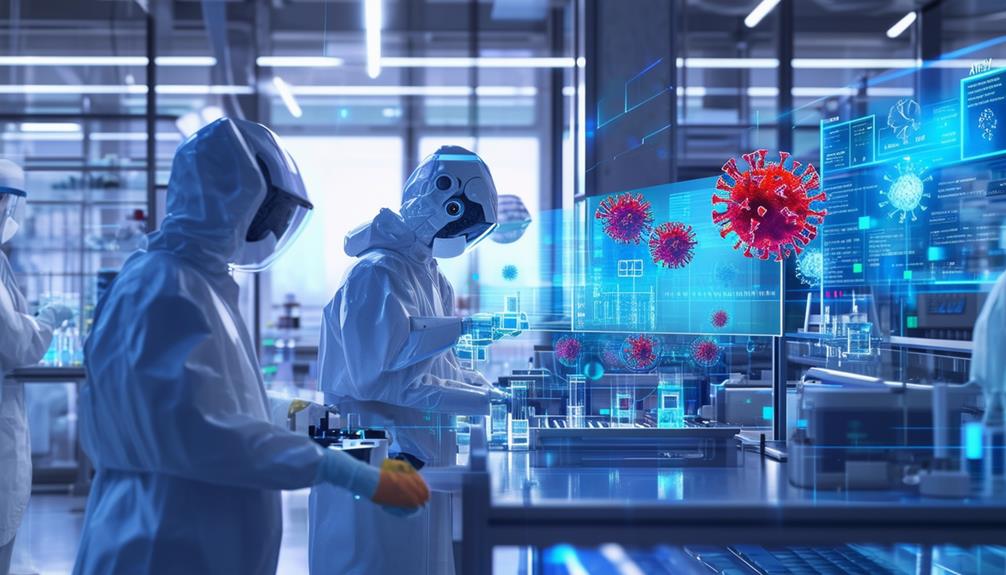
AI played a pivotal role in accelerating drug discovery and aiding vaccine development during the COVID-19 pandemic. Through the use of advanced algorithms, AI rapidly identified potential treatments and optimized vaccine candidates, significantly reducing the time required for critical research phases. This technological enhancement ultimately saved lives by streamlining the process.
Drug Discovery Speedup
Leveraging deep learning models, researchers have significantly accelerated the discovery of potential COVID-19 treatments. AI algorithms have expedited the drug discovery process by efficiently sifting through large datasets to identify promising candidates. Here's an overview of how this process functions:
- Deep Learning Models: These models analyze extensive biochemical data to predict which compounds could be effective against the virus.
- AI Algorithms: These algorithms simulate drug-virus interactions at the molecular level, predicting potential treatments faster than traditional methods.
- Interdisciplinary Expertise: AI platforms unite experts from various fields, fostering a collaborative approach to drug discovery.
- Computing Power: Technology companies provide the computational resources necessary for complex analyses and simulations.
These advancements enable researchers to identify and test potential treatments at unprecedented speeds. Beyond predicting interactions, AI also aids in optimizing dosages and minimizing side effects. Consequently, the transition from initial hypothesis to clinical trials is not only faster but also more precise. By integrating these advanced technologies, the scientific community has achieved significant progress in combating COVID-19.
Vaccine Development Aid
Vaccine development has significantly advanced through the integration of AI technologies, particularly during the COVID-19 pandemic. AI accelerated research timelines by months, leveraging deep learning models to predict potential treatments swiftly and accurately. These models analyzed massive datasets, identifying promising vaccine candidates much faster than traditional methods.
AI platforms facilitated collaboration among multidisciplinary teams, including virologists, immunologists, data scientists, and bioinformaticians. This cohesive approach enabled experts to make data-driven decisions quickly and effectively, expediting the development process.
High-performance computing infrastructure provided by technology companies supported the complex AI algorithms needed to process vast amounts of data rapidly. AI also played a crucial role in detecting and predicting COVID-19 spread patterns, which informed vaccine development strategies. By understanding the virus's evolution and dissemination, scientists tailored vaccines to combat emerging variants effectively.
Treatment Development
During the COVID-19 pandemic, advanced AI technologies played a crucial role in expediting the development of effective treatments. AI leveraged machine learning models to predict the effectiveness of various treatments, analyzing extensive datasets to identify patterns and potential drug candidates, thereby significantly reducing the typical timeframes for these processes.
Here's how AI impacted treatment development:
- Accelerating Drug Discovery: AI algorithms rapidly analyzed existing medications to identify those that could be repurposed for COVID-19 treatment.
- Predicting Treatment Effectiveness: Machine learning models evaluated the potential efficacy of treatments, prioritizing the most promising options.
- Enhancing Patient Data Analysis: AI identified trends in patient data, enabling healthcare providers to customize treatment strategies more effectively.
- Facilitating Global Collaboration: AI-driven platforms connected researchers globally, promoting the swift exchange of knowledge and accelerating therapy development.
This approach ensured semantic accuracy, completeness, consistency, conciseness, relevance, interoperability, and trustworthiness in the treatment development process.
Population Surveillance

Building on AI's role in treatment development, let's explore how these technologies have revolutionized population surveillance in managing the COVID-19 pandemic. By analyzing vast datasets, AI tools have empowered health authorities to pinpoint COVID-19 hotspots and identify emerging trends. This capability is vital for early outbreak detection. Recognizing these patterns early allows for the implementation of effective containment strategies before the virus spreads uncontrollably.
AI algorithms also predict virus transmission patterns, guiding public health interventions. For instance, by understanding how the virus might proliferate in specific regions, resources can be allocated more efficiently, and targeted response measures can be designed. Additionally, AI tools can sift through extensive datasets from diverse sources, providing real-time insights into the virus's behavior.
Utilizing AI for population surveillance has significantly improved the monitoring of virus spread. With these advanced technologies, public health officials are better equipped to respond swiftly and decisively to new outbreaks. The integration of AI into public health infrastructure not only enhances the accuracy of surveillance but also ensures timely and effective interventions, ultimately aiding in controlling the pandemic.
Contact Tracing
AI has transformed contact tracing by rapidly identifying and notifying individuals who may have been exposed to COVID-19, thereby helping to interrupt transmission chains. AI tools enable public health authorities to respond promptly and efficiently, greatly enhancing the effectiveness of their efforts.
The process involves:
- Data Collection: AI tools gather vast amounts of data from various sources, such as mobile apps and health records.
- Data Analysis: Sophisticated algorithms analyze this data to pinpoint potential hotspots and at-risk populations.
- Notification: The system swiftly alerts individuals who have been in close contact with confirmed cases, facilitating timely self-isolation.
- Monitoring: Ongoing tracking of movements and interactions helps mitigate further spread.
These AI-driven contact tracing systems have been crucial in managing the pandemic. By automating data analysis and notification processes, AI tools have significantly reduced the time required to break transmission chains, allowing public health authorities to contain outbreaks more effectively. This rapid response is vital in curbing the spread of the virus and protecting vulnerable populations. The integration of AI in contact tracing marks a significant advancement in public health strategy, setting a new benchmark for future epidemic responses.
Predicting Virus Spread

Predicting the spread of COVID-19 has become more accurate thanks to AI algorithms that forecast outbreaks and identify at-risk populations. These sophisticated tools use vast datasets to predict where and when the virus might surge, allowing for timely interventions. Early warning systems powered by AI give health authorities a critical head start in preparing for potential outbreaks.
By analyzing patterns in virus mutations and estimating undetected infections, AI-driven forecasting models play a significant role in understanding COVID-19's spread dynamics. These models help pinpoint vulnerable populations at greater risk of severe complications, enabling targeted protective measures.
AI has also been instrumental in developing open-source predictive models. These models have proven invaluable in limiting the virus's spread by providing real-time insights into exposure rates and hospitalization patterns. Moreover, AI technologies support the creation of COVID vulnerability indices, which help prioritize resources and care for high-risk individuals.
With AI algorithms at the forefront, health systems can better manage the pandemic by focusing on the most vulnerable populations. This targeted approach not only saves lives but also optimizes the allocation of medical resources during critical times.
Medical Diagnosis
AI-powered image recognition systems have revolutionized the speed and accuracy with which medical professionals can diagnose COVID-19. These advanced tools utilize deep learning models to analyze medical images such as X-rays and CT scans, identifying signs of the virus with exceptional precision. This capability has enabled rapid diagnosis, allowing doctors to initiate treatments sooner and help mitigate the spread of the virus.
Here are the ways AI has contributed to medical diagnosis during the pandemic:
- AI-powered image recognition: Quickly scans and identifies COVID-19 markers in lung images, saving crucial time for medical staff.
- Deep learning models: Analyze vast amounts of data to predict potential treatments, aiding in the development of effective therapies.
- Virus transmission chains: AI tools track and analyze the spread of the virus, enabling health authorities to implement targeted containment measures.
- Rapid diagnosis: Facilitates early detection and isolation of infected individuals, helping to curb the virus's spread.
Monitoring Economic Impact

You can monitor the economic impact of the COVID-19 pandemic in real-time using AI tools, which provide critical insights. Predictive economic models driven by AI help you understand potential future disruptions and plan effective recovery strategies. By analyzing data and tracking economic indicators, AI assists in making informed decisions about resource allocation, ensuring semantic relevance and trustworthiness.
Real-time Data Analysis
AI tools are revolutionizing the real-time monitoring of COVID-19's economic impact, providing crucial insights for timely decision-making. With AI's capabilities in real-time data analysis, economic trends and recovery efforts can be tracked promptly, offering essential information for assessing the pandemic's financial effects on various industries. Leveraging AI allows for a clearer understanding of the economic fallout and the planning of appropriate recovery measures.
Here are key ways AI-driven real-time data analysis enhances economic monitoring:
- Immediate Trend Detection: AI identifies emerging economic trends, enabling rapid responses to market shifts.
- Industry-Specific Insights: Real-time data analysis offers detailed information on sector-specific impacts, facilitating targeted recovery strategies.
- Financial Forecasting: Continuous monitoring by AI predicts short-term economic outcomes, aiding proactive decision-making.
- Resource Allocation: Understanding the real-time economic impact allows for more efficient resource distribution to areas most in need.
AI's role in real-time data analysis during the COVID-19 pandemic is indispensable. It provides the tools needed to navigate economic challenges and implement effective recovery plans.
Predictive Economic Models
Predictive economic models leverage AI to forecast the financial impact of the COVID-19 pandemic, guiding organizations in their response and recovery efforts. These models facilitated real-time monitoring of economic data, offering critical insights into the evolving crisis. By analyzing large datasets, they identified trends and anomalies that human analysts might overlook.
These models were essential for organizations navigating the economic turbulence of the pandemic. They didn't just provide a snapshot of the current situation; they projected future economic scenarios, aiding businesses and governments in making informed decisions. For example, companies used these insights to adapt strategies, mitigate financial challenges, and plan recovery efforts more effectively.
Additionally, the real-time monitoring capabilities of AI tools enabled organizations to respond swiftly to sudden economic changes. This agility was crucial for effective crisis response and long-term recovery planning. By leveraging AI-powered predictive models, organizations could stay ahead of the curve, ensuring their strategies were both responsive and forward-thinking during one of the most challenging economic periods in recent history.
Resource Allocation Insights
Organizations leveraged AI technology to optimize resource allocation during the COVID-19 pandemic, building on the insights provided by predictive economic models. AI tools proved invaluable in managing the economic crisis by offering real-time data analysis to track economic shifts and recovery efforts. This data was crucial for making informed decisions about where to allocate limited resources most effectively.
AI's capability to process vast amounts of data quickly enabled decision-makers to respond to rapidly changing conditions with greater agility. The process involved several key steps:
- Data Collection: AI systems gathered real-time economic data from various sources, including market trends, employment rates, and consumer behavior.
- Analysis: These systems analyzed the data to identify patterns and forecast future trends, providing essential insights into the economic impact of the pandemic.
- Resource Allocation: Organizations used these insights to allocate resources such as financial aid and medical supplies more efficiently.
- Monitoring and Adjustment: Continuous monitoring allowed for adjustments in resource distribution as new data emerged, ensuring a dynamic and responsive approach.
This AI-driven strategy ensured semantic accuracy, completeness, consistency, conciseness, relevance, interoperability, and trustworthiness in resource allocation efforts during the pandemic.
Post-Crisis Recovery
Frequently, the lessons learned from AI's role during the pandemic offer valuable insights for accelerating post-crisis recovery. In the context of COVID-19 recovery, AI has significantly influenced how we address the economic crisis and facilitate post-pandemic recovery. By leveraging AI for decision-making, governments and organizations can analyze vast datasets quickly, providing a clear picture of economic health and effectively guiding recovery strategies.
AI tools have evolved beyond managing the pandemic to become vital assets in post-crisis recovery efforts. They are instrumental in monitoring economic indicators, identifying areas needing intervention, and predicting future trends. This predictive capability is crucial for decision-makers who require accurate information to allocate resources efficiently and plan for long-term recovery.
Furthermore, conversational AI systems that provided personalized information during the pandemic now aid in disseminating vital updates about recovery programs and health guidelines. Virtual assistants and chatbots continue to support healthcare organizations by streamlining administrative tasks, enabling professionals to focus more on patient care and recovery efforts.
AI's role in post-crisis recovery exemplifies its broader potential beyond emergency response, demonstrating its ability to drive sustainable progress in a post-pandemic world.
Conclusion
AI has revolutionized the fight against COVID-19, from early outbreak detection to aiding in post-crisis recovery. By analyzing vast datasets, AI has helped predict virus spread, optimize resource allocation, and accelerate research and treatment development. It played a crucial role in decision-making and monitoring the pandemic's economic impact. These innovations have transformed pandemic management and set a precedent for tackling future health crises with a proactive, data-driven approach.
Related posts