
Frank Rosenblatt: Inventor of the Perceptron
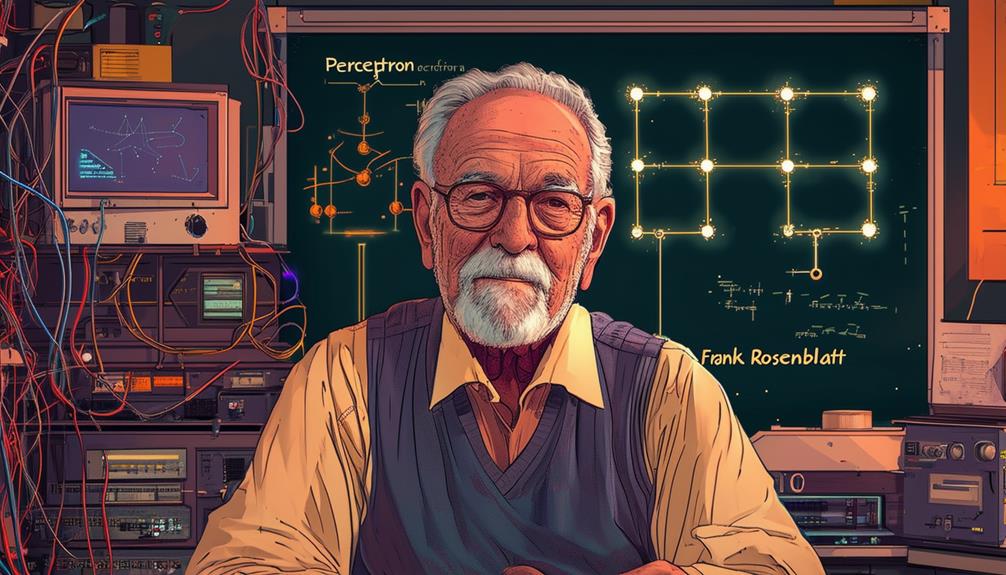
When considering the pioneers of artificial intelligence, Frank Rosenblatt's name is indispensable. As the inventor of the Perceptron, Rosenblatt advanced AI significantly by developing an algorithm that emulates the functions of biological neurons. His work was not merely theoretical; it laid the groundwork for practical applications in pattern recognition and binary classification. But what inspired this groundbreaking idea, and what obstacles did he encounter? The story of the Perceptron's creation and its enduring influence on AI is compelling and foundational to the field.
Early Life and Education

Frank Rosenblatt, born in 1928 in New Rochelle, New York, grew up in a Jewish family and demonstrated early academic promise. He attended The Bronx High School of Science, graduating in 1946, and continued his education at Cornell University, where he earned his A.B. in 1950 and his Ph.D. in 1956.
While at Cornell, Rosenblatt's interest in learning and cognitive systems deepened. His pioneering work on the perceptron, an early type of artificial neural network, began at the Cornell Aeronautical Laboratory. The perceptron aimed to model how the human brain processes information and learns from it, laying the foundation for modern machine learning and artificial intelligence.
Rosenblatt actively guided research as the director of the Cognitive Systems Research Program at Cornell, demonstrating his dedication to understanding and replicating human learning processes. His perseverance and intellectual rigor significantly advanced the field, leaving a lasting impact on the history of artificial intelligence.
Inspiration and Influences
Rosenblatt's work on the perceptron was deeply inspired by biological neural networks, particularly the principles of Hebbian learning and the McCulloch-Pitts neuron model. Hebbian learning, often summarized as "cells that fire together wire together," provided a foundation for understanding how neural connections strengthen through experience, guiding Rosenblatt in designing adaptive algorithms.
The McCulloch-Pitts neuron model, which simplified the complex behavior of biological neurons into a mathematically analyzable form, demonstrated that neural networks could perform logical operations. This was crucial for Rosenblatt's goal of creating intelligent systems.
Rosenblatt's inspirations and influences included:
- Hebbian Learning Principles: These principles underpinned the design of algorithms that mimicked neural adaptation and learning processes.
- McCulloch-Pitts Neuron Model: This model offered a powerful framework for understanding and replicating biological neurons' behavior in a computational context.
- Collaborations with Neuroscientists: Working with experts in neuroscience and computing sciences provided valuable insights that refined his approach to the perceptron.
Development of the Perceptron
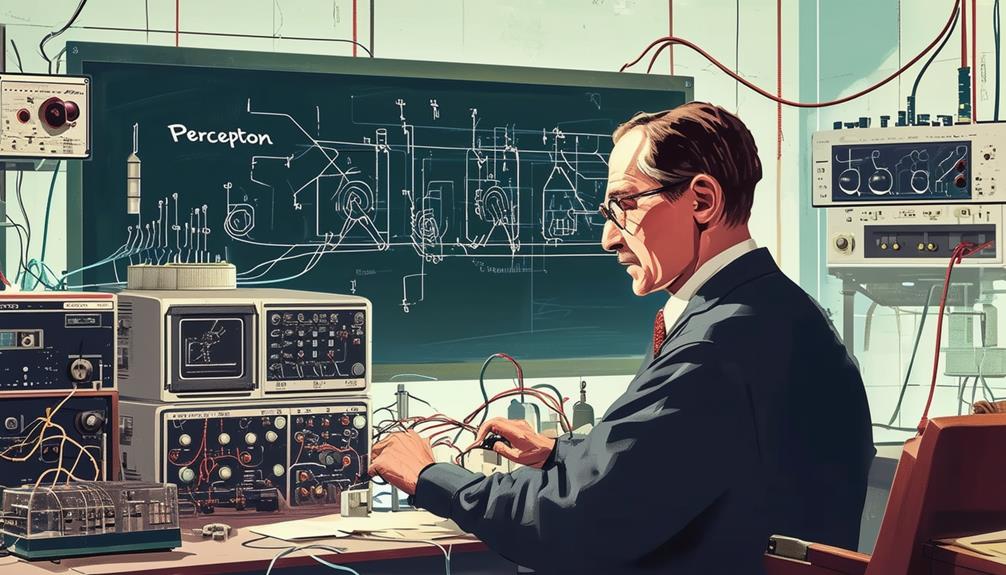
In developing the Perceptron, Rosenblatt built on the conceptual foundation laid by Donald Hebb's learning theories, adapting them into a functional algorithm. His technological innovations included using weighted sums and threshold functions to classify inputs. Initially, the Perceptron found applications in pattern recognition and binary classification tasks, marking a significant advancement in computational neuroscience.
Conceptual Foundation
The perceptron emerged from Frank Rosenblatt's ambition to create a computational model that emulates the way biological neurons process information. He aimed to develop a system capable of learning from experiences, akin to the human brain. This innovation laid the groundwork for neural networks, with its architecture centered around the concept of the artificial neuron.
Rosenblatt's model consisted of three crucial components:
- Weighted inputs: These inputs simulate the synapses in a biological neuron, with each weight indicating its significance.
- Activation function: This function decides whether a neuron should activate based on the weighted sum of inputs.
- Learning algorithm: The algorithm modifies the weights in response to errors during training, enhancing the model's accuracy over time.
The learning algorithm was groundbreaking because it enabled the perceptron to classify linearly separable data points by adjusting weights until classification errors were minimized. Essentially, Rosenblatt's perceptron could identify hyperplanes that separated different data classes, setting a foundation for future advancements in machine learning.
Technological Innovations
Frank Rosenblatt's development of the perceptron in 1957 marked a significant milestone in artificial intelligence. The perceptron was the first algorithm designed to mimic the function of a biological neuron, providing a computational model capable of pattern recognition. It operated by adjusting weights and biases through a learning process that used training examples, enabling it to learn and make decisions based on input data.
The initial demonstration of the perceptron's capabilities involved distinguishing between marked cards, showcasing its ability to recognize patterns. By adjusting the weights and biases for each input, the perceptron could improve its accuracy over time. This innovation was introduced in July 1958 by the U.S. Office of Naval Research, using the IBM 704 computer to process data.
Rosenblatt believed the perceptron was a pioneering machine capable of original ideas, laying a critical foundation for modern AI technologies. Despite its initial success, the perceptron's limitations eventually led to skepticism about its potential, contributing to a period known as the AI winter, which significantly impacted the field's progress.
Initial Applications
Inspired by the intricate workings of the human brain, Frank Rosenblatt's perceptron quickly found its initial applications in pattern recognition tasks, such as distinguishing between marked cards. This early success demonstrated the perceptron's potential as a binary classifier capable of making decisions based on input patterns. By training the perceptron with diverse examples, Rosenblatt showed that it could effectively learn to recognize and categorize different data points.
Rosenblatt's enhancements to the McCulloch-Pitts neuron model enabled the perceptron to handle numeric inputs, significantly expanding its capabilities beyond simple binary decisions. The perceptron employed linear classification through hyperplanes, allowing it to separate data points into distinct categories. This method laid the groundwork for more complex neural networks, such as multilayer perceptrons and those with recurrent connections.
Key early applications included:
- Pattern Recognition: The perceptron excelled at identifying patterns in data, such as distinguishing marked cards.
- Data Classification: As a binary classifier, it could effectively separate data into predefined categories.
- Neural Network Foundations: Rosenblatt's work provided a basis for future developments in neural network architecture.
These initial applications highlighted the perceptron's potential and set the stage for future advancements in machine learning and artificial intelligence.
Key Experiments
Rosenblatt's key experiments with the perceptron demonstrated its ability to classify geometric shapes based on visual inputs, underscoring its adaptive learning capabilities. These experiments primarily focused on binary classification tasks, where the perceptron had to distinguish between different patterns. By presenting the perceptron with diverse examples of shapes, Rosenblatt illustrated its capacity to learn and generalize from the data it received. This adaptive learning ability was revolutionary at the time.
In these experiments, Rosenblatt subjected the perceptron to a series of tests to evaluate its performance in pattern recognition and classification tasks. The perceptron successfully differentiated between distinct geometric shapes, showcasing its effectiveness in handling binary classification problems. These trials highlighted the perceptron's potential to tackle complex real-world problems by learning from examples and adjusting its internal parameters accordingly.
Rosenblatt's work laid the foundation for future advancements in neural networks, proving that machines could be trained to recognize and classify patterns. His research provided a forward-looking glimpse into the potential of machine learning, demonstrating the significant impact that adaptive learning systems could have on technology and society.
Impact on AI and Machine Learning

Frank Rosenblatt's invention of the perceptron revolutionized the fields of AI and machine learning by laying the foundation for modern neural networks. The perceptron demonstrated the potential of computer learning through its adaptability to input data, sparking extensive research in the field.
The perceptron model, featuring artificial neurons and learning algorithms, enabled binary classification tasks, proving that machines could learn and adapt. This was a significant milestone, showing that even simple algorithms could handle complex tasks, a principle central to today's AI technology.
The perceptron's impact on AI and machine learning can be summarized as follows:
- Inspired Further Research: It motivated extensive research in neural networks, leading to the development of more sophisticated models.
- Practical Applications: It laid the groundwork for practical applications of machine learning algorithms in fields like image recognition and natural language processing.
- Long-lasting Influence: Rosenblatt's contributions continue to influence current machine learning techniques and applications, driving advancements in artificial intelligence.
Rosenblatt's perceptron remains a cornerstone of AI and machine learning innovation, continuing to influence the field today.
Challenges and Criticisms
The perceptron encountered significant challenges, notably its limited computational power and inability to process linearly non-separable data. Critics, such as Marvin Minsky, argued that these limitations rendered it impractical for solving complex problems. Additionally, overhyped promises led to disillusionment, causing a decline in funding and interest in AI for several years.
Limited Computational Power
Despite its groundbreaking nature, the perceptron faced significant criticism due to its limited computational power. It was only capable of handling linear separations and binary classifications, which severely restricted its practical applications. It couldn't solve problems requiring complex decision boundaries due to its lack of computational depth.
This limitation stemmed from its simplistic structure, which lacked hidden layers and non-linear activation functions. Consequently, it struggled with tasks beyond straightforward linear separations, making it inadequate for many real-world problems. This was a significant drawback given the potential of neural networks.
Key challenges and criticisms included:
- Linear separations: The perceptron could only address problems with linearly separable data, rendering it ineffective for more complex datasets.
- Binary classifications: Its design was limited to binary classifications, lacking the versatility needed for multi-class problems.
- Simplistic structure: The absence of hidden layers and non-linear activation functions hindered its ability to model intricate patterns.
These challenges led researchers like Marvin Minsky to question the perceptron's practical utility, sparking debates that influenced the future direction of neural network research.
Linearly Non-Separable Data
Linearly non-separable data presents a significant challenge for perceptrons, as they can only draw straight-line boundaries to classify data. This limitation means that perceptrons struggle with complex patterns that cannot be divided by a single line or hyperplane. When faced with non-linearly separable data, a perceptron cannot find the correct classification boundary, leading to misclassifications and poor performance.
The solution to this problem lies in more advanced models, such as multi-layer perceptrons. Unlike single-layer perceptrons, multi-layer perceptrons can handle non-linearly separable data by using multiple layers of neurons to create complex decision boundaries. This allows them to classify data that isn't linearly separable effectively.
Frank Rosenblatt's perceptron faced significant criticism due to these limitations. Critics argued that the perceptron's inability to manage non-linearly separable data severely restricted its usefulness. This criticism contributed to the decline in popularity of perceptrons before the resurgence of neural networks in modern AI. Despite these challenges, the development of multi-layer perceptrons and other advanced models built upon Rosenblatt's foundational work, ultimately overcoming the limitations of the original perceptron.
Overpromised Capabilities
The perceptron's inability to handle non-linearly separable data led to significant criticisms regarding its overpromised capabilities in solving complex problems. Frank Rosenblatt, one of the key figures behind the perceptron, made bold claims suggesting it could eventually achieve human-like intelligence. However, these promises soon met with skepticism. Critics like Marvin Minsky highlighted its limitations, pointing out that the perceptron could only manage simple binary classification tasks and struggled with more sophisticated AI challenges.
These limitations became particularly glaring when it was clear that the perceptron couldn't solve problems involving non-linearly separable data. This led to a broader realization that early AI technologies were being oversold. The perception that AI was overhyped contributed to a period known as the 'AI winter,' where both funding and interest in AI research dwindled.
Key takeaways include:
- Overpromised Capabilities: Initial claims suggested the perceptron could achieve human-like intelligence.
- Limitations: It struggled with tasks beyond simple binary classification.
- AI Winter: The fallout from these overpromises led to reduced funding and interest in AI.
Understanding these challenges and criticisms helps appreciate the complexities involved in AI development and the importance of setting realistic expectations.
Legacy and Recognition
Frank Rosenblatt's pioneering work on the perceptron has garnered lasting acclaim in the field of artificial intelligence. His contributions laid the groundwork for contemporary machine learning and are celebrated globally. A tangible testament to his legacy is the Mark I Perceptron, displayed at the Smithsonian Institution, underscoring the historical importance of his work.
Rosenblatt's legacy is further solidified by the IEEE Frank Rosenblatt Award, which recognizes individuals who have made significant advancements in artificial intelligence. This award continues to inspire researchers and professionals, highlighting the enduring impact of Rosenblatt's contributions.
| Contribution | Impact | Recognition |
|---|---|---|
| Mark I Perceptron | Pioneering AI model | Smithsonian Institution |
| Theorems on Elementary Perceptrons | Foundational in machine learning | Academic publications |
| IEEE Frank Rosenblatt Award | Honors significant AI advancements | Named in his honor |
| Neurodynamics and AI discussions | Influential in ongoing research | Congressional recognition |
Rosenblatt's theorems on elementary perceptrons remain pivotal in academic literature and are fundamental to machine learning theory. His work continues to be a focal point in discussions on neurodynamics and AI, reflecting his lasting influence. With Congressional recognition and sustained academic interest, Rosenblatt's legacy remains vibrant and integral to the progression of artificial intelligence.
Conclusion
Frank Rosenblatt's impact on AI is profound. By inventing the Perceptron, he laid the groundwork for modern neural networks and machine learning advancements. Despite facing challenges and criticisms, his pioneering work continues to shape the field. His legacy is evident in the ongoing innovations that drive our technology-driven world. Rosenblatt's contributions remind us that groundbreaking ideas often start with a single, inspired vision.