Famous Robotics Projects: The Rise of Boston Dynamics
You're likely interested in Boston Dynamics, a trailblazer in robotics since 1992. Founded by Marc Raibert, they pushed boundaries by mimicking human and animal dynamics. Projects like BigDog tackled tough terrains, offering agility in mud and snow, while Cheetah showcased impressive speed and flexibility. Spot demonstrated remarkable versatility in numerous sectors like construction and safety. Atlas broke new ground with its human-like movements, balancing and performing intricate tasks. Meanwhile, Stretch transformed warehouse efficiency, streamlining logistics. Each innovation of Boston Dynamics continues to redefine what's possible in robotics, encouraging deeper exploration into their revolutionary advancements.
The Beginnings of Boston Dynamics
Boston Dynamics began as a vision of innovation and engineering excellence. You can imagine the excitement and ambition that surrounded its founding vision. The company emerged from the Massachusetts Institute of Technology in 1992, spearheaded by Marc Raibert. His goal was clear: to push the boundaries of robotics and create machines that could imitate the dynamic movements of humans and animals. This founding vision was ambitious, aiming to revolutionize how robots moved and interacted with the world.
However, you must appreciate the early challenges they faced. The technology needed to achieve their goals was still in its infancy, and they had to pioneer their path. Funding was a constant hurdle, as convincing investors to back a company with such a futuristic vision wasn't easy. Furthermore, the team had to develop new software and hardware from scratch, which was no small feat. Their commitment to innovation required overcoming technical limitations and skepticism from the industry.
Despite these early challenges, Boston Dynamics' determination never wavered. Their unwavering dedication to their founding vision laid the groundwork for what would become one of the most influential robotics companies in the world.
BigDog: A Quadrupedal Pioneer
One of the remarkable innovations from Boston Dynamics is BigDog, a groundbreaking quadrupedal robot designed to tackle challenging terrains. Imagine you're in a rugged environment where traditional wheeled or tracked vehicles struggle. BigDog steps in, showcasing its impressive quadrupedal locomotion, designed to mimic the movement of animals. This robot can navigate through mud, snow, and rocky paths, making it an invaluable asset for military and emergency operations.
BigDog's robotic agility is truly remarkable. It uses a combination of sensors, gyroscopes, and sophisticated software to maintain balance and adapt to unpredictable surfaces. Picture a robot that can recover from a slip or even a forceful shove, all while carrying a heavy load. That's BigDog for you. Its ability to manage weight up to 340 pounds and climb slopes of up to 35 degrees demonstrates its powerful engineering.
You might wonder how it achieves such feats. Each of its four legs is equipped with advanced hydraulic actuators, allowing precise control over movement. These actuators replicate the muscle dynamics of animals, providing BigDog with the agility needed to conquer diverse environments. BigDog stands as a proof of Boston Dynamics' pioneering spirit in robotics.
Advancements With Cheetah
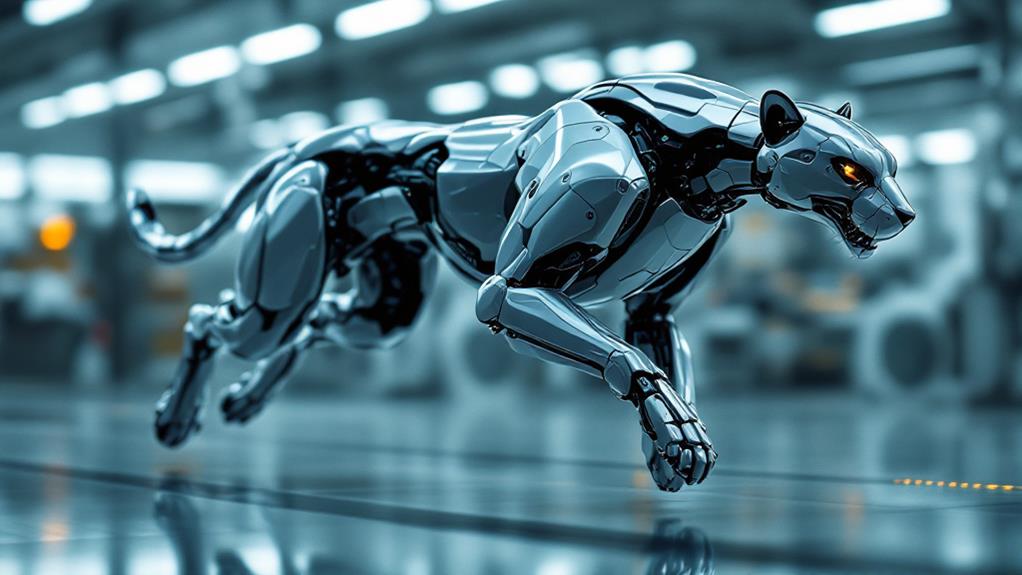
Have you ever marveled at the speed and agility of a cheetah in the wild? Boston Dynamics captures this essence with their Cheetah robot, pushing the boundaries of robotic locomotion. Imagine a machine that mirrors the swift, graceful movements of the fastest land animal. The Cheetah robot exemplifies advanced engineering and mimics the impressive cheetah agility through its design.
Picture this:
- Speed: The Cheetah robot can sprint at a remarkable pace of over 28 miles per hour. This speed showcases the potential for robots to perform tasks requiring rapid movement, from search and rescue operations to dynamic obstacle navigation.
- Flexibility: Unlike traditional robots, Cheetah can bend its spine, emulating the fluid, flexible motion of a real cheetah. This feature improves its ability to maneuver through complex environments with ease.
- Stability: The Cheetah robot maintains balance at high speeds, utilizing advanced algorithms to guarantee it doesn't topple over. This stability is essential for performing tasks in unpredictable terrains.
The Versatile Spot Robot
While the Cheetah robot impresses with speed and agility, Boston Dynamics offers another marvel in their lineup: the adaptable Spot robot. Spot's agility and flexibility make it a standout in numerous fields. You can see it deployed in construction sites, where its ability to navigate uneven terrain and capture real-time data is invaluable. Spot applications extend to public safety, where it can inspect hazardous areas without risking human lives. In healthcare, Spot even delivers supplies, showcasing its utility in sensitive environments.
However, like any technology, Spot has its limitations. Despite its impressive capabilities, it struggles in extreme weather conditions, which can affect its sensors and mobility. You might also find that Spot's battery life restricts its operational time, requiring frequent recharges or battery swaps. Furthermore, while Spot navigates many terrains, particularly challenging or cluttered environments can pose problems.
When considering Spot for your tasks, weigh its advantages against these Spot limitations. It's a powerful tool, but understanding its constraints guarantees you deploy it effectively. With Spot, Boston Dynamics has crafted a robot that's versatile yet not without its challenges, making it crucial to evaluate its fit for your specific needs.
Atlas: The Humanoid Revolution
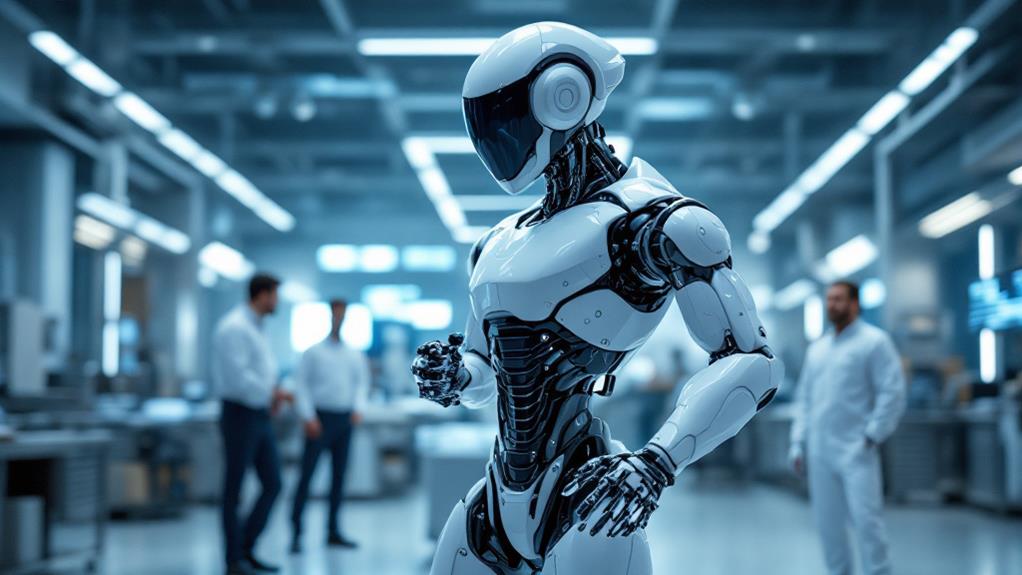
Meet Atlas, the humanoid robot that's shaking up the world of robotics. Designed by Boston Dynamics, Atlas is a pinnacle of humanoid capabilities and robotic agility. It's built to mimic human movements, making it a fascinating spectacle in the field of advanced robotics. This robot isn't just about walking; it's about redefining what's possible with humanoid machines.
Imagine watching Atlas in action. Here's what you might see:
- Impressive Balance: Atlas can navigate rough terrains and maintain its balance, even when pushed or tripped. Its agility is unmatched, setting new standards for balance in humanoid robots.
- Dynamic Movements: You'll be amazed by Atlas's ability to perform dynamic tasks like jumping over obstacles, doing backflips, and executing complex dance routines. Its movements are fluid and human-like.
- Intricate Manipulation: With its dexterous hands, Atlas can handle objects of diverse shapes and sizes, showcasing its potential in tasks requiring precision and care.
Atlas represents a significant leap in robotic technology, blurring the lines between human and machine. Its advancements in humanoid capabilities and robotic agility demonstrate a future where robots can perform tasks traditionally reserved for humans.
Stretch: Transforming Warehousing
Transforming the logistics industry, Stretch is Boston Dynamics' answer to the growing demands of warehousing efficiency. As you navigate the complexities of supply chain management, you'll find Stretch tackling automation challenges head-on. With its advanced robotic integration, it's designed to improve warehouse efficiency by handling repetitive tasks like unloading trucks and sorting packages with precision and speed.
Adopting this technology can greatly reduce operational costs, but it also brings workforce implications. While Stretch takes over monotonous tasks, your human workforce can focus on more complex problems, improving general productivity. However, this shift requires careful technology adoption strategies to guarantee a smooth changeover. Training and reskilling initiatives become vital as you integrate Stretch into your existing operations.
Looking towards future logistics, Stretch positions itself as an indispensable tool in optimizing supply chain processes. By embracing this innovation, you're not just keeping pace with industry standards but setting yourself up as a leader in logistical efficiency. As you evaluate the potential of Stretch, consider both its immediate benefits and the long-term impact on your business's growth trajectory. The path to modernize your warehousing starts with embracing the robotic revolution that Boston Dynamics offers.
The Impact on Robotics Industry
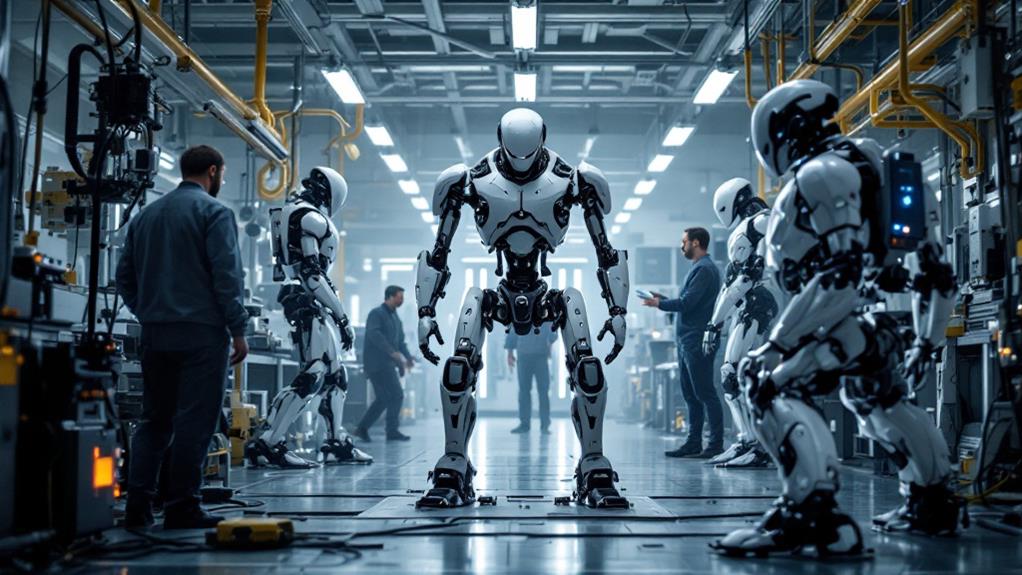
As Stretch revolutionizes warehousing, its influence ripples across the entire robotics industry. You see how automation challenges become central as companies endeavor to integrate advanced robotics. The potential for collaboration grows, with diverse sectors investigating how to utilize these innovations effectively. Yet, as you investigate these advancements, questions around robotic ethics and safety regulations become unavoidable.
The workforce implications are significant. While robots like Stretch improve efficiency, they also raise concerns about job displacement. You must consider how to balance automation with human employment. Public perception plays a vital role here, as acceptance hinges on visible benefits and addressing fears about job loss.
Military applications of robotics present another layer of complexity. Ethical considerations and safety are paramount, especially when deploying robots in sensitive environments. The industry must navigate these challenges carefully.
Looking forward, future innovations will likely focus on overcoming these hurdles. The industry can't ignore the need for responsible development, guaranteeing robots serve humanity positively. Consider these points:
- Workforce Shift: How will industries prepare workers for robotics integration?
- Ethical Deployment: What guidelines guarantee robots are used ethically?
- Safety Standards: How will safety regulations evolve with technological advancements?
Related posts