Alan Turing and the Foundations of AI: The Turing Test Explained
When discussing the foundations of artificial intelligence, Alan Turing's name is inevitable. Turing's introduction of the Turing Test in 1950 was revolutionary, establishing a benchmark for machine intelligence. The test is more than a simple measure; it presents a complex challenge where a machine attempts to convince a human judge of its human-like responses through text-based conversation. This concept has not only shaped the early development of AI but has also ignited numerous debates and interpretations. Curious about how this test works and its implications for the future of AI? Let's explore the intricacies and broader significance of Turing's pioneering idea.
Alan Turing and AI Origins

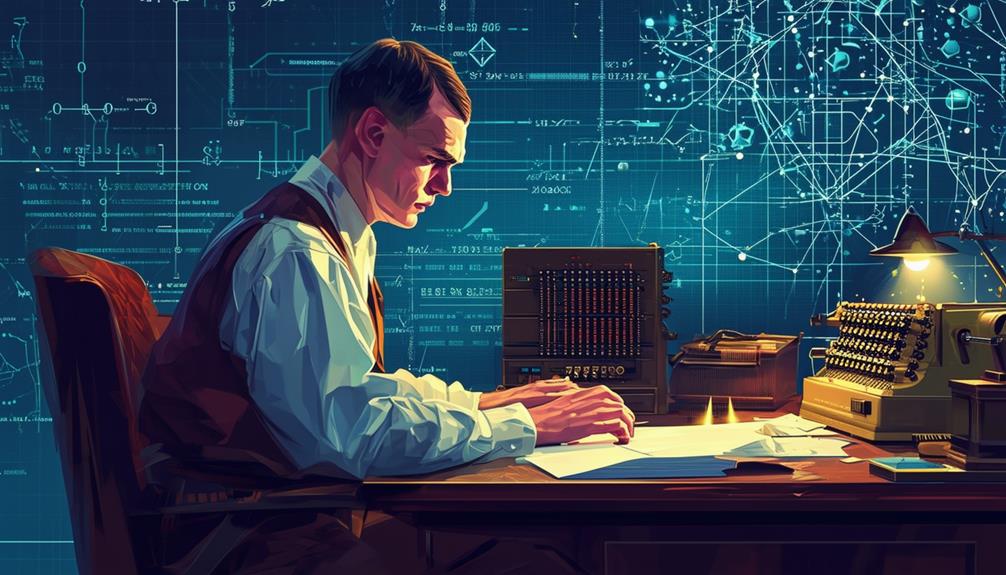
Alan Turing, a pioneer in artificial intelligence, introduced the concept of the Turing Test in 1950. This groundbreaking idea questioned whether a machine could exhibit behavior indistinguishable from a human's, laying the foundation for modern AI.
Turing revolutionized computing with his stored-program concept, enabling machines to store and execute instructions. His code-breaking efforts during World War II further shaped his ideas on machine intelligence, demonstrating the potential of machines to solve complex problems.
Turing also explored heuristic problem-solving in chess programs, accurately predicting that computers would excel at the game. His work on artificial neurons and machine learning principles was crucial to AI's development. Alan Turing's multifaceted contributions ignited a technological revolution that continues to evolve.
The Imitation Game Explained
The Imitation Game, conceptualized by Alan Turing, is a test designed to evaluate a machine's ability to exhibit intelligent behavior indistinguishable from that of a human. This test, commonly known as the Turing Test, involves a human judge who interacts with both a machine and a human without knowing which is which. The objective is for the machine to produce responses that are convincingly human-like, thereby deceiving the judge.
Turing's focus on this game was driven by his quest to determine whether machines could replicate human intelligence and consciousness. Success in the Imitation Game would signify a substantial milestone in artificial intelligence, showcasing the machine's capability to generate responses similar to those of a human.
Key elements of the Imitation Game include:
| Key Elements | Description |
|---|---|
| Human Judge | Interacts with both the machine and the human, attempting to discern which one is the machine. |
| Machine Intelligence | The machine's ability to convincingly simulate human-like behavior. |
| Machine Deception | The machine's aim to convince the human judge that it is human. |
| Human Intelligence | Serves as the standard for assessing the machine's performance. |
This test remains a cornerstone in the field of artificial intelligence, providing a practical framework for evaluating machine intelligence.
Structure of the Turing Test

In the Turing Test, a human judge engages in text-based conversations with both a human and a machine, aiming to identify which is which. The judge remains unaware of the identities, and the machine's goal is to convince the judge that it is the human. This setup evaluates the machine's ability to simulate intelligent conversation, a crucial aspect of artificial intelligence.
The Turing Test's structure includes several core elements:
- Human Judge: The individual tasked with distinguishing between the human and the machine.
- Machine Respondent: The AI designed to convincingly imitate human behavior.
- Text-Based Conversations: The medium through which interactions occur, preventing the judge from using visual or auditory clues.
- Natural Language Processing: A critical feature enabling the machine to understand and generate human language proficiently.
- Evaluation Benchmark: The test serves as a standard for assessing a machine's ability to exhibit human-like intelligence.
These elements collectively ensure the Turing Test's relevance and effectiveness in evaluating artificial intelligence.
Key Interpretations and Debates
Many scholars and enthusiasts debate the Turing Test's effectiveness in measuring genuine machine intelligence. Some argue that the Turing Test, which evaluates artificial intelligence based on human-like behavior, falls short in assessing true intelligence and consciousness. While a machine might successfully mimic human responses, this does not necessarily imply it genuinely understands the content or context of those responses.
Philosophical discussions around the Turing Test often delve into the nature of intelligence and consciousness. Critics point out that passing the Turing Test might only indicate that a machine can convincingly imitate human behavior. This raises questions about whether such performance demonstrates true machine intelligence or merely sophisticated programming designed to mimic human responses.
The debate also touches on the complexity of human thought and emotion, which machines might not fully capture. The Turing Test's focus on external behavior neglects internal processes, casting doubt on its ability to measure the depth of machine intelligence. These ongoing discussions emphasize the need to explore new methods and criteria for evaluating artificial intelligence, aiming to better understand the intricate nature of intelligence and consciousness beyond just human-like behavior.
Strengths of the Turing Test
One major strength of the Turing Test lies in its ability to drive advancements in natural language processing and human-computer interaction. By setting a benchmark for AI progress, the test challenges machines to convincingly imitate human responses. This pushes developers to create systems that understand and generate language more naturally, showcasing their problem-solving skills.
The Turing Test's emphasis on human-like responses has directly influenced the development of chatbots and virtual assistants. These applications aim to pass as human in conversation, improving user experience and functionality. Consequently, the test contributes significantly to the evolution of machine intelligence.
Key strengths of the Turing Test include:
- Encourages natural language processing advancements: Drives innovations in how machines comprehend and produce human language.
- Promotes AI progress: Sets a high standard for machine intelligence, pushing the boundaries of AI capabilities.
- Improves chatbots and virtual assistants: Inspires the creation of more sophisticated and responsive AI applications.
- Enhances problem-solving skills: Challenges AI to think and respond in human-like ways, enhancing its overall capabilities.
- Raises ethical considerations: Sparks important discussions about the implications of machines mimicking humans.
Criticisms and Limitations
When considering the Turing Test, it's important to recognize its criticisms and limitations. Critics argue that human responses can be ambiguous, and the test often overlooks emotional understanding. Furthermore, the test may yield misleading results by focusing on surface-level mimicry rather than genuine intelligence.
Ambiguity in Human Responses
Critics argue that ambiguity in human responses complicates the identification of genuine intelligence in the Turing Test. The inherent subjectivity in human judgment often introduces biases and inconsistencies when assessing whether a machine can think like a human. This ambiguity can lead to varying interpretations by judges, thereby undermining the reliability of the Turing Test.
Human nuances, emotions, and contextual understanding further complicate the comparison between human and machine interactions. For example, a subtle joke or a culturally specific reference might be perfectly understood by one human but entirely missed by another, and even more so by a machine. This variability makes it challenging to establish a consistent standard for passing the Turing Test.
Consider these points:
- Ambiguity: Human responses can be vague or open to multiple interpretations.
- Judgment biases: Judges may bring their own biases into the evaluation process.
- Inconsistencies: Different judges may have inconsistent criteria for determining intelligence.
- Human nuances: Subtle aspects of human interaction can be difficult for machines to replicate or understand.
- Contextual understanding: The context in which a response is given can significantly alter its perceived meaning.
These factors highlight why ambiguity in human responses is a significant criticism of the Turing Test, challenging its effectiveness in measuring true machine intelligence.
Lack of Emotional Understanding
Despite advancements in AI, machines still struggle to grasp emotional nuances and convincingly replicate human empathy and emotional intelligence. This shortcoming is a significant criticism of the Turing Test, which measures a machine's ability to imitate human behavior. Emotional understanding is vital for human interactions, as it encompasses the subtleties of non-verbal cues and the depth of emotional nuances that humans effortlessly navigate.
Machine intelligence often lacks the ability to exhibit genuine empathy. While AI can process and generate natural language, it frequently falls short in understanding the emotional context behind words. This gap in emotional intelligence hinders a machine's ability to respond appropriately in emotionally charged situations, making human interactions feel stilted or insincere.
The challenge lies in how AI systems interpret and respond to emotions. Current advancements in natural language processing and behavioral analysis are not yet sufficient to bridge this gap. Emotional intelligence involves understanding and responding to emotional cues, a complex trait that AI still struggles with. Hence, the Turing Test highlights this limitation, as the inability to convincingly replicate human empathy and emotional understanding marks a clear distinction between human and machine intelligence.
Misleading Test Results
The Turing Test's emphasis on conversational intelligence often neglects broader aspects of machine intelligence, leading to criticisms about its inclusiveness. By centering on a machine's ability to mimic human conversation, the test overlooks critical dimensions like problem-solving abilities and real-world AI applications. This narrow focus can result in misleading outcomes, as machines might excel in deception and trickery without genuinely understanding or processing information like humans do.
Human biases also play a significant role. Judges' subjective interpretations of human-like behavior can skew outcomes, making it difficult to obtain objective and consistent results. The reliance on conversational intelligence means that a machine's ability to perform practical tasks or solve complex problems isn't adequately assessed.
Key criticisms include:
- Conversational intelligence focus: Neglects other aspects of machine intelligence.
- Deception and trickery: Can produce misleading results about a machine's true capabilities.
- Human biases: Influence judging, leading to skewed outcomes.
- Real-world applications: Test doesn't evaluate practical problem-solving abilities.
- Subjective interpretations: Make obtaining consistent results challenging.
Given these limitations, the Turing Test may not be a definitive measure of machine intelligence. It's crucial to explore more holistic benchmarks for evaluating AI.
Future Implications in AI
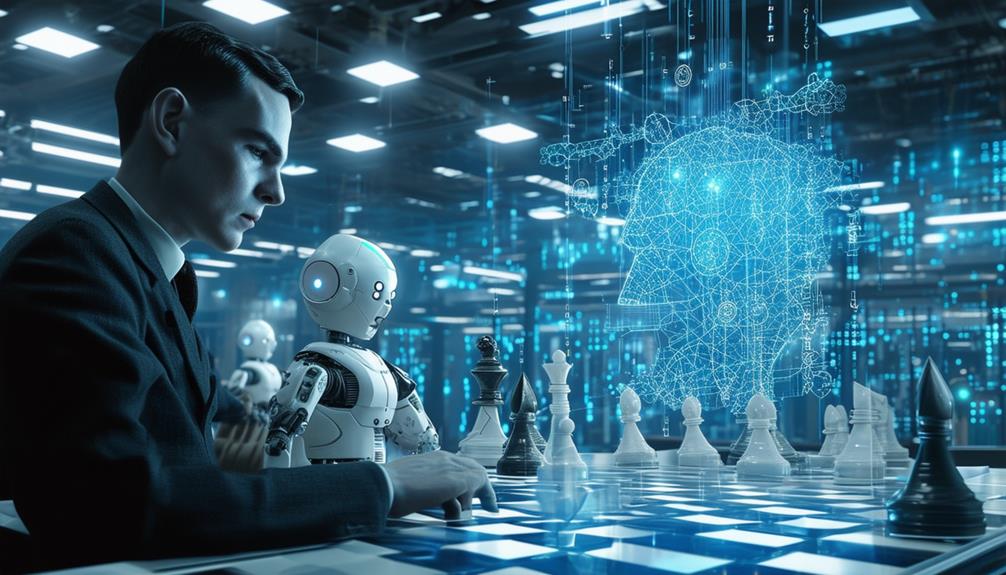
Looking ahead, advancements in AI are poised to revolutionize natural language processing and sensory perception capabilities, driven in part by principles akin to the Turing Test. These advancements enable AI systems to interact with humans more naturally and intuitively. Through ongoing research and development, we are witnessing breakthroughs that allow machines to better emulate human intelligence. While the Turing Test serves as an influential benchmark, it is the broader goals of AI integration and functionality that shape the evolution of these technologies.
As AI systems evolve, industries are exploring their potential to enhance task performance across various domains. From customer service chatbots to sophisticated diagnostic tools in healthcare, the applications are vast and transformative. The criteria inspired by the Turing Test ensure that these AI systems can understand and respond to human inputs in ways increasingly indistinguishable from human behavior.
The influence of the Turing Test extends beyond academic circles, driving practical implementations in real-world scenarios. As machine intelligence continues to improve, AI technologies are expected to become more prevalent in daily life, transforming business operations and personal interactions alike. The future of AI, inspired by Turing's vision, is unfolding, promising significant advancements and widespread integration.
Conclusion
Alan Turing's contributions have demonstrated the connection between human interaction and machine intelligence through the Turing Test. The strengths and limitations of the test highlight ongoing debates in AI development. Turing's work continues to influence how we evaluate and understand artificial intelligence. By grasping these concepts, you can better navigate the evolving landscape of AI and its transformative potential.
Related posts