Agricultural Robotics: Revolutionizing Farming Practices
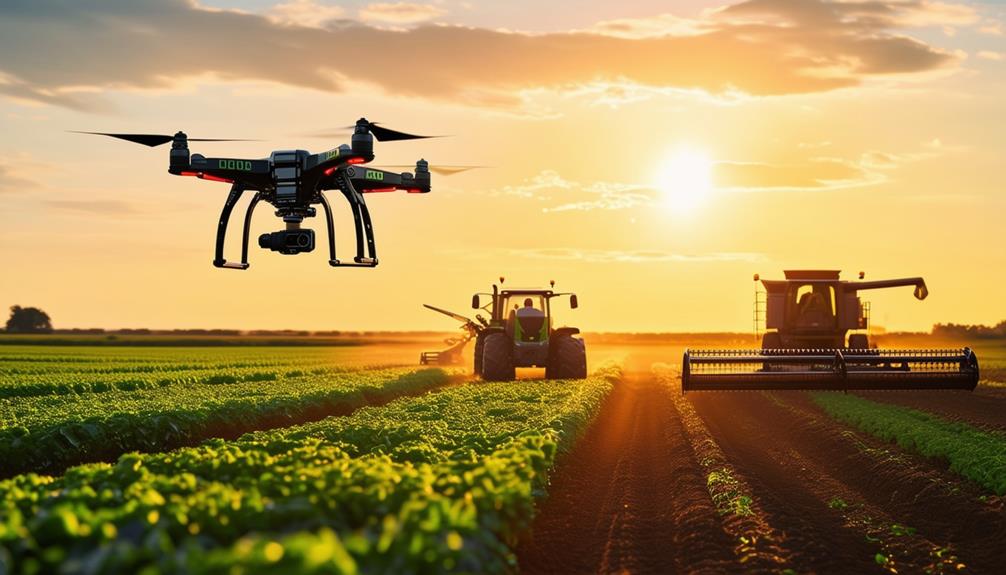
Imagine managing a farm where autonomous tractors handle the plowing, drones monitor crop health, and robotic harvesters pick the produce—all without needing a break. Agricultural robotics is turning this vision into reality by integrating AI, advanced sensors, and GPS technology to enhance precision in every farming task. These innovations not only boost productivity but also advance sustainable farming practices. How do these technologies work together to revolutionize traditional farming, and what challenges might arise when implementing them into your operations?
Autonomous Tractors

How are autonomous tractors transforming modern farming? Equipped with advanced AI algorithms, these high-tech machines are taking over roles traditionally performed by human-operated vehicles. Utilizing cutting-edge sensors and GPS technology, autonomous tractors achieve precise and efficient plowing, planting, and harvesting. Their AI-driven capabilities allow them to operate continuously without human intervention, significantly enhancing farm productivity.
One major advantage of autonomous tractors is their ability to optimize crop management and resource utilization. By leveraging sophisticated AI algorithms, these tractors can determine the best practices for managing crops, leading to increased yields. They can analyze soil conditions, monitor weather patterns, and make real-time adjustments to farming operations. This precision ensures efficient use of resources like water, fertilizers, and pesticides, minimizing waste and maximizing output.
Additionally, autonomous tractors are revolutionizing agriculture by streamlining tasks and reducing long-term labor costs. Capable of operating 24/7 without breaks, these machines enable farmers to accomplish more in less time, boosting overall efficiency. This not only enhances farming operations but also significantly reduces labor expenses. In essence, autonomous tractors are transforming farm management, making it more productive and cost-effective.
Crop Monitoring Drones
Using crop monitoring drones provides real-time data crucial for precision agriculture. These drones enhance environmental stewardship by enabling precise monitoring and targeted interventions, leading to more efficient resource management and healthier crops.
Real-Time Data Collection
Crop monitoring drones are transforming agriculture by capturing real-time aerial imagery of fields using advanced cameras and sensors. These drones provide vital data on crop health, growth patterns, and potential pest infestations. With real-time data collection, farmers can make immediate decisions and implement targeted interventions to optimize crop yields. The precise aerial imagery enables accurate monitoring and efficient farm management.
Utilizing GPS technology, crop monitoring drones navigate fields with precision, ensuring comprehensive coverage. This facilitates precision farming practices, allowing treatments to be applied exactly where and when needed. By leveraging the real-time data collected, farmers can enhance their decision-making process, reducing waste and increasing intervention effectiveness.
Incorporating crop monitoring drones into farming operations offers an up-to-date view of crop conditions, enabling timely issue resolution. This results in healthier crops and higher yields. Ultimately, the use of these drones streamlines farm management and supports sustainable agricultural practices, ensuring farmers stay competitive in the constantly evolving agricultural landscape.
Precision Agriculture Techniques
Leveraging crop monitoring drones, farmers can employ precision agriculture techniques to optimize resource use and enhance yields. These drones are equipped with advanced robotics, AI, and computer vision capabilities to provide real-time aerial imagery of crop health and growth. Early detection of pests, diseases, and nutrient deficiencies enables targeted interventions, improving both efficiency and productivity.
Key benefits of crop monitoring drones include:
- Accurate Monitoring: Advanced sensors and GPS technology provide precise data on crop conditions, enabling informed decision-making.
- Cost Savings: Optimizing resource use and reducing labor costs contribute to more sustainable farming practices.
- Actionable Insights: Real-time data collection allows for prompt adjustments in treatments and strategies, ensuring excellent crop health.
Utilizing crop monitoring technology revolutionizes traditional farming methods. Instead of relying on time-consuming and often inaccurate manual inspections, drones swiftly gather and analyze data. This shift not only enhances efficiency but also supports sustainable farming practices by ensuring judicious resource use. Adopting this cutting-edge technology helps farmers stay ahead in the constantly evolving agricultural landscape.
Environmental Impact Reduction
Using crop monitoring drones significantly reduces the environmental impact of farming by minimizing chemical usage and optimizing resource allocation. Equipped with advanced sensors and GPS technology, these drones provide real-time aerial imagery for precise crop health assessments. This enables early detection of pests, diseases, and nutrient deficiencies, allowing for targeted interventions rather than blanket chemical applications.
Incorporating crop monitoring drones into your farming practices constitutes precision farming. The data collected by these drones inform decisions about the timing and location of resource applications, enhancing resource efficiency. This ensures that water, fertilizers, and pesticides are used only when necessary and in the exact amounts required.
Beyond reducing chemical usage, these drones optimize crop management by offering detailed insights into crop growth and soil conditions. With GPS integration, you can accurately map your fields and implement site-specific treatments, further minimizing environmental impact. Leveraging these advanced tools not only improves crop yields but also promotes sustainable and eco-friendly farming practices.
Robotic Harvesters
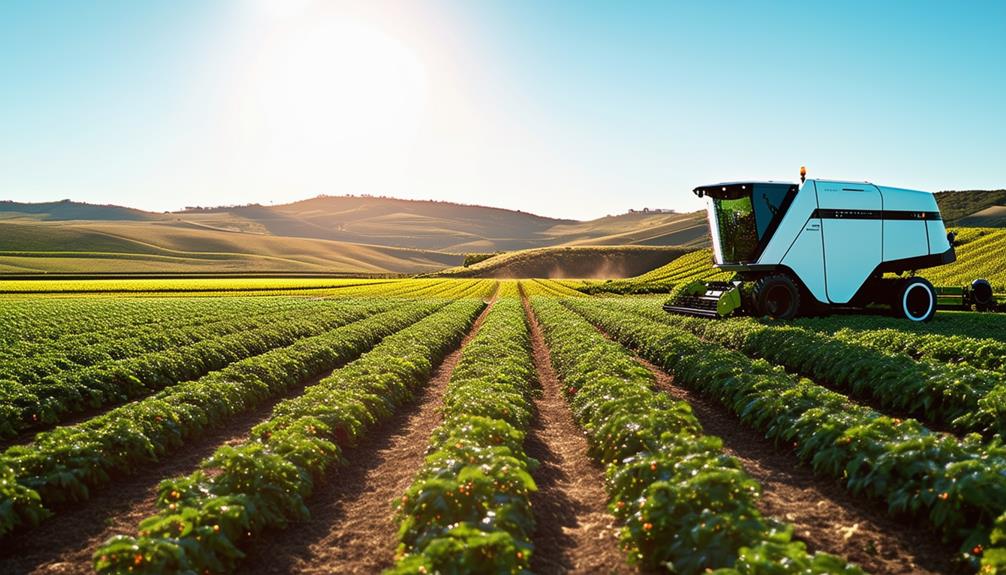
Robotic harvesters can revolutionize farming operations by automating the crop-picking process, significantly boosting efficiency and yield. Equipped with sensors and AI, these advanced machines precisely identify and harvest ripe crops, optimizing field output. Incorporating robotic harvesters ensures continuous productivity and reduces labor costs, making them a reliable and cost-effective solution for modern agriculture.
Automated Crop Picking
Imagine a future where machines expertly pick ripe fruits and vegetables, transforming the efficiency and cost-effectiveness of farming. Automated crop picking is no longer just a vision but a reality, thanks to robots equipped with advanced sensors and artificial intelligence (AI). These robots use high-resolution cameras to identify ripe produce, ensuring precision and reducing labor costs. By working tirelessly without breaks, they increase crop yields and revolutionize traditional farming practices.
Here's how automated crop picking enhances modern agriculture:
- Quality Assurance: Robots minimize crop damage and ensure consistent quality by targeting only ripe fruits and vegetables.
- Operational Efficiency: Continuous operation without the need for breaks results in faster harvesting and reduced labor costs.
- Sustainable Farming: Increased productivity through automation supports more sustainable farming methods.
Artificial intelligence (AI) plays a crucial role in this transformation. By analyzing data from high-resolution cameras, AI algorithms make real-time decisions, allowing for precise and efficient harvesting. This not only optimizes crop yields but also contributes to more sustainable practices. As you integrate these robotic harvesters, you'll find significant improvements in both the productivity and sustainability of your farming operations.
Efficiency and Yield Improvement
By integrating robotic harvesters into your farming operations, you'll significantly enhance both efficiency and crop yields. These state-of-the-art machines automate the harvesting process through advanced sensors and AI algorithms, enabling them to identify and pick ripe produce with exceptional precision. This technology not only boosts efficiency but also substantially reduces labor costs.
Robotic harvesters deliver round-the-clock productivity, operating tirelessly without human intervention. This continuous operation accelerates the harvesting process, ensuring higher yields in less time. Additionally, precision farming practices are enhanced as these robots implement optimized crop management strategies, providing individualized care for each plant.
| Feature | Benefit | Outcome |
|---|---|---|
| Advanced Sensors | Identifies ripe produce | Higher yields |
| AI Algorithms | Precise harvesting actions | Increased efficiency |
| Round-the-clock Productivity | Non-stop operation | Faster harvesting |
| Optimized Crop Management | Individual plant care | Improved precision farming |
Incorporating robotic harvesters into your daily operations is not merely about embracing new technology; it's about revolutionizing your entire farming approach. With these robots, you'll achieve significant yield improvements and streamlined efficiency, allowing you to focus on other crucial farming tasks while the robots manage the labor-intensive harvesting.
Advanced Sensing Technology
In today's farming landscape, advanced sensing technology enables agricultural robots to monitor soil moisture levels, nutrient content, and temperature variations with exceptional precision. These sensors are crucial for identifying crop health issues, pest infestations, and weed growth, allowing for timely and targeted interventions.
High-resolution cameras and multispectral sensors on these robots capture detailed images and data on crop conditions and growth patterns. This technology aids in the early detection of problems such as nutrient deficiencies or diseases, enabling you to take corrective action swiftly. Lidar technology further enhances this by providing accurate mapping of fields, obstacles, and crop rows, optimizing robot navigation and ensuring efficient field coverage.
- High-resolution cameras: Capture detailed images to identify crop health issues and pest infestations.
- Multispectral sensors: Analyze light spectra to detect stress, nutrient deficiencies, and weed growth.
- Lidar technology: Provides accurate mapping for improved navigation and field management.
Additionally, infrared sensors deliver real-time data on plant stress and water needs, assisting you in making informed decisions to maintain optimal crop health. Integrating these advanced sensing technologies transforms the management and monitoring of fields, leading to higher productivity and sustainability.
Precision Agriculture
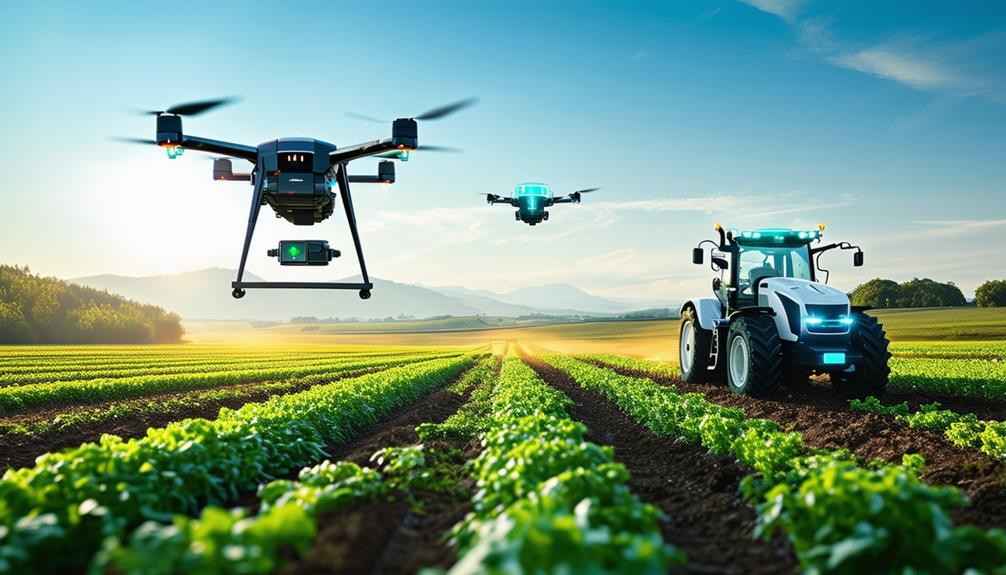
Precision agriculture leverages advanced sensing technology, AI-driven analytics, and robotics to optimize all aspects of farming practices. Autonomous tractors, equipped with sophisticated AI algorithms, replace traditional human-operated vehicles, working tirelessly day and night to enhance efficiency and significantly reduce labor costs.
AI-powered robots autonomously identify and remove weeds, increasing crop yields and minimizing the need for manual labor. These robots are so precise that they target and eliminate weeds without harming surrounding crops, leading to healthier plants and more abundant harvests.
AI-driven indoor farming systems enable year-round crop production by offering precise monitoring and control of environmental factors. This ensures ideal growth conditions, eliminating concerns over seasonal changes or unpredictable weather impacting crops.
Harvesting robots with AI vision systems streamline the harvesting process by identifying ripe produce and picking it with incredible accuracy. This reduces waste and ensures that only the highest quality produce reaches the market. By embracing precision agriculture, you not only modernize your farming practices but also revolutionize them.
Yield Optimization
Harnessing the power of agricultural robotics, farmers can significantly enhance crop yields through precise planting, meticulous monitoring, and adaptive environmental adjustments. Integrating robotics automation into farming practices allows for unprecedented optimization of crop yields. Precision agriculture tools equipped with advanced sensors enable real-time crop monitoring, facilitating immediate adjustments based on current environmental conditions.
Robots assist in:
- Precise Planting: Ensuring seeds are placed at optimal depths and spacing, thereby reducing waste and maximizing plant growth.
- Irrigation Management: Automated systems adjust water usage based on soil moisture levels, conserving water and improving plant health.
- Pest Control: Robotics can swiftly detect and address pest issues, minimizing crop damage.
Data collection is foundational to these advancements. Robotics automation gathers and analyzes vast amounts of data, aiding in better decision-making. Real-time monitoring allows tracking of factors such as soil health and weather changes, ensuring timely interventions that optimize yield. Leveraging insights from this data, farmers can make informed decisions that enhance productivity and crop quality. Embracing these technologies in farming practices not only improves efficiency but also ensures sustainable growth and profitability.
Sustainability in Farming
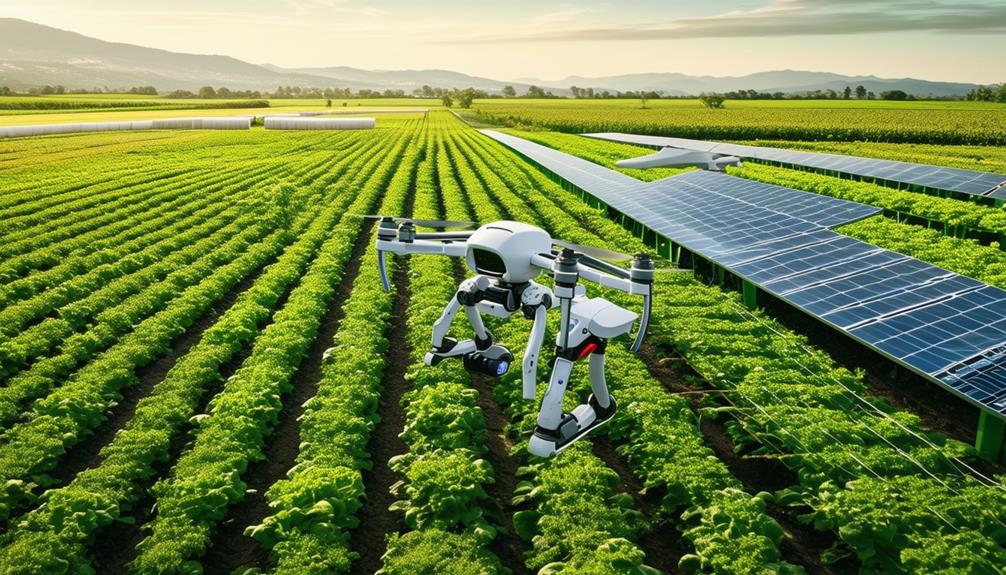
Agricultural robotics significantly enhance sustainability in farming by precisely applying resources and minimizing waste. These robots reduce the use of chemicals by targeting specific areas for treatment, thereby minimizing environmental impact and ensuring that only the necessary amount of chemicals is used.
At the core of this transformation is precision agriculture. Robots optimize resource management and reduce waste by delivering the exact amount of water directly to plants, preventing over-irrigation. This precision conserves water and maximizes crop yield efficiency.
Additionally, robotic technology facilitates data-driven decision-making. By collecting and analyzing data, farmers can make informed choices about resource allocation, further promoting sustainable farming practices. This optimized resource management ensures that inputs like fertilizers and water are used efficiently and responsibly.
Incorporating agricultural robotics into farming practices increases productivity and significantly contributes to sustainability. This approach benefits both the farmer and the environment, ensuring long-term agricultural viability and environmental health.
Technological Advancements
As technology advances, agricultural robotics are becoming increasingly sophisticated, revolutionizing traditional farming methods. Cutting-edge technologies are at the forefront of this transformation, utilizing AI-driven precision agriculture to optimize crop management through advanced analytics and robotics, leading to improved efficiency and productivity.
Autonomous tractors, equipped with AI algorithms, are replacing human-operated vehicles, significantly enhancing traditional farming practices. These smart machines can operate continuously, ensuring tasks are performed accurately and efficiently. AI-powered robots also autonomously identify and remove weeds, reducing the need for manual labor and contributing to the future of farming.
Additionally, AI-driven indoor farming systems enable year-round crop production within controlled environments, ensuring consistent yields regardless of external weather conditions. Harvesting robots, equipped with AI vision systems, streamline the harvesting process, increasing efficiency and reducing crop loss.
Key technological advancements include:
- AI-Driven Precision Agriculture: Optimizes crop management and resource use.
- Autonomous Tractors: Replacing human-operated vehicles, improving efficiency.
- Indoor Farming Systems: Enabling year-round production with controlled environments.
As technology continues to evolve, these innovations are transforming modern agriculture, making farming practices more efficient, sustainable, and productive than ever before.
Overcoming Challenges
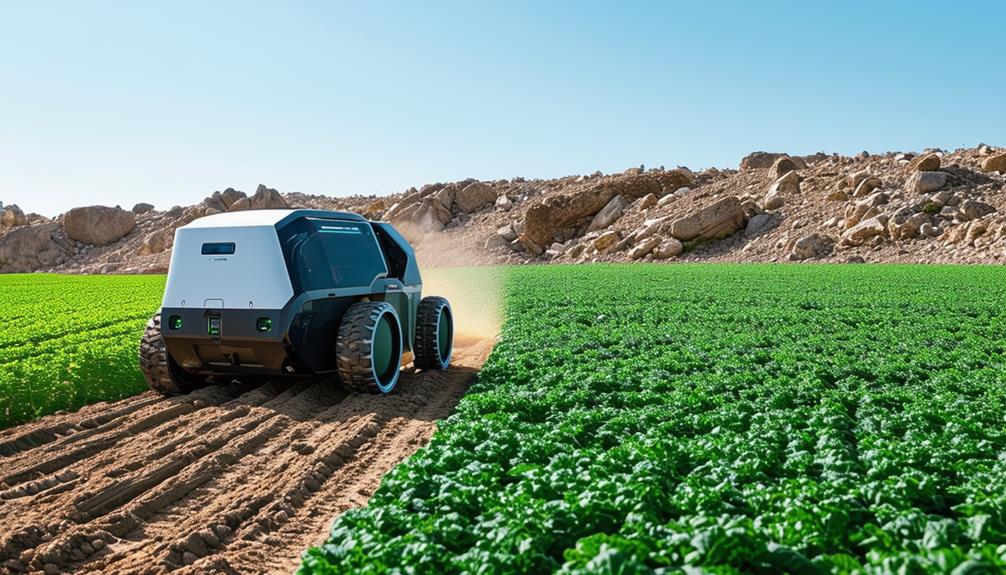
Adopting agricultural robotics offers promising benefits, but farmers must overcome several challenges for successful implementation. A significant hurdle is the high initial investment costs, which can be prohibitive for small and medium-sized farmers. However, by strategically investing in durable and reliable robotics, you can achieve long-term cost savings.
To ensure smooth operations, integrating these robots with your existing systems is essential. This requires thorough compatibility checks and proper training for you and your team. Without these steps, technical failures or malfunctions could disrupt farm operations, leading to potential losses.
Monitoring systems are crucial for maintaining the performance and efficiency of agricultural robots. Continuous tracking allows you to quickly identify and address any issues, minimizing downtime and ensuring reliable performance. The robots must also be durable enough to withstand harsh farming conditions to be a viable long-term investment.
Despite the challenges, overcoming them can lead to more efficient and productive farming practices. By focusing on reliability, proper training, and effective monitoring systems, you can fully harness the potential of agricultural robotics and revolutionize your farming operations.
Conclusion
The transformative power of agricultural robotics in modern farming is undeniable. With autonomous tractors, crop-monitoring drones, and robotic harvesters, farmers can achieve unprecedented efficiency and productivity. Advanced sensing technology and precision agriculture ensure optimal use of every acre. These innovations also promote sustainability, making farming not only easier but also more eco-friendly. Embracing these technological advancements allows farmers to overcome challenges and revolutionize their farming practices.
Related posts